News
One of my favourite raptors.
01st January 2026
01st January 2026
It was a pleasure to be driving along with our other top bird guide friend Massaneh Sanyang, Mass for short, who is probably the best all round naturalist I’ve met in The Gambia. His knowledge is not only about birds, but butterflies, dragonflies, animals and plants. He is always collecting plants when we are out walking typically for making things like tea and remedies for all sorts of ailments.
He was bemoaning the habitat loss in the country, in particular bush clearance for building and the felling of hardwood trees like Mahogany for sale around the world.
He was talking about the Black Shouldered Kite and how few there are around now compared to a few years ago when they were plentiful. This conversation came up when I was asking him about them because they are one of my all-time favourite raptors. They are so beautiful, their body is little bigger than a Common Kestrel but their wingspan is greater. They appear ghost-like with their grey white plumage and with intense ruby red eyes - quite stunning.

As if to be, when we turned a corner Mass shouted there above – a Black Shouldered Kite, I couldn’t believe it, we were all laughing at the coincidence. We screeched to a halt and I jumped out and fired off a few frames as it hovered above us. It then drifted away and landed in a nearby tree. I told him I had to give it a go and get nearer to it; I wasn’t expecting any luck because these birds are quite nervous. However, using an old building as cover I sneaked forward and to my surprise it tolerated me and I was able to get quite close indeed.

They really are a stunning bird!
He was bemoaning the habitat loss in the country, in particular bush clearance for building and the felling of hardwood trees like Mahogany for sale around the world.
He was talking about the Black Shouldered Kite and how few there are around now compared to a few years ago when they were plentiful. This conversation came up when I was asking him about them because they are one of my all-time favourite raptors. They are so beautiful, their body is little bigger than a Common Kestrel but their wingspan is greater. They appear ghost-like with their grey white plumage and with intense ruby red eyes - quite stunning.
As if to be, when we turned a corner Mass shouted there above – a Black Shouldered Kite, I couldn’t believe it, we were all laughing at the coincidence. We screeched to a halt and I jumped out and fired off a few frames as it hovered above us. It then drifted away and landed in a nearby tree. I told him I had to give it a go and get nearer to it; I wasn’t expecting any luck because these birds are quite nervous. However, using an old building as cover I sneaked forward and to my surprise it tolerated me and I was able to get quite close indeed.
They really are a stunning bird!
A huge ambition finally achieved.
01st January 2026
01st January 2026
Many years ago, I watched a wildlife programme on TV and I witnessed the spectacle of Carmine Bee Eaters flying around and landing on large animals like Hippos. Ever since I have wanted to see these birds up close because their vibrant colours fascinated me. Most Bee Eaters are either coloured with a variety of greens, blues, yellows or a small amount of red. These are so different, with their carmine red, pink and turquoise bodies and a bottle green head with a black mask - I have always thought they were absolutely beautiful.
I have been trying to locate these birds in The Gambia for five years but have always come up short. It’s been very frustrating. l have seen all the other species of Bee Eater in the country, but these birds have remained stubbornly elusive.
They are an intra African migrant and although fairly widespread can still be awkward to find. They can turn up almost anywhere but also be frustratingly absent the next day. On our last visit to The Gambia, we were due to travel ‘Up-river’ to Janjanbureh near Georgetown in an attempt to see them but we were delayed. To rub salt into the wounds they had been seen a few days earlier but were not there when we arrived, it was so disappointing!
Fast forward to just before Xmas last year when we had an email from the new owners of the lodges we always stay at, offering a special deal on accommodation, food and airport pick-up, which was very tempting indeed. By a remarkable coincidence a few days later while we were considering the offer I also received a WhatsApp message from our bird guide friend Dawda Barry, it read ‘Steve, do you still want the Carmine Bee Eaters’?
He told me he had found a site ‘Up-river’ where these birds were turning up every morning around the same time to feed on grasshoppers and dragonflies etc. This was the straw that broke the camel’s back, we booked up immediately and we told him to pick us up from the lodges the day after we arrived.
After a straightforward flight and journey to the lodges, arriving on a Friday, the new owners who are very nice people, were a little surprised after being told we would see them on Monday afternoon.
It was a smash and grab attempt for the Carmines.
The following morning after a quick breakfast and a packed lunch we were on the road in Dawda’s Mercedes. The journey was broken up into two stages because to attempt it in one isn’t realistic, it’s just too far. We stopped at Tendaba camp first and had a boat trip where we saw the Pel’s Fishing Owl, so a good start. Next morning we were on the road again, and after a few hours we arrived at our new accommodation, we went out for a bit of birding and didn’t see much really and I confess to being a little disappointed because Dawda said he had seen Carmines there previously. I was beginning to get those old feelings of Déjà Vu. However, Dawda assured me that tomorrow would be better. We had dinner and turned in.
The following morning, I was chomping at the bit to get going, but Dawda said there was no point in going too early and we would go somewhere else first. His confidence was not shared by me, but he was the professional guide and presumably knew what he was doing.
When we arrived at the site, a large wetland with literally thousands of Ducks, Geese, Herons and Egrets, it was quite a remarkable spectacle. We then navigated along a dirt track through the marshes and parked up. It was now 10.00 we walked along seeing many Blue Cheeked Bee Eaters but no Carmines. Dawda went walking and we stayed put and watched the area where we were, but still no luck.
I could see him coming back and he told us he had found a single bird and was confident more would come. We followed him to a group of dead trees and there on the top of one was a Northern Carmine Bee Eater – at last!
It was a bit distant but I was hopeful, Susan and I sat on an old fallen log under the shade of a small tree because it had now become quite hot. We were about fifteen yards from a short dead single tree stump and I set up in readiness. We couldn’t see to our left so it was a surprise when a single Carmine drifted past us, and then another and in total six birds appeared and started to hunt for food. What happened next was so fulfilling, a single bird perched right in front of us on the tree stump.

We were stunned, but it was no time for complacency, I shot it immediately and after looking at the camera screen I knew I had a good shot – What a feeling, I really can’t explain it.
It flew off but came back to the same perch time and again, we were enthralled and amazed because it was totally unfazed by our close proximity.


Because of the bird being faithful to this perch I decided to try and catch it in flight by focussing on the perch and then switching off the auto focus on the lens to avoid any hunting. I don’t carry a tripod in Africa because of the extra weight, so after the bird left the perch, I remained hand holding the camera and lens looking at the perch. Susan was watching the bird and when it was on its way back to the perch and about three yards away, she said ‘Now’ and I just held the shutter button down trying to capture it in flight on its approach. This worked after a fashion and I managed some flight shots as a bonus.


To say I was pleased would be a gross understatement.
It was a huge ambition finally achieved.
All shots taken with a Canon R5 Mk2 + Canon Rf 100-500 f7.1 lens - handheld.
I have been trying to locate these birds in The Gambia for five years but have always come up short. It’s been very frustrating. l have seen all the other species of Bee Eater in the country, but these birds have remained stubbornly elusive.
They are an intra African migrant and although fairly widespread can still be awkward to find. They can turn up almost anywhere but also be frustratingly absent the next day. On our last visit to The Gambia, we were due to travel ‘Up-river’ to Janjanbureh near Georgetown in an attempt to see them but we were delayed. To rub salt into the wounds they had been seen a few days earlier but were not there when we arrived, it was so disappointing!
Fast forward to just before Xmas last year when we had an email from the new owners of the lodges we always stay at, offering a special deal on accommodation, food and airport pick-up, which was very tempting indeed. By a remarkable coincidence a few days later while we were considering the offer I also received a WhatsApp message from our bird guide friend Dawda Barry, it read ‘Steve, do you still want the Carmine Bee Eaters’?
He told me he had found a site ‘Up-river’ where these birds were turning up every morning around the same time to feed on grasshoppers and dragonflies etc. This was the straw that broke the camel’s back, we booked up immediately and we told him to pick us up from the lodges the day after we arrived.
After a straightforward flight and journey to the lodges, arriving on a Friday, the new owners who are very nice people, were a little surprised after being told we would see them on Monday afternoon.
It was a smash and grab attempt for the Carmines.
The following morning after a quick breakfast and a packed lunch we were on the road in Dawda’s Mercedes. The journey was broken up into two stages because to attempt it in one isn’t realistic, it’s just too far. We stopped at Tendaba camp first and had a boat trip where we saw the Pel’s Fishing Owl, so a good start. Next morning we were on the road again, and after a few hours we arrived at our new accommodation, we went out for a bit of birding and didn’t see much really and I confess to being a little disappointed because Dawda said he had seen Carmines there previously. I was beginning to get those old feelings of Déjà Vu. However, Dawda assured me that tomorrow would be better. We had dinner and turned in.
The following morning, I was chomping at the bit to get going, but Dawda said there was no point in going too early and we would go somewhere else first. His confidence was not shared by me, but he was the professional guide and presumably knew what he was doing.
When we arrived at the site, a large wetland with literally thousands of Ducks, Geese, Herons and Egrets, it was quite a remarkable spectacle. We then navigated along a dirt track through the marshes and parked up. It was now 10.00 we walked along seeing many Blue Cheeked Bee Eaters but no Carmines. Dawda went walking and we stayed put and watched the area where we were, but still no luck.
I could see him coming back and he told us he had found a single bird and was confident more would come. We followed him to a group of dead trees and there on the top of one was a Northern Carmine Bee Eater – at last!
It was a bit distant but I was hopeful, Susan and I sat on an old fallen log under the shade of a small tree because it had now become quite hot. We were about fifteen yards from a short dead single tree stump and I set up in readiness. We couldn’t see to our left so it was a surprise when a single Carmine drifted past us, and then another and in total six birds appeared and started to hunt for food. What happened next was so fulfilling, a single bird perched right in front of us on the tree stump.
We were stunned, but it was no time for complacency, I shot it immediately and after looking at the camera screen I knew I had a good shot – What a feeling, I really can’t explain it.
It flew off but came back to the same perch time and again, we were enthralled and amazed because it was totally unfazed by our close proximity.
Because of the bird being faithful to this perch I decided to try and catch it in flight by focussing on the perch and then switching off the auto focus on the lens to avoid any hunting. I don’t carry a tripod in Africa because of the extra weight, so after the bird left the perch, I remained hand holding the camera and lens looking at the perch. Susan was watching the bird and when it was on its way back to the perch and about three yards away, she said ‘Now’ and I just held the shutter button down trying to capture it in flight on its approach. This worked after a fashion and I managed some flight shots as a bonus.
To say I was pleased would be a gross understatement.
It was a huge ambition finally achieved.
All shots taken with a Canon R5 Mk2 + Canon Rf 100-500 f7.1 lens - handheld.
A break from the UK winter.
01st January 2026
01st January 2026
Susan and I have just arrived back from a couple of weeks birding in West Africa where we enjoyed glorious unbroken sunshine and mid-thirties warmth. We booked our usual very nice quiet accommodation out in the countryside which is secure and well away from the main tourism hotels which are plagued by noise and harassment from ‘Bumsters’. The food at these lodges is of a very high standard and the staff are really friendly and have over time become friends of ours. Our other two friends and top-class bird guides who we have been using for a number of years, and who we are in regular contact with transported us every day in their own vehicles finding lovely birds out in the bush and forests.

Green Turaco coming for a drink.
We only birded in the morning up until about 13.00 because the heat in the afternoons, especially out in the bush is really debilitating. We instead spent this time at our lodge lounging by the small pool with a cold beer listening to the birds singing and the palm trees sighing in the warm breeze.
More blogs will follow in time illustrating the various birds we saw and tried to photograph on the trip.
Green Turaco coming for a drink.
We only birded in the morning up until about 13.00 because the heat in the afternoons, especially out in the bush is really debilitating. We instead spent this time at our lodge lounging by the small pool with a cold beer listening to the birds singing and the palm trees sighing in the warm breeze.
More blogs will follow in time illustrating the various birds we saw and tried to photograph on the trip.
Grey Heron, a common bird in nice light.
11th December 2025
11th December 2025
I spent an hour in a hide at a nearby flooded lake this morning. I am trying to get used to my new camera before I take it away on any trips. There was nothing much around unfortunately except this Grey Heron that came in to land in quite a nice light. This is a very common bird and as a result is somewhat overlooked but good light is everything, it makes such a difference to any subject.

Canon R5 Mk2 + Canon EF600 f4 L IS 2 lens.
Canon R5 Mk2 + Canon EF600 f4 L IS 2 lens.
Change of kit for Xmas.
09th December 2025
09th December 2025
A consequence of using the Canon R6 Mk 2 mirrorless camera over the past 9 months is that my Canon R5 has become almost redundant. Although it veritably is a great camera in a static situation, it’s bird tracking in flight performance is so limited compared to the R6 Mk 2, there really is no comparison - I was shocked to see it.
This has sounded the death knell for the R5 because it's very difficult to go backwards, technology wise – it’s pointless. However, it’s also very thought provoking when you realise the rapid and relentless way camera technology is moving forward. It now costs serious money to stay ‘ahead of the game’ so to speak.
With regard to the Canon R6 Mk2 my only two gripes are;
Firstly the ‘Pre capture’ mode – it is a pain to operate because the files captured are written to a folder in the camera and that folder cannot be downloaded en bloc. The user has to ‘Cut’ individual files from the folder, in camera, and then those files are written to the memory card as low resolution Jpegs.
Pre capture undoubtably works and it’s a brilliant feature, but it really is unnecessarily protracted on this camera.
Secondly at twenty ‘fps’ you have around eight seconds of shooting time before the camera’s buffer fills when shooting compressed RAW files. It’s enough in almost all scenarios and I have to admit to having hardly any problems when using SDXC V60 cards. You only need the V90 cards if you are shooting 4K video. However, using the 40fps feature on the camera is only viable when shooting in Jpeg, because these card’s write speeds are far too slow at 280mb/sec.
I still maintain, however, that apart from these small ‘gripes’ it is still a very capable camera indeed!
Moving on, last week I received a very good offer from a discerning woman photographer for my Canon R5 and after much deliberation I decided to sell it and to upgrade to the Canon R5 Mk2 - an early Xmas present.
The above-mentioned reservations with the R6 Mk2 have been fully addressed on the R5 Mk2.
Pre capture is now in full RAW and each file is written to the media card conventionally. Also, I can shoot without restriction at various frame rates, up to 30fps using compressed raw files, this is because the R5 Mk2 unlike the R6 Mk2 uses the very fast writing CF Express Type B cards -1200 MB/s.
These are huge advantages, and in addition the stacked and back lit sensor coupled with a top end ‘Digic X’ processor is lighting quick to read and process data, drastically reducing waiting time and eliminating frame blackout and rolling shutter at very high frame rates.
The autofocus itself has its own dedicated ‘Digic accelerator’ processor, this should be particularly useful for tracking birds in flight; it appears to be another step up from the R6 Mk2 – remarkable!
Unfortunately since I bought this camera it has rained virtually everyday with leaden skies and dull flat light - it couldn't be worse| However, this morning for an hour it was drier and I went for a walk on a local canal, the light was still generally very poor and light drizzle hung in the air, but glimpses of sunlight broke through intermittently. I came across a small flock of Starlings in a tree where they were perching and resting and then flying down to feed in a nearby field. As they swept across me the camera still locked onto them even in this very variable light.

Quite remarkable focussing in these conditions really and I can't wait for a sunny day to put the camera through its paces.
In addition there are other features like eye-controlled focussing where the camera, once calibrated to your eye, focusses on whatever you are looking at – remarkable, I may try it at some time.
I am not going to abandon the R6 Mk2, far from it, I am using it without a battery grip which I have now transferred to the R5 Mk2. It’s so light and portable that when I go walking for a distance, particularly up a steep hill, it will be my camera of choice. I will also use it in tightly wooded situations combined with my Canon EF 70-200 F4, which has as a consequence now got a new lease of life. I enjoy using this lens with a 1.4 converter and the 1.6 crop mode on the R6 Mk2 giving me an effective focal length of 200x1.4x1.6 = 448mm/f5.6, it’s featherweight and razor sharp.
Also, particularly good for butterflies and dragonflies.
This has sounded the death knell for the R5 because it's very difficult to go backwards, technology wise – it’s pointless. However, it’s also very thought provoking when you realise the rapid and relentless way camera technology is moving forward. It now costs serious money to stay ‘ahead of the game’ so to speak.
With regard to the Canon R6 Mk2 my only two gripes are;
Firstly the ‘Pre capture’ mode – it is a pain to operate because the files captured are written to a folder in the camera and that folder cannot be downloaded en bloc. The user has to ‘Cut’ individual files from the folder, in camera, and then those files are written to the memory card as low resolution Jpegs.
Pre capture undoubtably works and it’s a brilliant feature, but it really is unnecessarily protracted on this camera.
Secondly at twenty ‘fps’ you have around eight seconds of shooting time before the camera’s buffer fills when shooting compressed RAW files. It’s enough in almost all scenarios and I have to admit to having hardly any problems when using SDXC V60 cards. You only need the V90 cards if you are shooting 4K video. However, using the 40fps feature on the camera is only viable when shooting in Jpeg, because these card’s write speeds are far too slow at 280mb/sec.
I still maintain, however, that apart from these small ‘gripes’ it is still a very capable camera indeed!
Moving on, last week I received a very good offer from a discerning woman photographer for my Canon R5 and after much deliberation I decided to sell it and to upgrade to the Canon R5 Mk2 - an early Xmas present.
The above-mentioned reservations with the R6 Mk2 have been fully addressed on the R5 Mk2.
Pre capture is now in full RAW and each file is written to the media card conventionally. Also, I can shoot without restriction at various frame rates, up to 30fps using compressed raw files, this is because the R5 Mk2 unlike the R6 Mk2 uses the very fast writing CF Express Type B cards -1200 MB/s.
These are huge advantages, and in addition the stacked and back lit sensor coupled with a top end ‘Digic X’ processor is lighting quick to read and process data, drastically reducing waiting time and eliminating frame blackout and rolling shutter at very high frame rates.
The autofocus itself has its own dedicated ‘Digic accelerator’ processor, this should be particularly useful for tracking birds in flight; it appears to be another step up from the R6 Mk2 – remarkable!
Unfortunately since I bought this camera it has rained virtually everyday with leaden skies and dull flat light - it couldn't be worse| However, this morning for an hour it was drier and I went for a walk on a local canal, the light was still generally very poor and light drizzle hung in the air, but glimpses of sunlight broke through intermittently. I came across a small flock of Starlings in a tree where they were perching and resting and then flying down to feed in a nearby field. As they swept across me the camera still locked onto them even in this very variable light.
Quite remarkable focussing in these conditions really and I can't wait for a sunny day to put the camera through its paces.
In addition there are other features like eye-controlled focussing where the camera, once calibrated to your eye, focusses on whatever you are looking at – remarkable, I may try it at some time.
I am not going to abandon the R6 Mk2, far from it, I am using it without a battery grip which I have now transferred to the R5 Mk2. It’s so light and portable that when I go walking for a distance, particularly up a steep hill, it will be my camera of choice. I will also use it in tightly wooded situations combined with my Canon EF 70-200 F4, which has as a consequence now got a new lease of life. I enjoy using this lens with a 1.4 converter and the 1.6 crop mode on the R6 Mk2 giving me an effective focal length of 200x1.4x1.6 = 448mm/f5.6, it’s featherweight and razor sharp.
Also, particularly good for butterflies and dragonflies.
Miserable Autumn weather in the Brecon Beacons.
08th December 2025
08th December 2025
What a thoroughly miserable spell of weather we are enduring in the Brecon Beacons this November. Heavy rain, strong winds and low grey cloud, it’s enough to depress anybody. However, today we have had a break, it is dry and very mild with bouts of sunshine. I drove down to a local church where about a hundred Starlings were flying into the old Yew trees in the graveyard and eating the berries. It made a nice scene because Starlings are beautiful birds and against the dark Yew needles and bright red berries, they looked very nice indeed.

It didn’t last long though, because suddenly they all scattered and I knew something was wrong and then I could see what it was. A Common Buzzard had been watching them feeding and came in low through some bare trees with a view to catching a Starling unawares.
I managed to lock onto it for a couple of seconds and get a few shots, but by then the Starlings had already flown so there was no success for the Buzzard.

It made a second pass later in the sunshine but it left without any luck so to speak.

In Autumn and Winter raptors like Common Buzzards, Sparrowhawks, Goshawks and Peregrines often try to predate Starlings when they are feeding and during murmuration prior to roosting.
The weather forecast is predicting up to 100mm of rain tomorrow for the Brecon Beacons and this combined with very strong winds makes for highly dangerous conditions for anybody walking the mountains.
Let’s hope for some dry cold weather soon.
It didn’t last long though, because suddenly they all scattered and I knew something was wrong and then I could see what it was. A Common Buzzard had been watching them feeding and came in low through some bare trees with a view to catching a Starling unawares.
I managed to lock onto it for a couple of seconds and get a few shots, but by then the Starlings had already flown so there was no success for the Buzzard.
It made a second pass later in the sunshine but it left without any luck so to speak.
In Autumn and Winter raptors like Common Buzzards, Sparrowhawks, Goshawks and Peregrines often try to predate Starlings when they are feeding and during murmuration prior to roosting.
The weather forecast is predicting up to 100mm of rain tomorrow for the Brecon Beacons and this combined with very strong winds makes for highly dangerous conditions for anybody walking the mountains.
Let’s hope for some dry cold weather soon.
Angel of Death.
01st November 2025
01st November 2025
We were out walking yesterday looking for birds and possibly some fungi, unfortunately there was no luck whatsoever on the bird front and the fungi count was little better either. However, at the edge of a deciduous wood there was one highlight, a medium sized pure white mushroom that stood out like a sore thumb in the leaf litter.
Pure white should be a warning sign in the mushroom world because it can possibly mean that deadly poisons are present.
On closer examination this particular mushroom exhibited some of the characteristics of the Amanita genus (in particular the Destroying Angel). These are a family of extremely poisonous mushrooms, which include the infamous Death Cap. These names weren’t pulled out of a hat; they were named thus for a reason.
A recent case in the national news involved a woman from Australia who deliberately and fatally poisoned some of her relatives using the Death Cap mushroom added to a Beef Wellington.
Destroying Angel is possibly more dangerous than Death Cap, not in terms of toxicity, but because it can be confused with other small white mushrooms such as young Agaricus Campestris (Field Mushroom) and Agaricus Sylvicola (Wood Mushroom) which can grow as it does on woodland edges.
Distinguishing features of this particular mushroom is the ‘Egg Sack’ at the base of the stipe and the stipe itself which is patterned with varying degrees of striations and also then the remnants of the skirt which attached the cap to the stipe and is still at the top of the stipe.

All these indicators should be a red light to anybody finding this mushroom. I don’t profess to being a fungi expert, in fact quite the opposite, but even to me this would set the alarm bells ringing.
This mushroom contains extremely powerful ‘Amatoxins’ which if ingested, even in small amounts as little as one cap, can have very serious consequences indeed.
Symptoms manifest themselves within five to twelve hours with severe gastric upsets, namely, sickness, diarrhoea and stomach cramps. However, there are a strange set of circumstances attached, because after a few hours these upsets finish and for a day or so a person is relieved, thinking it’s all over and recovery is underway. However, those feelings of recovery are the precursor to the horror show that is about to unfold. This starts with volcanic vomiting, raging diarrhoea, delirium, coma and a protracted death from liver and kidney failure. Immediate medical treatment must be obtained at the first set of symptoms because by the time the secondary and much worse symptoms manifest themselves it may already be too late.
Treatments are also arduous and very challenging and even if survival occurs it may be in the form of a liver transplant, which well documented evidence shows itself can have very serious implications.
This genus of mushrooms is responsible for about fifty percent of all deaths from fungi poisoning in the western world.
So, if you fancy a few mushrooms with your crispy bacon and scrambled egg of a morning, it’s probably best to be on the safe side and go to a supermarket, because picking one of these may result in it being your last breakfast.
Happy Halloween.
A serious caveat to all who seek out fungi in general – If you are not absolutely one hundred percent sure of its identity: Don’t Pick It!
Pure white should be a warning sign in the mushroom world because it can possibly mean that deadly poisons are present.
On closer examination this particular mushroom exhibited some of the characteristics of the Amanita genus (in particular the Destroying Angel). These are a family of extremely poisonous mushrooms, which include the infamous Death Cap. These names weren’t pulled out of a hat; they were named thus for a reason.
A recent case in the national news involved a woman from Australia who deliberately and fatally poisoned some of her relatives using the Death Cap mushroom added to a Beef Wellington.
Destroying Angel is possibly more dangerous than Death Cap, not in terms of toxicity, but because it can be confused with other small white mushrooms such as young Agaricus Campestris (Field Mushroom) and Agaricus Sylvicola (Wood Mushroom) which can grow as it does on woodland edges.
Distinguishing features of this particular mushroom is the ‘Egg Sack’ at the base of the stipe and the stipe itself which is patterned with varying degrees of striations and also then the remnants of the skirt which attached the cap to the stipe and is still at the top of the stipe.
All these indicators should be a red light to anybody finding this mushroom. I don’t profess to being a fungi expert, in fact quite the opposite, but even to me this would set the alarm bells ringing.
This mushroom contains extremely powerful ‘Amatoxins’ which if ingested, even in small amounts as little as one cap, can have very serious consequences indeed.
Symptoms manifest themselves within five to twelve hours with severe gastric upsets, namely, sickness, diarrhoea and stomach cramps. However, there are a strange set of circumstances attached, because after a few hours these upsets finish and for a day or so a person is relieved, thinking it’s all over and recovery is underway. However, those feelings of recovery are the precursor to the horror show that is about to unfold. This starts with volcanic vomiting, raging diarrhoea, delirium, coma and a protracted death from liver and kidney failure. Immediate medical treatment must be obtained at the first set of symptoms because by the time the secondary and much worse symptoms manifest themselves it may already be too late.
Treatments are also arduous and very challenging and even if survival occurs it may be in the form of a liver transplant, which well documented evidence shows itself can have very serious implications.
This genus of mushrooms is responsible for about fifty percent of all deaths from fungi poisoning in the western world.
So, if you fancy a few mushrooms with your crispy bacon and scrambled egg of a morning, it’s probably best to be on the safe side and go to a supermarket, because picking one of these may result in it being your last breakfast.
Happy Halloween.
A serious caveat to all who seek out fungi in general – If you are not absolutely one hundred percent sure of its identity: Don’t Pick It!
A late autumn mini break.
22nd October 2025
22nd October 2025
Susan and I have just spent a few late Autumn days down on the Devon coast relaxing after a period of work around the house and garden. It was probably the last opportunity this year for some pleasant weather before the predicted rain and winds arrive.
Although cloudy in the mornings the sun broke through most days by the afternoon, and the weather was mild throughout. After some sightseeing around the local areas in the mornings we were sat outside a nice seafront pub by mid- afternoon enjoying a few refreshing beverages, clad only in tee shirts in the very pleasant sunshine.
We hadn’t intended doing any birding or taking any photographs but I brought my Canon 100-500 zoom lens with me ‘Just in case’ because it’s so easy to carry around, and on one morning we did have a short walk around a local wetland which was very pleasant and I managed to take a few images.

Water Rail.

Lapwing.

Little Egret.

Carrion Crow.
One particular area of damp meadow was quite productive because as we were walking along some Black-tailed Godwits flew in to feed.

They were a lovely sight as they spiralled down low in a flock of about twenty birds.
I could see where they landed so we decided to walk back along the board walk near to them to get a better look.

They were quite confiding but inevitably they took flight, however, they flew surprisingly very close to us, to the extent that I could barely frame them – what a lovely experience, because you don’t usually get that close to waders in flight.


At the risk of repeating myself ad nauseam, a big prime lens would have been no use in this situation, but my little 100-500 zoom lens mounted on a Canon R6 Mk2 was perfect.
What a combination this is!!
A few cool beers after this pleasant episode went down very nicely.
Later reading a leaflet about the local area I came across by accident a few lines about a heathland nearby where Dartford Warblers were resident. It’s late to get good views of these birds now because after breeding when they can at times be quite showy, they tend to become shy and very awkward to find, but any chance of seeing these enigmatic little birds is worth a try.
We paid a visit the following morning, which was bright, calm and mild - perfect conditions for these birds, they don't like cold windy days and it was only fifteen miles away after all. As soon as we arrived the potential for seeing these birds was obvious, a mixture of gorse and heather and a mild climate what’s not to like if you’re a Dartford Warbler!
Only a hundred yards from the car park along a track we could hear their scratchy song, so we were quite hopeful of at least a sighting. Almost immediately we could see a bird on a gorse bush but a little far away and against a light-coloured sky, not ideal but a sighting at least.

However, after this things got a little frustrating – very brief glimpses of birds disappearing down into the gorse and heather was the norm.
Never mind because one thing wildlife photography has taught me is that you don’t give up easily and after spending an hour walking up and down the track we managed some better views of these lovely little birds – quite satisfying!


After this though things became very quiet, typical behaviour for these little birds at this time of year, and anyway it’s quite hard sometimes to see them even if they are perched out because of the way they blend in to their environment. We left contented and stopped for some lunch before retiring to our favourite watering hole in the afternoon sun.
This was a very nice end to our mini break.
Although cloudy in the mornings the sun broke through most days by the afternoon, and the weather was mild throughout. After some sightseeing around the local areas in the mornings we were sat outside a nice seafront pub by mid- afternoon enjoying a few refreshing beverages, clad only in tee shirts in the very pleasant sunshine.
We hadn’t intended doing any birding or taking any photographs but I brought my Canon 100-500 zoom lens with me ‘Just in case’ because it’s so easy to carry around, and on one morning we did have a short walk around a local wetland which was very pleasant and I managed to take a few images.
Water Rail.
Lapwing.
Little Egret.
Carrion Crow.
One particular area of damp meadow was quite productive because as we were walking along some Black-tailed Godwits flew in to feed.
They were a lovely sight as they spiralled down low in a flock of about twenty birds.
I could see where they landed so we decided to walk back along the board walk near to them to get a better look.
They were quite confiding but inevitably they took flight, however, they flew surprisingly very close to us, to the extent that I could barely frame them – what a lovely experience, because you don’t usually get that close to waders in flight.
At the risk of repeating myself ad nauseam, a big prime lens would have been no use in this situation, but my little 100-500 zoom lens mounted on a Canon R6 Mk2 was perfect.
What a combination this is!!
A few cool beers after this pleasant episode went down very nicely.
Later reading a leaflet about the local area I came across by accident a few lines about a heathland nearby where Dartford Warblers were resident. It’s late to get good views of these birds now because after breeding when they can at times be quite showy, they tend to become shy and very awkward to find, but any chance of seeing these enigmatic little birds is worth a try.
We paid a visit the following morning, which was bright, calm and mild - perfect conditions for these birds, they don't like cold windy days and it was only fifteen miles away after all. As soon as we arrived the potential for seeing these birds was obvious, a mixture of gorse and heather and a mild climate what’s not to like if you’re a Dartford Warbler!
Only a hundred yards from the car park along a track we could hear their scratchy song, so we were quite hopeful of at least a sighting. Almost immediately we could see a bird on a gorse bush but a little far away and against a light-coloured sky, not ideal but a sighting at least.
However, after this things got a little frustrating – very brief glimpses of birds disappearing down into the gorse and heather was the norm.
Never mind because one thing wildlife photography has taught me is that you don’t give up easily and after spending an hour walking up and down the track we managed some better views of these lovely little birds – quite satisfying!
After this though things became very quiet, typical behaviour for these little birds at this time of year, and anyway it’s quite hard sometimes to see them even if they are perched out because of the way they blend in to their environment. We left contented and stopped for some lunch before retiring to our favourite watering hole in the afternoon sun.
This was a very nice end to our mini break.
Carrion Crow v Sparrowhawk.
28th September 2025
28th September 2025
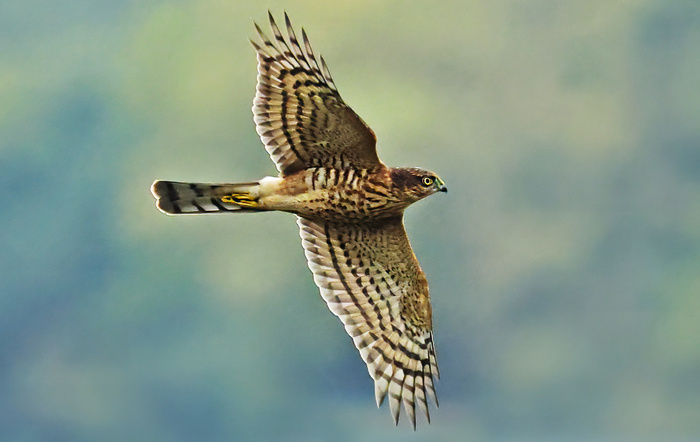
Sitting in my usual place where I encountered the Kestrel (Previous blog) I heard a commotion and looking across a reedbed I could now see the culprits, a raptor was being vigorously pursued by a Carrion Crow. As they approached, I attempted to frame both the performers on this frenetic stage. The crow, the antagonist, was almost upon its victim, a female Sparrowhawk. However, just as the pair were about to engage, the Sparrowhawk seemed to look at me, the only member of the audience, with an almost disdainful glance, as if to say, ‘just watch this’
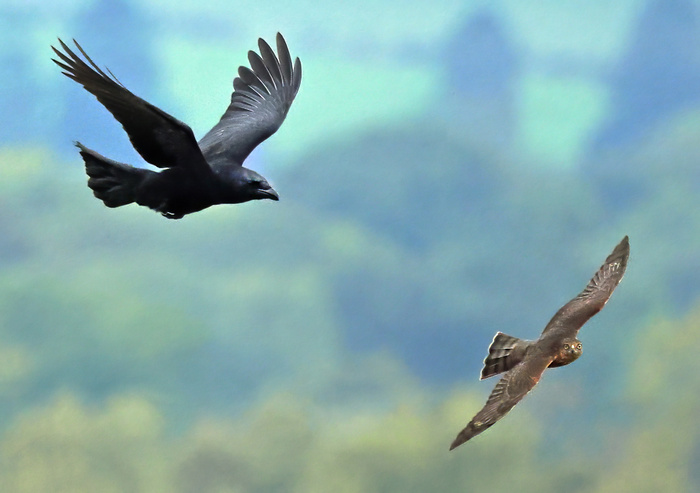
And with an impressive burst of speed coupled with aerial dexterity she left the crow in her slipstream, probably quite annoyed and embarrassed, if crows can ever get embarrassed.
Style and speed are always preferable to brute force!
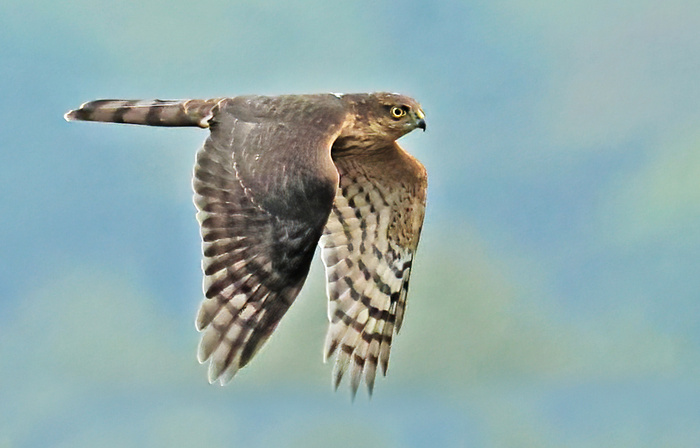
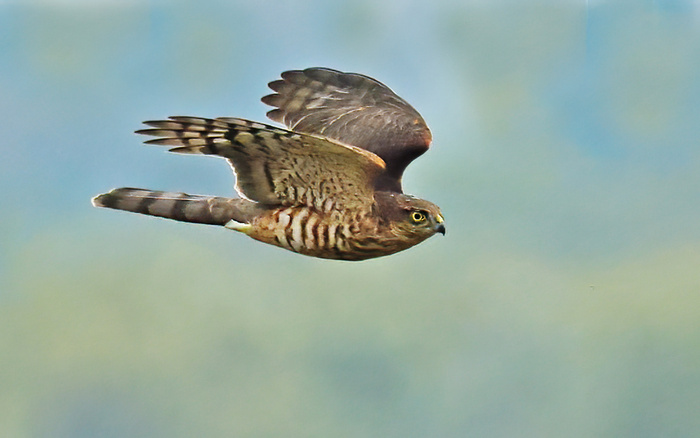
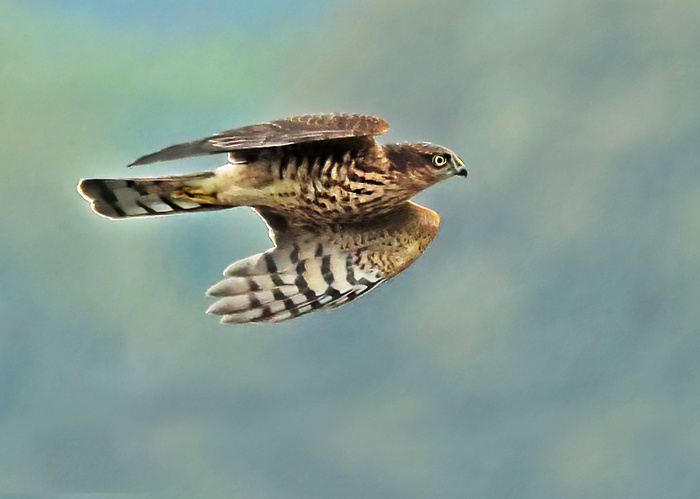
Canon R6 Mk2 / Canon RF 100-500 handheld.
And with an impressive burst of speed coupled with aerial dexterity she left the crow in her slipstream, probably quite annoyed and embarrassed, if crows can ever get embarrassed.
Style and speed are always preferable to brute force!
Canon R6 Mk2 / Canon RF 100-500 handheld.
Kestrel - a special encounter.
24th August 2025
24th August 2025
I was sitting quietly on a stone wall under a tree early this morning looking across a grassy meadow and enjoying a glorious morning. The sky was blue with just a few wispy clouds and a warm breeze blew. There was nobody else around - just as I like it!
Suddenly about a hundred yards away I could see a bird flying towards me, I realised it was a kestrel, a bird which has become quite scarce in the Brecon Beacons, so I was interested immediately, curious to see what would happen, usually as soon as raptors see you they veer away and fly off, but this bird kept on coming.
I got ready to focus my camera and as it approached I fired a few shots.
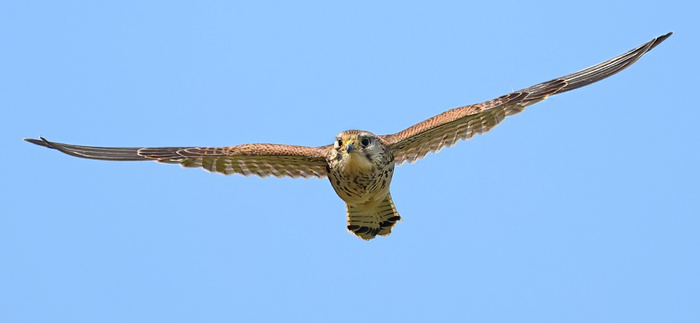
But on it came,
I fired some more shots.
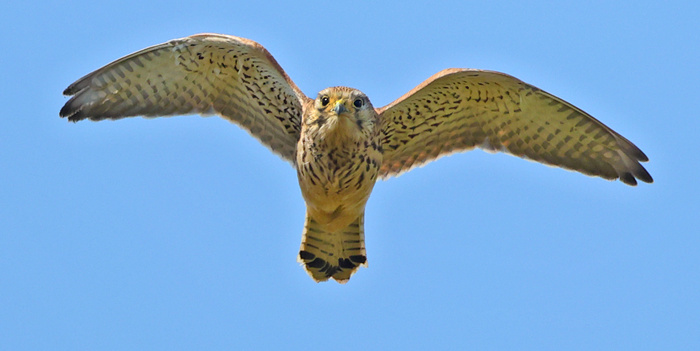
But on it came again.
This was really unusual because Kestrels are quite spooky birds.
Then the unbelievable happened I couldn't shoot any more frames because it was too near and I just expected it to fly over the top of the tree above me and disappear, but it didn't - well not at once. Incredibly it perched fifteen feet away on a branch and just stared at me inquisitively for what seemed about twenty seconds and then it flew off.
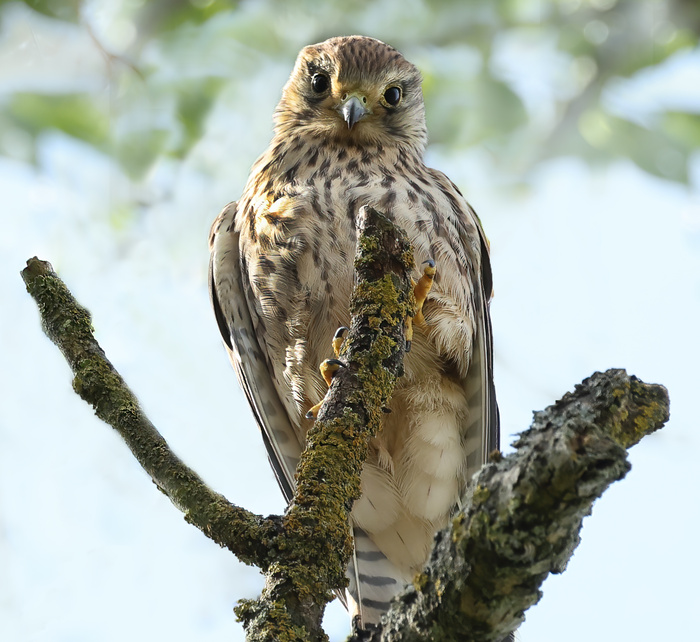
Fortunately I had my Canon 100-500 lens with me which allowed me to zoom right out so I could frame this lovely bird. I was really surprised by this behaviour but it was a lovely experience.
Canon R6 Mk2 + Canon Rf 100-500 - Handheld.
Suddenly about a hundred yards away I could see a bird flying towards me, I realised it was a kestrel, a bird which has become quite scarce in the Brecon Beacons, so I was interested immediately, curious to see what would happen, usually as soon as raptors see you they veer away and fly off, but this bird kept on coming.
I got ready to focus my camera and as it approached I fired a few shots.
But on it came,
I fired some more shots.
But on it came again.
This was really unusual because Kestrels are quite spooky birds.
Then the unbelievable happened I couldn't shoot any more frames because it was too near and I just expected it to fly over the top of the tree above me and disappear, but it didn't - well not at once. Incredibly it perched fifteen feet away on a branch and just stared at me inquisitively for what seemed about twenty seconds and then it flew off.
Fortunately I had my Canon 100-500 lens with me which allowed me to zoom right out so I could frame this lovely bird. I was really surprised by this behaviour but it was a lovely experience.
Canon R6 Mk2 + Canon Rf 100-500 - Handheld.
A nice surprise.
24th August 2025
24th August 2025
The Clouded Yellow is a scarce and difficult to find butterfly in the Brecon Beacons and to come across one feeding on Knapweed this morning in glorious sunshine was a lovely find for Susan and myself. These beautiful butterflies brighten up anyone's morning.
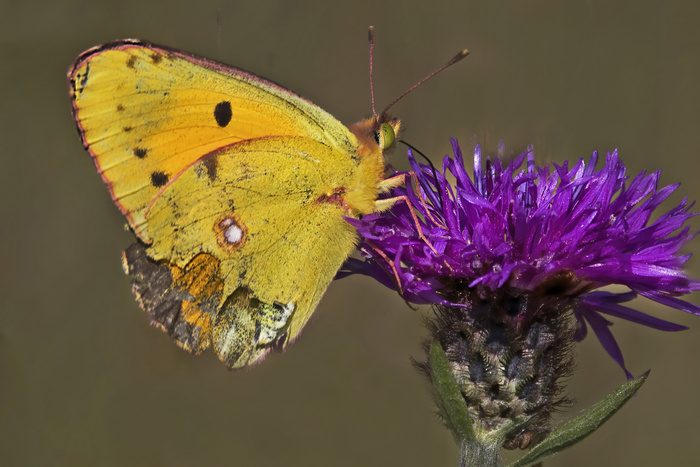
Canon R5 + Canon Rf100-500 lens.
Canon R5 + Canon Rf100-500 lens.
Spotted Flycatchers.
24th August 2025
24th August 2025
I was out walking this morning along the River Usk which is quite low, allowing Dippers and Grey Wagtails to hunt insects over and under the water. I casually came across a family party of Spotted Flycatchers consisting of about six birds a lovely sight. I tucked myself away under some willows and watched them, adults and juveniles together. The young birds were quite adept at hunting flying insects, they had obviously been taught well.
I could see them perching on isolated branches before launching into flight at passing prey. I thought this particular situation might be where I could try the 'Pre Capture' mode on my Canon R6 MK2. I have this feature pre programmed into the camera so it's just a press of a button to activate it, I waited for some time until a bird perched in a suitable position - and this is preferably an uncluttered background and an open space for the bird to fly into.
Using full frame mode to give a wider field of view, I waited...

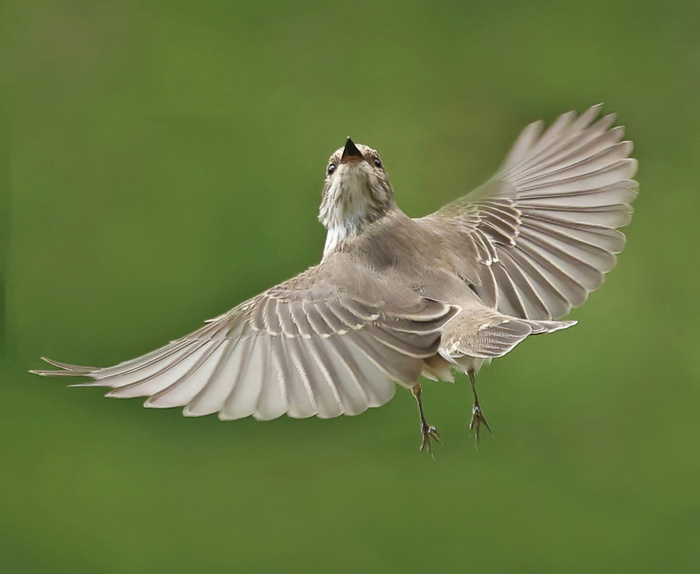
It does work up to a point, as catching fast and unpredictable little birds like these in flight, using conventional methods would be quite difficult.
I could see them perching on isolated branches before launching into flight at passing prey. I thought this particular situation might be where I could try the 'Pre Capture' mode on my Canon R6 MK2. I have this feature pre programmed into the camera so it's just a press of a button to activate it, I waited for some time until a bird perched in a suitable position - and this is preferably an uncluttered background and an open space for the bird to fly into.
Using full frame mode to give a wider field of view, I waited...
It does work up to a point, as catching fast and unpredictable little birds like these in flight, using conventional methods would be quite difficult.
A more difficult subject. - A bit 'Techno'
24th August 2025
24th August 2025
In previous blog posts I outlined how I manage to photograph wildlife in flight. I for one would never try to tell people how to achieve this, instead I prefer to just outline the methods I use, and this may, or may not, help somebody in their photographic endeavours.
Undoubtably modern mirrorless camera have made this process slightly easier, and shots are appearing now that would have been more or less unachievable previously. Two particular features are the 'Eye Tracking' (of birds in particular) where the camera's focussing system locks onto a bird's eye and providing a photographer can retain the bird in the camera viewfinder the eye will be kept sharp. This is such an improvement over DSLR cameras with which you had to just hope the focussing system would find something to 'Lock' onto.
However, this system does not work so efficiently with some insects e.g. moths, butterflies and bees. This is because of their wing patterns and bodies which are often adorned with colourful geometric shapes which can obviously confuse the camera's focusing system. The tendency is for the camera's autofocus to jump around looking for the 'Eye' to track.
This is where 'Double Back Button Focussing' is critical;
If you assign one button to activate 'Eye Tracking' focus, and another button to activate single point focussing then when the former is struggling to achieve focus the latter will focus the system wherever the single point is located. In short your thumb cam be poised over the button which activates 'Single Point' focussing with your index finger on the shutter button. Then inevitably when the insect moves you can refocus without fear of activating the shutter when focus hasn't been achieved and then fire the shutter at the appropriate 'In Focus' moment.
The second feature is Canon's 'Pre Capture' mode, this is achieved when the shutter button is half pressed allowing the camera to continually record the images seen until the shutter button is then fully depressed when the last half a second of the images it has been recording are downloaded to the camera. - in effect going back in time.
These two modes when used in combination can achieve good results.
To illustrate;
An insect like a Bee is crawling around a flower collecting pollen and 'Pre Capture is activated. 'Eye Tracking' is also activated but is not suitable because the Bee is continually going out of focus because of its movement and the system is therefore continually 'Hunting' to achieve focus. Activating single point focus with your thumb on the appropriate back button allows you to continually keep up with the insect, focussing as it moves simply by touching said button. Then with your index finger half depressing the shutter button which is recording images continually, the shutter can be finally depressed with the bee in focus.
If you are shooting at twenty frames/sec obviously ten images will be committed to the camera and these are the frames you would have almost certainly missed, unless you are possessed with the reactions of a fighter pilot, which most are not.
Now come the composition problems, because to achieve a sharp pleasing image you need to avoid cluttered backgrounds and this is solved by, if possible, choosing a flower that is isolated with no obstacles in the background. This is not always possible but is always preferable, because to have an OOF stem e.g. in your image is distracting and can spoil what otherwise would be a nice shot.
Secondly, again if possible, I chose a situation, when the Bee in this case, flies into the air, it will ideally fly into a clear space and importantly this must be provided in the viewfinder by the photographer!
Sometimes a Bee will take off at an angle but sometimes it will take off in the same focal plane as the flower and this is a bonus because then both are sharp.
Having in theory achieved the above then very high shutter speeds are paramount to 'Freeze the action'
It might seem involved but with practice it can become second nature, and is well worth the effort.
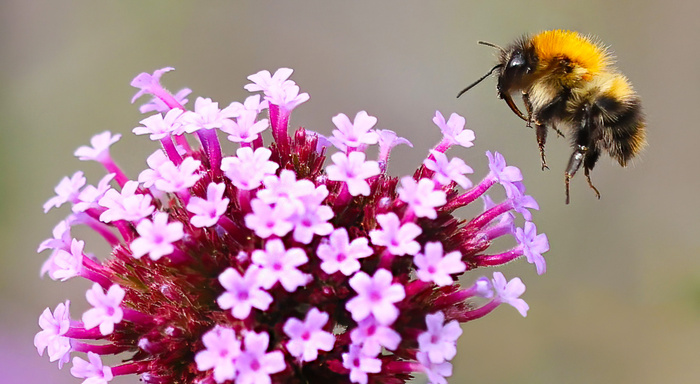
Shooting info;
Common Carder Bee examining Verbena flowers.
Canon R6Mk2
Canon EF 100mm f2.8 Macro Lens
6400/sec - ISO 2000 - F3.5
Undoubtably modern mirrorless camera have made this process slightly easier, and shots are appearing now that would have been more or less unachievable previously. Two particular features are the 'Eye Tracking' (of birds in particular) where the camera's focussing system locks onto a bird's eye and providing a photographer can retain the bird in the camera viewfinder the eye will be kept sharp. This is such an improvement over DSLR cameras with which you had to just hope the focussing system would find something to 'Lock' onto.
However, this system does not work so efficiently with some insects e.g. moths, butterflies and bees. This is because of their wing patterns and bodies which are often adorned with colourful geometric shapes which can obviously confuse the camera's focusing system. The tendency is for the camera's autofocus to jump around looking for the 'Eye' to track.
This is where 'Double Back Button Focussing' is critical;
If you assign one button to activate 'Eye Tracking' focus, and another button to activate single point focussing then when the former is struggling to achieve focus the latter will focus the system wherever the single point is located. In short your thumb cam be poised over the button which activates 'Single Point' focussing with your index finger on the shutter button. Then inevitably when the insect moves you can refocus without fear of activating the shutter when focus hasn't been achieved and then fire the shutter at the appropriate 'In Focus' moment.
The second feature is Canon's 'Pre Capture' mode, this is achieved when the shutter button is half pressed allowing the camera to continually record the images seen until the shutter button is then fully depressed when the last half a second of the images it has been recording are downloaded to the camera. - in effect going back in time.
These two modes when used in combination can achieve good results.
To illustrate;
An insect like a Bee is crawling around a flower collecting pollen and 'Pre Capture is activated. 'Eye Tracking' is also activated but is not suitable because the Bee is continually going out of focus because of its movement and the system is therefore continually 'Hunting' to achieve focus. Activating single point focus with your thumb on the appropriate back button allows you to continually keep up with the insect, focussing as it moves simply by touching said button. Then with your index finger half depressing the shutter button which is recording images continually, the shutter can be finally depressed with the bee in focus.
If you are shooting at twenty frames/sec obviously ten images will be committed to the camera and these are the frames you would have almost certainly missed, unless you are possessed with the reactions of a fighter pilot, which most are not.
Now come the composition problems, because to achieve a sharp pleasing image you need to avoid cluttered backgrounds and this is solved by, if possible, choosing a flower that is isolated with no obstacles in the background. This is not always possible but is always preferable, because to have an OOF stem e.g. in your image is distracting and can spoil what otherwise would be a nice shot.
Secondly, again if possible, I chose a situation, when the Bee in this case, flies into the air, it will ideally fly into a clear space and importantly this must be provided in the viewfinder by the photographer!
Sometimes a Bee will take off at an angle but sometimes it will take off in the same focal plane as the flower and this is a bonus because then both are sharp.
Having in theory achieved the above then very high shutter speeds are paramount to 'Freeze the action'
It might seem involved but with practice it can become second nature, and is well worth the effort.
Shooting info;
Common Carder Bee examining Verbena flowers.
Canon R6Mk2
Canon EF 100mm f2.8 Macro Lens
6400/sec - ISO 2000 - F3.5
Canon Pre capture mode.
24th August 2025
24th August 2025
Butterflies numbers are low near where I live again this year. Although our garden is full of plants supposedly attractive to insects there's not much happening. Today is hot and sunny here and so I went for a look at an area of Knapweed which is attractive to butterflies and although I saw Holly Blue, Common Blue, Small, Green Veined and Large Whites, a Red Admiral and plenty of Meadow Browns the larger coloured butterflies such as Comma, Peacock, Red Admiral, Small Tortoiseshell and Painted lady remain scarce.
The one painted lady seen was persistently paying attention to the Knapweed plant and therefore gave me a chance to use Canon's 'Pre Capture' mode again. It's still far from easy manipulating the situation for a shot because you have to isolate your subject from cluttered backgrounds or the effect is compromised.
This involves waiting for your subject to land on a suitable flower, preferably above the other flowers and then wait for take-off. However, wind is then a problem because it ruins focus by moving the subject, so patience is needed....

Canon R6 MK2 + Canon RF 100-500 f7.1 lens.
5000/sec - 2000 ISO - 238mm
The one painted lady seen was persistently paying attention to the Knapweed plant and therefore gave me a chance to use Canon's 'Pre Capture' mode again. It's still far from easy manipulating the situation for a shot because you have to isolate your subject from cluttered backgrounds or the effect is compromised.
This involves waiting for your subject to land on a suitable flower, preferably above the other flowers and then wait for take-off. However, wind is then a problem because it ruins focus by moving the subject, so patience is needed....
Canon R6 MK2 + Canon RF 100-500 f7.1 lens.
5000/sec - 2000 ISO - 238mm
House Martins / Canon R6 Mk2.
24th August 2025
24th August 2025
House Martins are quick, period! Frustratingly they also fly in a multidirectional manner, this may seem obvious, as all birds do over a period of time. However, birds like Swallows, Martins and Swifts do this very quickly and frequently. These erratic flight patterns make them very difficult to follow in a photographer's camera viewfinder. To have any success of photographing them in flight you have to use a particular modus operandi. It is very difficult indeed, almost impossible, without a huge slice of luck, just to point a lens and capture a sharp image.
To illustrate - one afternoon in Lesvos this spring, it had got far too hot to go birding so I was relaxing on the balcony of my hotel room just sipping a chilled glass of the very good and cheap (even better) local wine. I could see some Barn Swallows flying low and skimming the swimming pool, drinking water - a nice sight.
Another man staying at the hotel had obviously seen this avian spectacle and decided to position himself on a pool-side chair thinking he would try and capture them in flight, this was all very good. However, being side-on to these very fast flying birds as they came in presented a significant problem, and I thought that he had no chance whatsoever of any success. You just can't do it, by the time he had pointed his lens at an incoming bird and waited to achieve focus the bird was already twenty feet past him. He tried this method for about twenty minutes and gave up, and anybody would have experienced the same problem.
To have any chance of success you have to step back for a wider perspective which gives you an idea of the birds flight direction. Then you have more time to achieve focus by tracking the flight and if you can obtain focus early, which is critical, then for two or three seconds you have a chance of getting a few sharp images.
Back home in the Brecon Beacons there is a stone maintenance tower on a local reservoir, and House Martins have nested there for as long as I can recall. I was there yesterday on a cloudy morning watching these lovely birds flying back and fore their nests. I decided to have a try at capturing them in flight using my Canon R6 Mk2 and a Canon 100-500 f7.1 lens. I used the bare lens and the full frame camera setting, this gave me the widest perspective possible, this is important because to use the 1.6 crop factor in the camera and possibly a 1.4 tele converter would not only slow the lens down but give a much narrower field of view, making it much more difficult to track these birds.
I watched one particular bird's flight path, it's no good jumping from bird to bird, I obtained focus early on and just kept track of it until it flew nearer. Using 'back button focussing' is fundamentally important in this situation because if shooting conventionally (using the shutter button to focus and then fire the shutter) you will inevitably fire the shutter during tracking when focus hasn't been achieved. I just depressed the pre-programmed back button to track the bird's flightpath until it was in focus, and when it came nearer I fired the shutter button, thereby only firing when the bird was in focus.
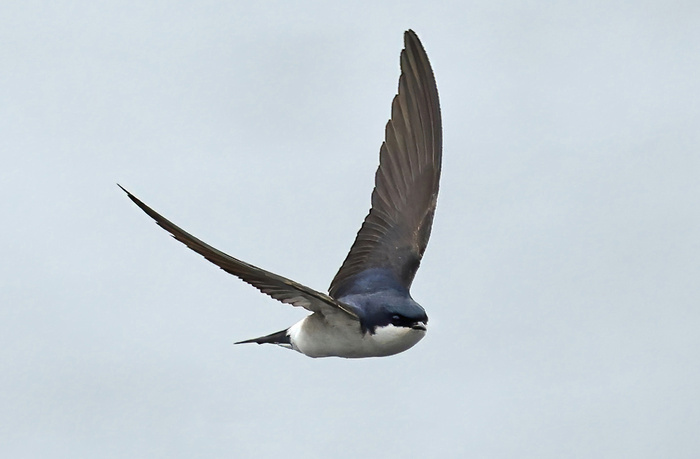
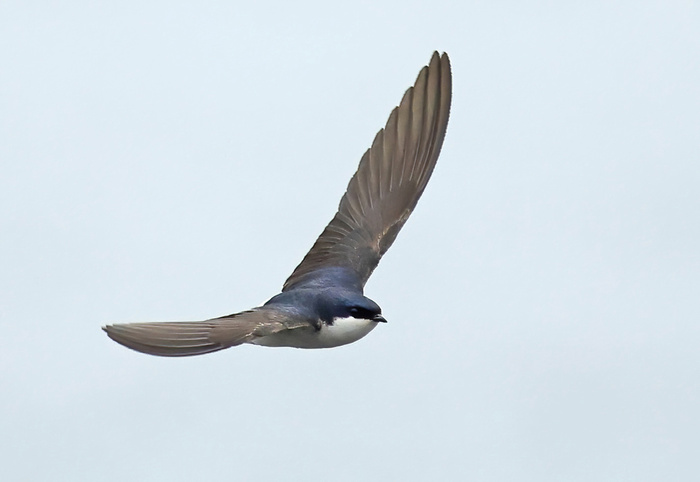

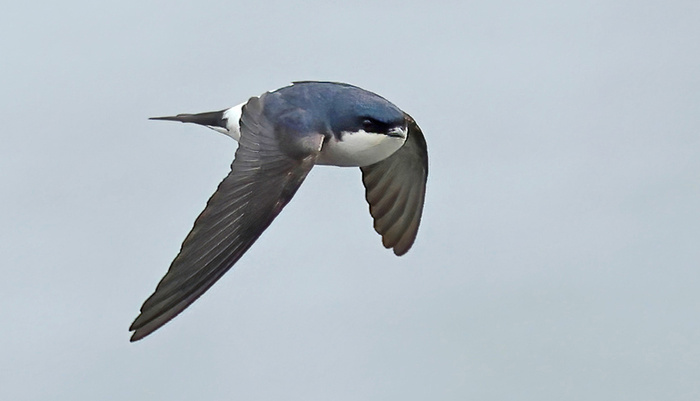
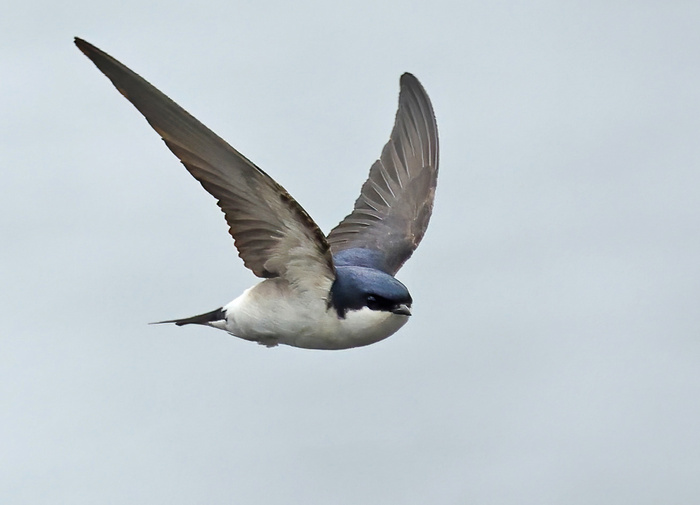
This is the only method that works for me.
Shooting Info;
Canon R6 Mk2 + Canon RF100-500 f7.1 lens.
F7.1 / 5000 sec / iso 2000 / @ 20FPS
To illustrate - one afternoon in Lesvos this spring, it had got far too hot to go birding so I was relaxing on the balcony of my hotel room just sipping a chilled glass of the very good and cheap (even better) local wine. I could see some Barn Swallows flying low and skimming the swimming pool, drinking water - a nice sight.
Another man staying at the hotel had obviously seen this avian spectacle and decided to position himself on a pool-side chair thinking he would try and capture them in flight, this was all very good. However, being side-on to these very fast flying birds as they came in presented a significant problem, and I thought that he had no chance whatsoever of any success. You just can't do it, by the time he had pointed his lens at an incoming bird and waited to achieve focus the bird was already twenty feet past him. He tried this method for about twenty minutes and gave up, and anybody would have experienced the same problem.
To have any chance of success you have to step back for a wider perspective which gives you an idea of the birds flight direction. Then you have more time to achieve focus by tracking the flight and if you can obtain focus early, which is critical, then for two or three seconds you have a chance of getting a few sharp images.
Back home in the Brecon Beacons there is a stone maintenance tower on a local reservoir, and House Martins have nested there for as long as I can recall. I was there yesterday on a cloudy morning watching these lovely birds flying back and fore their nests. I decided to have a try at capturing them in flight using my Canon R6 Mk2 and a Canon 100-500 f7.1 lens. I used the bare lens and the full frame camera setting, this gave me the widest perspective possible, this is important because to use the 1.6 crop factor in the camera and possibly a 1.4 tele converter would not only slow the lens down but give a much narrower field of view, making it much more difficult to track these birds.
I watched one particular bird's flight path, it's no good jumping from bird to bird, I obtained focus early on and just kept track of it until it flew nearer. Using 'back button focussing' is fundamentally important in this situation because if shooting conventionally (using the shutter button to focus and then fire the shutter) you will inevitably fire the shutter during tracking when focus hasn't been achieved. I just depressed the pre-programmed back button to track the bird's flightpath until it was in focus, and when it came nearer I fired the shutter button, thereby only firing when the bird was in focus.
This is the only method that works for me.
Shooting Info;
Canon R6 Mk2 + Canon RF100-500 f7.1 lens.
F7.1 / 5000 sec / iso 2000 / @ 20FPS
Rufous Scrub Robin.
24th August 2025
24th August 2025
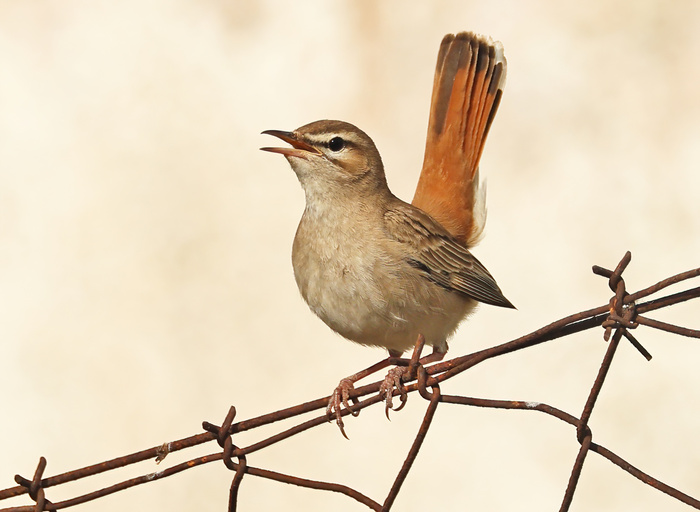
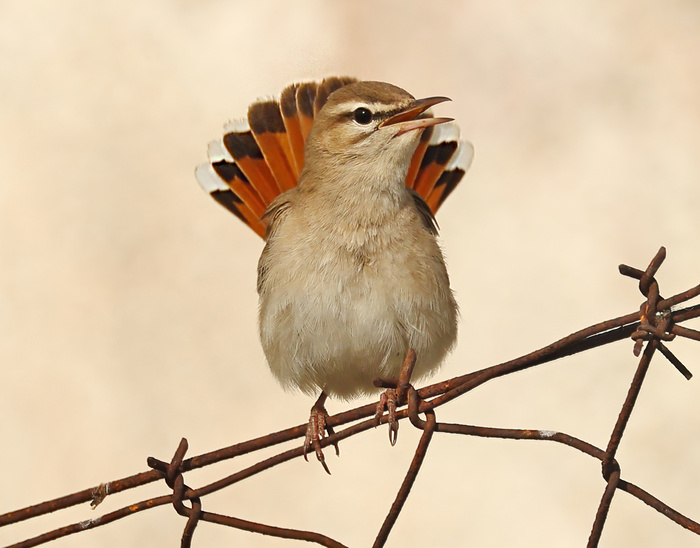
The Rufous Scrub Robin, at least this is the current iteration, is a small chat which favours hot and dry habitats with dense scrubby bushes. Originally known as a Rufous Bush Chat, then Rufous Bush Robin and now known as the above. They usually arrive on Lesvos in May and immediately take up territory.
This one particular bird took am obvious fancy, for whatever reasons, to an old derelict building and if you waited in your vehicle it would come and perch in various positions and sing for a mate. One of its favourite perches was a rusty old chain link fence - don't try to think why, it defies logic.
I waited one morning in my vehicle, it was quiet and sure enough here it comes to its favoured perch. It wasn't the most photogenic situation but it gave very good views in a nice light.
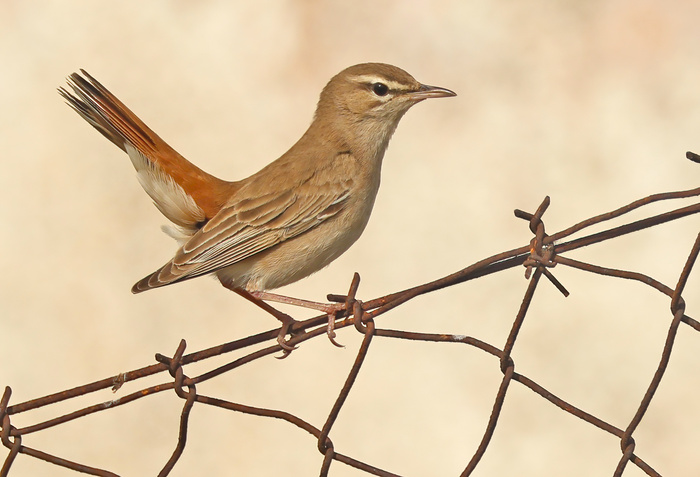
Sometimes birds do strange things.
This one particular bird took am obvious fancy, for whatever reasons, to an old derelict building and if you waited in your vehicle it would come and perch in various positions and sing for a mate. One of its favourite perches was a rusty old chain link fence - don't try to think why, it defies logic.
I waited one morning in my vehicle, it was quiet and sure enough here it comes to its favoured perch. It wasn't the most photogenic situation but it gave very good views in a nice light.
Sometimes birds do strange things.
Little Bittern.
24th August 2025
24th August 2025
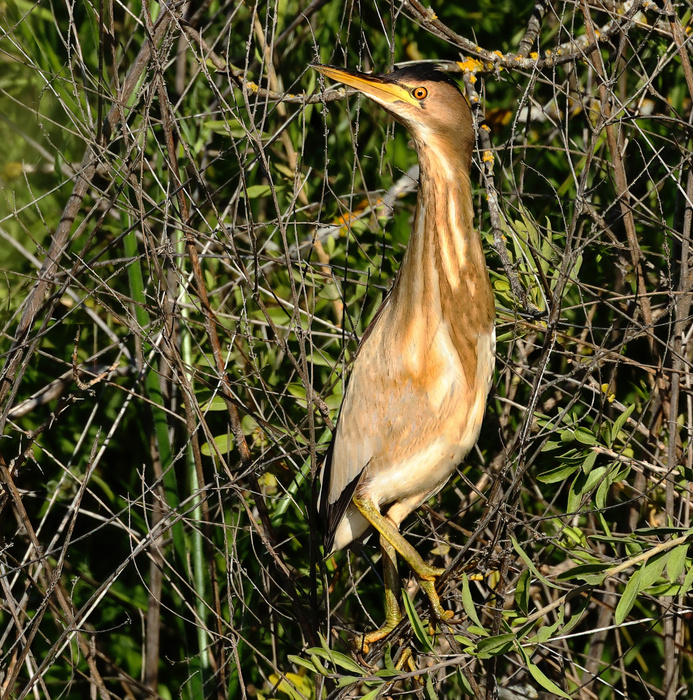
Another bird that can be found across the island of Lesvos. They can be difficult to see or alternatively they will stand out in the open. They are undoubtably less difficult to see than the Purple Heron. Nevertheless they can also blend in with the foliage, and this bird was in roughly the same area as the Purple Heron. They are a great deal smaller of course, which is an advantage, and so they can be easily missed.
Night Heron.
24th August 2025
24th August 2025
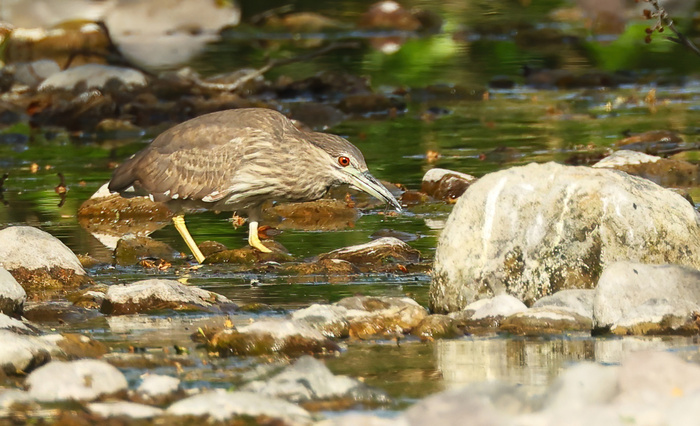
In Lesvos if you have the time and sit quietly by a water course, sooner or later something will appear, and that's just what happened when this juvenile Night Heron came out of the undergrowth looking for food, particularly froglets, which were in abundance in this small stream.
These birds are quite spooky - but with patience...
These birds are quite spooky - but with patience...
Golden Orioles.
24th August 2025
24th August 2025
These birds are very arboreal, they can be heard infrequently but they are usually difficult to see well and this proved to be the case.
We had one occasion when we could see six birds flying into a tree and sometimes perching out. They were always distant but just seeing them is a bonus.
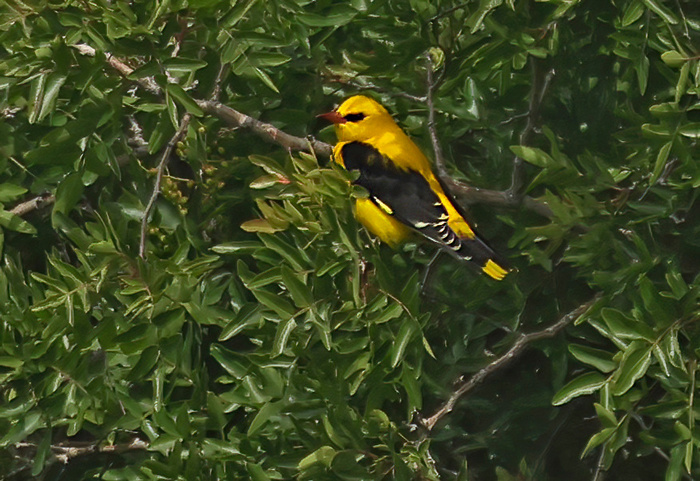
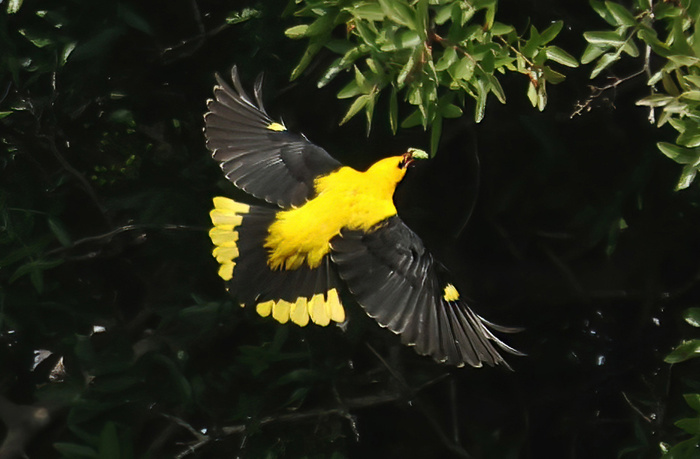
We had one occasion when we could see six birds flying into a tree and sometimes perching out. They were always distant but just seeing them is a bonus.
Purple Heron.
24th August 2025
24th August 2025
A secretive and very wary bird, the Purple Heron hides in undergrowth near water feeding unobtrusively. If caught out in the open they will fly away immediately if that is their best option, however, if they are found in a situation that they think compromises their safety by flying, their next course of action is to freeze and remain motionless relying on their natural camouflage.
Early one morning we were driving past a local lake and we saw a bird standing on a steep banking alongside a water filled ditch. I slowed the car right down and as described above it froze solid because we were only twenty feet away, it was too close to us for it to fly up and away - it was just too big.
It stood there intently staring at us as I poked my little zoon lens out of the car window, but it remained perfectly still. I took a few shots and drove on - the closest encounter with a Purple Heron by far.
As we were parking up we met a man who was staying at our hotel and he was trying to take images of wildlife and by his own admission he was a beginner. Nothing wrong with that we all had to start somewhere. I don't mind helping people out so I gave him details exactly where the Purple Heron was located.
He left his car and walked along the track. later on I asked him if he had any luck, he hadn't. He told me he must have walked right past the bird because when he looked back after walking along said track he could now see the bird, but after turning around and trying to walk back nearer, it flew away.
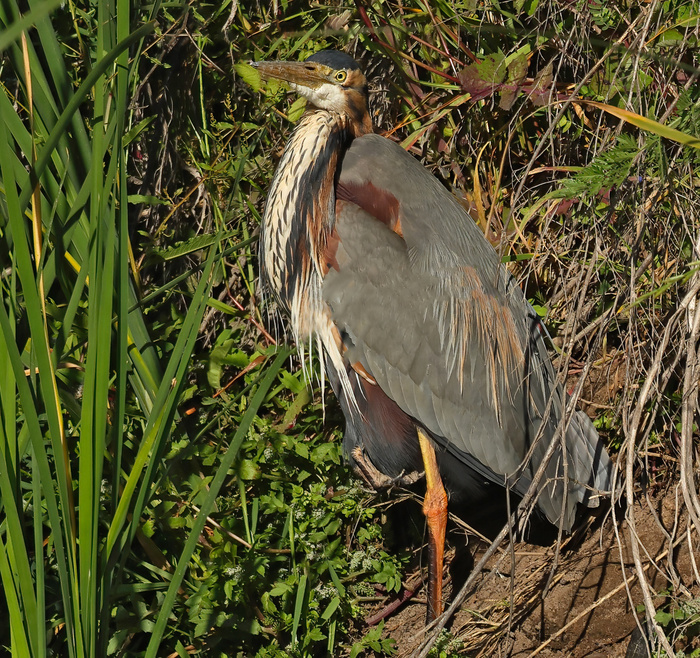
A combination of not looking closely enough and the bird's natural camouflage.
Early one morning we were driving past a local lake and we saw a bird standing on a steep banking alongside a water filled ditch. I slowed the car right down and as described above it froze solid because we were only twenty feet away, it was too close to us for it to fly up and away - it was just too big.
It stood there intently staring at us as I poked my little zoon lens out of the car window, but it remained perfectly still. I took a few shots and drove on - the closest encounter with a Purple Heron by far.
As we were parking up we met a man who was staying at our hotel and he was trying to take images of wildlife and by his own admission he was a beginner. Nothing wrong with that we all had to start somewhere. I don't mind helping people out so I gave him details exactly where the Purple Heron was located.
He left his car and walked along the track. later on I asked him if he had any luck, he hadn't. He told me he must have walked right past the bird because when he looked back after walking along said track he could now see the bird, but after turning around and trying to walk back nearer, it flew away.
A combination of not looking closely enough and the bird's natural camouflage.