News
Ring Ouzels back in the Beacons.
05th April 2016
05th April 2016
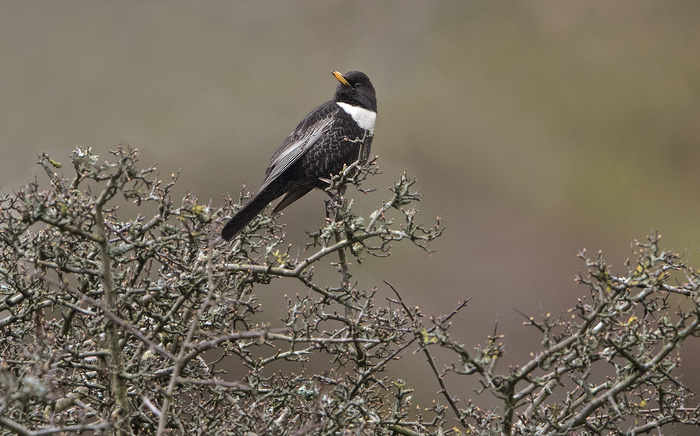
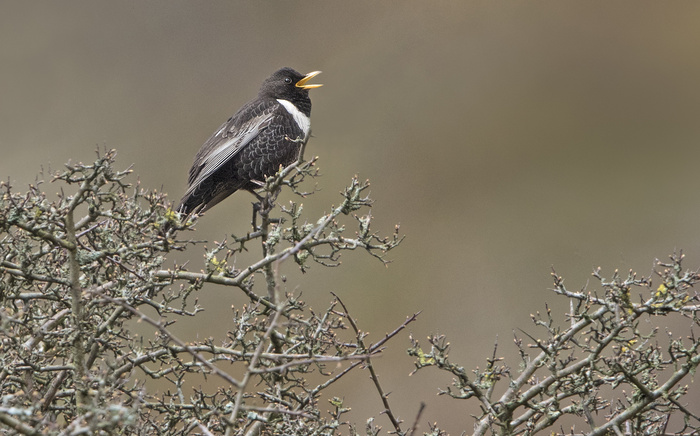
I was up early this morning walking up on the Beacons looking for Ring Ouzels. It is just about prime time now for migrating birds to arrive at their breeding grounds. The morning was quite cold and overcast with a brisk keen wind blowing. I tucked in under a large Hawthorn tree looking for shelter and also to hide myself away from any potential birds. I had been there for about an hour when I could hear that characteristic 'chuck chuck' contact call of a Ring Ouzel. I made myself ready, I had my kit assembled just in case I saw a bird because you don't have much shooting time with Ouzels in this location. Then a beautiful male bird appeared on top of a nearby Hawthorn tree, I reacted immediately and fired off a few shots just as he began to sing, it was special to hear him singing as he looked out over the valley. Ring Ouzels really are iconic mountain birds and it's really good to see them back home!
Spring in the Brecon Beacons.
01st April 2016
01st April 2016
What a day it was yesterday! A true spring day in the Beacons.
I was up early and walking at Craig Cerrig Gleisiad looking for Ring Ouzels but although there have been a few isolated reports from around the country there were none there yesterday. However, they will come soon and the lack of birds was compensated by the weather. Later on in the early afternoon I was walking on Mynydd Illtud, an upland area in the middle of the Beacons. The Skylarks are now establishing territories and they are singing their song from on high and then characteristically parachuting back down to earth. I always love to see them doing this and they are an iconic bird of this type of terrain.
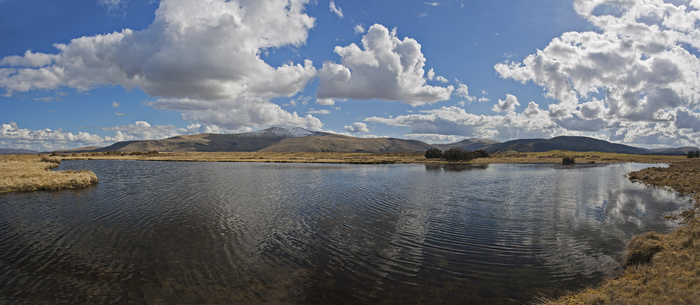
The views of the Beacons from Mynydd Illtyd are spectacular and I decided to take a few shots from the highest point looking across at Corn Ddu and Penyfan. A circular polarizing filter helps to mellow the light on these bright spring days and I would recommend anybody taking photographs outdoors, where ever they are, to buy one of these filters. They are quite expensive but are definitely worth the money and can transform your images!
Polarizing filter results
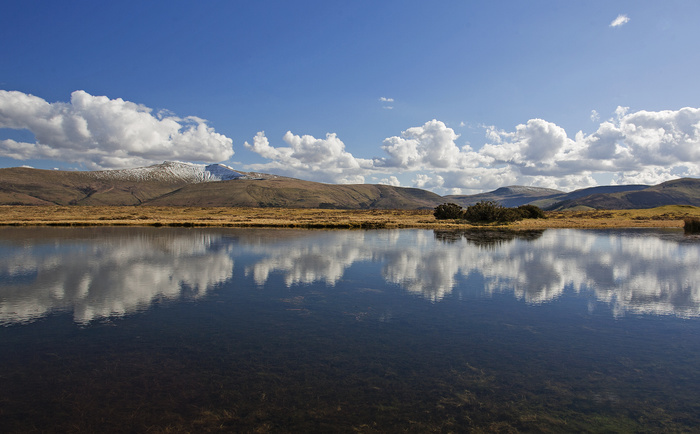
Penyfan and Corn Ddu fron Mynydd Illtud
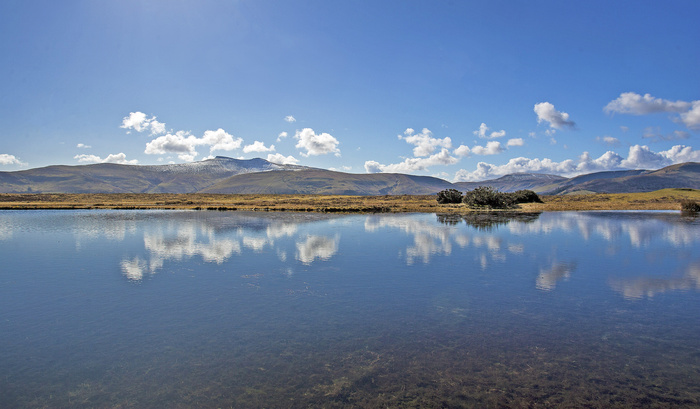
A three photo stitch at the same location.
I'll keep on trying for the Ring Ouzels, I hope they arrive soon!
I was up early and walking at Craig Cerrig Gleisiad looking for Ring Ouzels but although there have been a few isolated reports from around the country there were none there yesterday. However, they will come soon and the lack of birds was compensated by the weather. Later on in the early afternoon I was walking on Mynydd Illtud, an upland area in the middle of the Beacons. The Skylarks are now establishing territories and they are singing their song from on high and then characteristically parachuting back down to earth. I always love to see them doing this and they are an iconic bird of this type of terrain.
The views of the Beacons from Mynydd Illtyd are spectacular and I decided to take a few shots from the highest point looking across at Corn Ddu and Penyfan. A circular polarizing filter helps to mellow the light on these bright spring days and I would recommend anybody taking photographs outdoors, where ever they are, to buy one of these filters. They are quite expensive but are definitely worth the money and can transform your images!
Polarizing filter results
Penyfan and Corn Ddu fron Mynydd Illtud
A three photo stitch at the same location.
I'll keep on trying for the Ring Ouzels, I hope they arrive soon!
A million hits!
18th March 2016
18th March 2016
A milestone for this website today as it clocks up a million hits. I’m quite pleased that this obscure little website, with only one person providing the info has achieved this total. Another pleasing fact is that almost half of those hits are by readers of my blog. I try to make the blog interesting, however, it’s not easy because most of the time there really is nothing much to write about. There is an obvious phenomena associated with internet blogs and it is as follows; the banality of what is written in a blog is inversely proportional to the internet hits it receives. I hope this isn’t the case with me, therefore, I am determined never to intentionally put this into practice. I am a firm believer in quality over quantity and this is exemplified I hope when people write to me and tell me they really enjoy my blog.
Also very popular are my equipment review and trip report pages, which I’m pleased to say have been a useful source of information to many, both these pages have been read over five thousand times each.
When I first started I didn’t have a clue on how to construct, and more importantly, maintain a website of this kind. Some may say that I still don’t, but the traffic statistics suggest otherwise! Finally; a huge amount of credit must go to my wife Susan whose flair, insight and encouragement are major contributing factors to this website's popularity.
Long may it continue.
Also very popular are my equipment review and trip report pages, which I’m pleased to say have been a useful source of information to many, both these pages have been read over five thousand times each.
When I first started I didn’t have a clue on how to construct, and more importantly, maintain a website of this kind. Some may say that I still don’t, but the traffic statistics suggest otherwise! Finally; a huge amount of credit must go to my wife Susan whose flair, insight and encouragement are major contributing factors to this website's popularity.
Long may it continue.
Hawfinch, Spring 2016, Forest of Dean.
16th March 2016
16th March 2016
My wife Susan and I dropped into the Forest of Dean today on the off chance of seeing a Hawfinch that had been showing at Crown Lane, Parkend. To be honest it's not a favourite location of ours, it's extremely busy there with traffic and dog walkers. However, it's probably the easiest place in the forest to see these enigmatic birds. It's very difficult to photograph these shy birds unless you have inside information and I don't blame the locals for keeping good sites to themselves, I would do the same!
I have managed to photograph self-found birds there in the past but it's a long journey and a very early start because it takes an hour to get there from the Brecon Beacons. There is also the added problem of possible disturbance when you get there, it’s OK if you live there, you can come back the following morning but an hour’s drive each way and a 05.00 start is tough.
Although we were there just after 06.30, we expected to see cars parked there trying to see the bird. If this had been the case we would have driven straight past and gone for our intended walk in the forest. However, the site was deserted, so we parked up and sat waiting in the car. After about half an hour a male Hawfinch dropped down out of a Yew tree and began feeding in the leaf litter allowing me to take some photographs. We never try and see Hawfinches until mid-March because that’s when they come into full breeding plumage and the male is then a stunning bird. His beak turns from a straw colour in the winter to a leaden grey and he is then, for me, the smartest bird in the forest.
He showed for about thirty seconds and then flew up into the canopy as the noise began to increase from work traffic and people walking dogs. We decided to pack-up and leave and drove into the forest and had a very nice walk in a couple of locations.
Mission accomplished after a necessary very early start, if anyone wants to see these birds at this location, unless you are very lucky it’s got to be an early morning job!
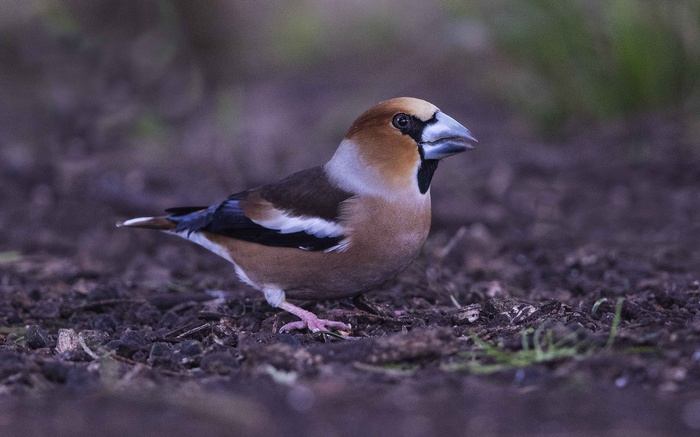
Always wary!
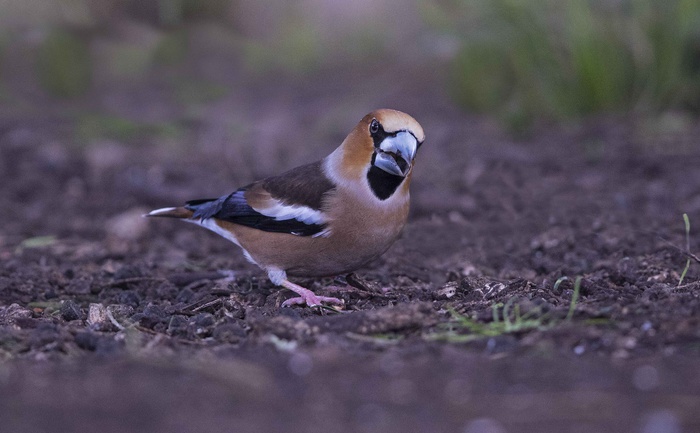
He's heard the shutter even though it's on silent.
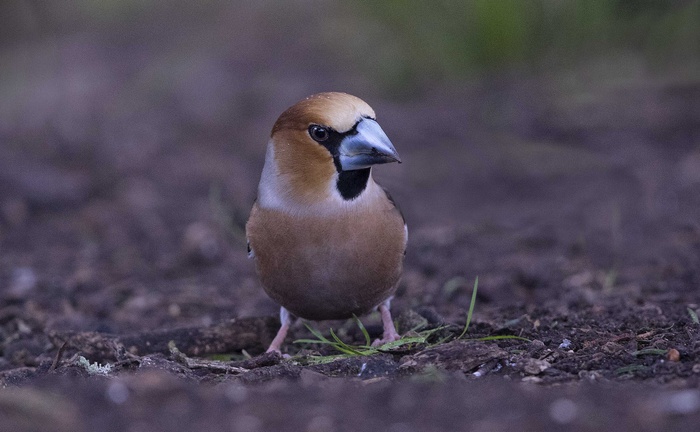
That's a really powerful beak!
I have managed to photograph self-found birds there in the past but it's a long journey and a very early start because it takes an hour to get there from the Brecon Beacons. There is also the added problem of possible disturbance when you get there, it’s OK if you live there, you can come back the following morning but an hour’s drive each way and a 05.00 start is tough.
Although we were there just after 06.30, we expected to see cars parked there trying to see the bird. If this had been the case we would have driven straight past and gone for our intended walk in the forest. However, the site was deserted, so we parked up and sat waiting in the car. After about half an hour a male Hawfinch dropped down out of a Yew tree and began feeding in the leaf litter allowing me to take some photographs. We never try and see Hawfinches until mid-March because that’s when they come into full breeding plumage and the male is then a stunning bird. His beak turns from a straw colour in the winter to a leaden grey and he is then, for me, the smartest bird in the forest.
He showed for about thirty seconds and then flew up into the canopy as the noise began to increase from work traffic and people walking dogs. We decided to pack-up and leave and drove into the forest and had a very nice walk in a couple of locations.
Mission accomplished after a necessary very early start, if anyone wants to see these birds at this location, unless you are very lucky it’s got to be an early morning job!
Always wary!
He's heard the shutter even though it's on silent.
That's a really powerful beak!
My final evening with the Barn Owl.
27th February 2016
27th February 2016
There was only one thing missing from my encounter with this beautiful Owl and that was just one decent flight image. I have refused all opportunities to photograph her in flight because I didn’t want to spook her by moving the lens and spoil the chance of a perched image. I have literally hundreds of Barn Owl flight photographs, in the main from Norfolk, but decent perched Barn Owl photographs don’t come around too often, especially here in the Beacons. I am now satisfied with the half decent perched shots I have managed and it’s not about getting ‘The Best’ shot, it’s about being close to a very special bird. If you want ‘That’ shot go to a bird of prey centre where they will perch in front of you.
The only trouble with getting images from places such as this and other places where situations have been created for people, eg Kingfisher, Sparrowhawk etc etc is that it’s not really your photograph.
The image is really the person's who created the situation that you pay to use!
That’s why I will never go to any of them - these places are not for me.
Anyway I’ve put the soap box back in the shed for another year.
For the final time, the night before last my wife Susan and I went down to the Owl location, I collected some fallen Ash branches and pushed them into the soft ground, I strung some camo netting across them and we both sat down behind it and waited. About an hour past when we could see the Owl flying around, we both pulled our scarves up over our faces and tucked in. It’s important to cover your face and hands because these birds will detect a white ‘object’ from some distance and they will become suspicious and avoid coming near.
She flew low over the meadow and came closer and closer, Susan kept her binoculars up to her eyes to hide what little white skin was showing above the camo net and I hid behind the camera. For these situations and indeed for all the perched shots, I have used a corded shutter release. This way you don’t have to move your hands much, just hold the bottom of the camera with one hand and control the focussing remotely. For me it’s all about cutting down your movement!
The Owl came right up to where we were hidden and we had some glorious views of her as she hunted in the evening light. Finally she swept over us and just gave a cursory glare as she realised we were there.
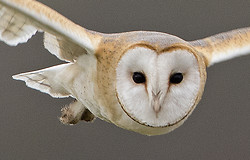
She disappeared into the fields and we packed up and left very contented indeed.
It's been a special experience for me and now Susan, to see this stunning bird up close, but now it’s time to leave her to hopefully find a mate and start a new generation, I really hope so.
The only trouble with getting images from places such as this and other places where situations have been created for people, eg Kingfisher, Sparrowhawk etc etc is that it’s not really your photograph.
The image is really the person's who created the situation that you pay to use!
That’s why I will never go to any of them - these places are not for me.
Anyway I’ve put the soap box back in the shed for another year.
For the final time, the night before last my wife Susan and I went down to the Owl location, I collected some fallen Ash branches and pushed them into the soft ground, I strung some camo netting across them and we both sat down behind it and waited. About an hour past when we could see the Owl flying around, we both pulled our scarves up over our faces and tucked in. It’s important to cover your face and hands because these birds will detect a white ‘object’ from some distance and they will become suspicious and avoid coming near.
She flew low over the meadow and came closer and closer, Susan kept her binoculars up to her eyes to hide what little white skin was showing above the camo net and I hid behind the camera. For these situations and indeed for all the perched shots, I have used a corded shutter release. This way you don’t have to move your hands much, just hold the bottom of the camera with one hand and control the focussing remotely. For me it’s all about cutting down your movement!
The Owl came right up to where we were hidden and we had some glorious views of her as she hunted in the evening light. Finally she swept over us and just gave a cursory glare as she realised we were there.
She disappeared into the fields and we packed up and left very contented indeed.
It's been a special experience for me and now Susan, to see this stunning bird up close, but now it’s time to leave her to hopefully find a mate and start a new generation, I really hope so.
Day three with the Barn Owl.
24th February 2016
24th February 2016
I decided to have one more session trying to photograph the Barn Owl, the weather was set fair and the winds were light. It looked like perfect conditions for her to hunt so I set up in my usual location, tucked away in the hedge. Getting there is a little easier now because the ground isn’t so waterlogged, however, it is still far from ideal with glutinous mud still in a lot of areas.
I had been waiting for around two hours when suddenly like a spectre she appeared on the post beside me. I thought the previous experience was a one off but no here she was again! It’s quite remarkable how she just appears from nowhere, in total silence. We all know that they are silent flyers but to experience it first hand is still amazing. It is very difficult for me to keep totally silent in this situation with a wild bird perched six feet away. I watched her surveying the area before deciding in which direction to fly, then she just took off again in total silence flying spectre-like over the meadows, quartering to and fro in search of prey. It’s such a glorious and inspiring sight to watch these birds flying in the late afternoon sunshine.
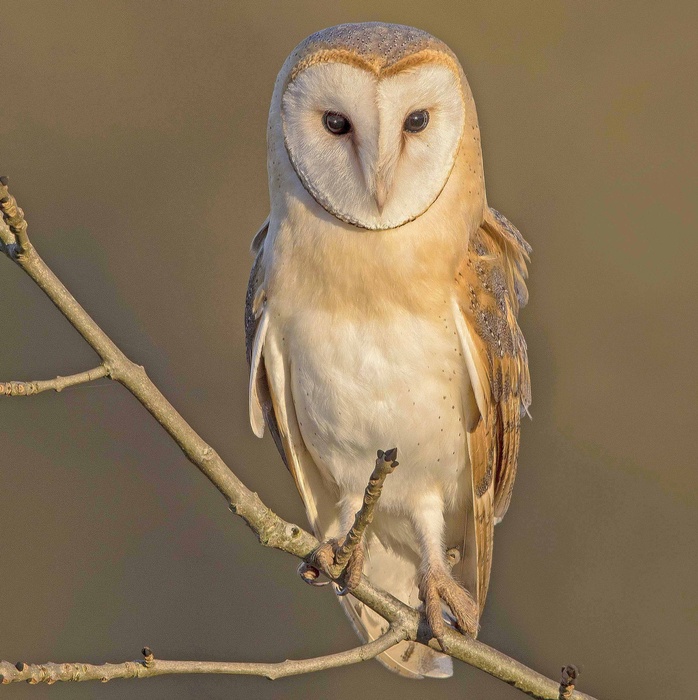
She disappeared for some time, no doubt hunting her favourite areas and in the meantime I just waited, feeling quite warm in the winter sunshine. After about an hour a familiar pattern started to unfold, here she was flying towards me. I tucked into the hedge full of anticipation as she approached, I moved my lens to where I hoped she might perch. I know when she is about to perch because she stops looking down and looks ahead and just starts to glide. It illustrates just how light these owls are when they perch on the flimsiest of twigs. Her judgement must be superb because once perched she never has to move to a more comfortable position, she always gets it right first time!
She perched beautifully and I shot here in several poses, she doesn’t stay long if you have thirty seconds you’re lucky.
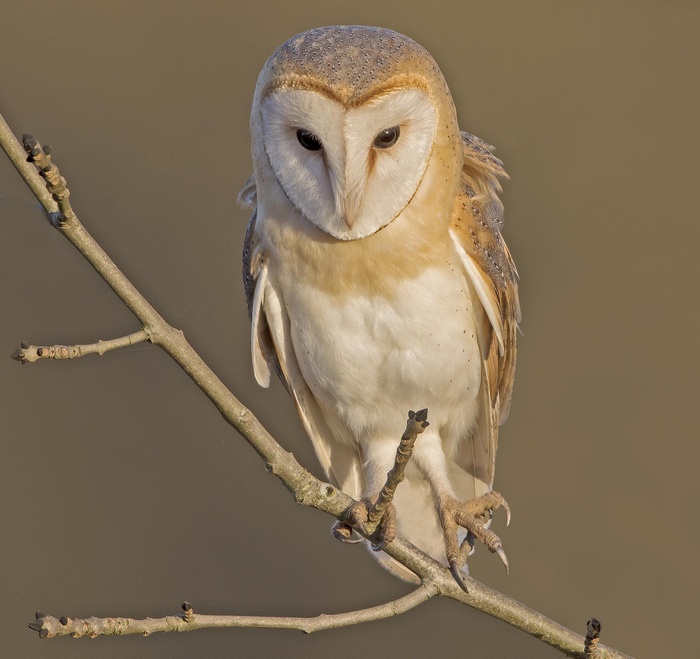
It’s basically a three hour wait for thirty seconds, if you haven’t got that sort of patience then you are not going to get the shot unless you have a huge stroke of luck.
I have always stuck to my mantra over the years, it’s not rocket science;
Do your homework, Get there early, Dress suitably, Be quiet, (Patience)!!
I had been waiting for around two hours when suddenly like a spectre she appeared on the post beside me. I thought the previous experience was a one off but no here she was again! It’s quite remarkable how she just appears from nowhere, in total silence. We all know that they are silent flyers but to experience it first hand is still amazing. It is very difficult for me to keep totally silent in this situation with a wild bird perched six feet away. I watched her surveying the area before deciding in which direction to fly, then she just took off again in total silence flying spectre-like over the meadows, quartering to and fro in search of prey. It’s such a glorious and inspiring sight to watch these birds flying in the late afternoon sunshine.
She disappeared for some time, no doubt hunting her favourite areas and in the meantime I just waited, feeling quite warm in the winter sunshine. After about an hour a familiar pattern started to unfold, here she was flying towards me. I tucked into the hedge full of anticipation as she approached, I moved my lens to where I hoped she might perch. I know when she is about to perch because she stops looking down and looks ahead and just starts to glide. It illustrates just how light these owls are when they perch on the flimsiest of twigs. Her judgement must be superb because once perched she never has to move to a more comfortable position, she always gets it right first time!
She perched beautifully and I shot here in several poses, she doesn’t stay long if you have thirty seconds you’re lucky.
It’s basically a three hour wait for thirty seconds, if you haven’t got that sort of patience then you are not going to get the shot unless you have a huge stroke of luck.
I have always stuck to my mantra over the years, it’s not rocket science;
Do your homework, Get there early, Dress suitably, Be quiet, (Patience)!!
A Classic Encounter with a Barn Owl.
14th February 2016
14th February 2016
The Barn Owl is without doubt an iconic British farmland bird. There are not many more rewarding sights for a bird watcher on an evening walk than a Barn Owl sitting out with its beautiful plumage and heart shaped face standing out against the fading light.
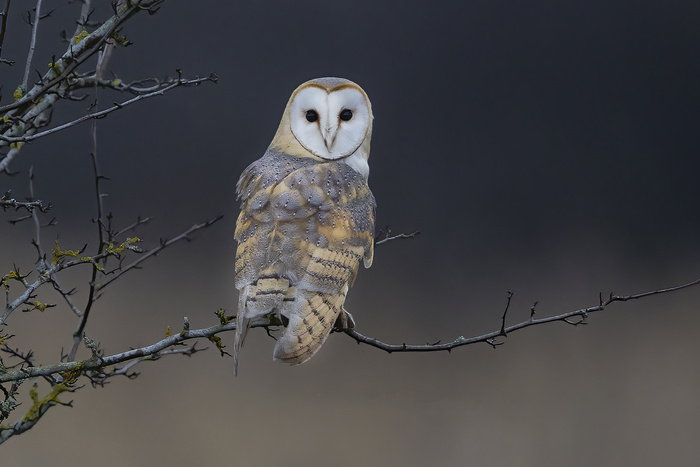
These birds inspire me, they epitomise our countryside and having seen one in the above circumstances gives me a sense of satisfaction. Then after this lovely experience to stroll to a country pub and sit outside with a pint of real ale is my perfect end to a day!
This winter there has been a Barn Owl roosting near Llangors Lake in the Brecon Beacons. I have been watching its habits for a week trying to see if I could form some sort of pattern to its behaviour in order to find a way to photograph this beautiful bird. The recent inclement weather has not been kind to this Owl and it has been battered by wind and rain, as I mentioned in my previous blog post. I have seen the Owl struggle with the elements as it tries to find food to survive the winter. The time of day it appears from its ‘Day Roost’ varies greatly and that in itself is a big challenge because one day you could have a four hour wait and another day you are too late and the bird is out and gone. Add to this the bird’s super eyesight and hearing and unpredictable perching regime and you have some idea of the problems involved in obtaining a photograph.
However, after extensive observation and planning I felt I was ready to try and get close up. Because of the horrendous mud in the area I could not carry my normal portable hide to where I wanted to be, so I rigged up a temporary hide made from some old wood from packaging - I never throw wood away. I fixed a foot of Bamboo bean stick to the bottom of each piece of wood so that the hide frame could be pushed into the soft ground. I then covered the wood with Camo netting, this was very lightweight and portable allowing me to get through the mud.
My first attempt at photographing this bird went much better than I expected, I had set my little 3’ cubed frame up in a gap in a hedge near to where I had seen the Owl perching during my previous observations. I had been waiting for three hours and I was getting quite cold when suddenly I spotted the Owl flying in the distance across the meadows, I hadn’t realised that it was already out from roost! This was a bit worrying because it may have seen me setting up my hide and therefore avoid coming near. I nevertheless decided to sit tight and I could now see it making its way across the meadow towards me. The low sun was shining very brightly from the west directly on where I was hoping the Owl would perch. These moments are really adrenalin fuelled and I could feel my heart beating faster. Even after all these years the thought of 'capturing' a beautiful bird such as this is still very exciting.
I had to use an aperture of around f10 to reduce the exposure because of the bright sunlight. It’s ironic that after all the gloom we have been experiencing over the previous months here I was on the one day I didn’t need bright sun!! I always shoot in RAW format, some people won’t do this because of the processing involved and the media space large RAW files take up. However, RAW allows me to deliberately and consistently under-expose by up to one stop. This, in addition to a small aperture is my main tool to combat excessive light. The images look dark on first inspection but all the data is still there, unlike Jpeg images! and they fully recover in Photoshop. Always better to under rather than over expose!! Another invaluable feature I use is the silent shooting mode on the Canon 7Dii camera. This really dampens down the noise from the shutter but it reduces the frames per second down to about four. Hopefully when a bird is perched frames per second won’t matter but shutter noise will. These Owls are hyper aware of any little unfamiliar noise.
Suddenly across the meadow the Owl flew inexorably towards me, quartering to and fro as it came until it was just a matter of yards away. I thought it was going to fly past when suddenly it veered left and perched right where I had hoped.
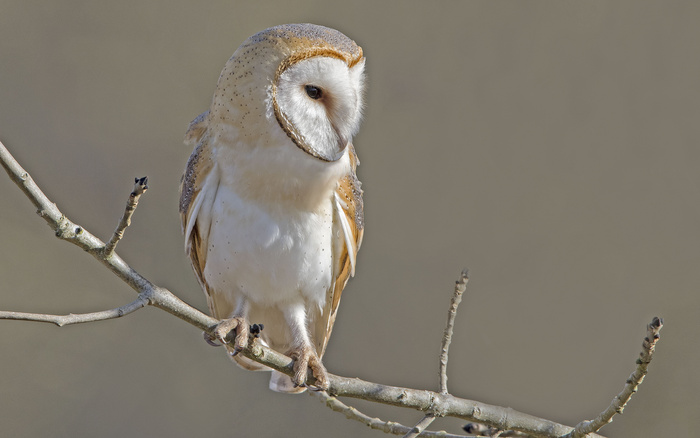
I very carefully moved the lens to focus on it, praying it wouldn’t fly off - these are very tense moments indeed. The shutter fired and the Owl didn’t react at all - the silent shooting mode was working. I was able to take shot after shot in various poses as the Owl seemed oblivious to me. I now believe the Owl didn’t know I was there. This is the perfect scenario for taking a photograph without disturbing the bird. Then it casually flew off and I didn’t see it again that day. I packed up and left feeling very contented indeed!!
When I got home and viewed the images they were beyond all my expectations - the bright sunlight had actually done me a favour highlighting this wonderful bird to a new level. To say I was pleased is an understatement.
The following two days were blighted with wind and rain again, however, after this bad weather had blown through I decided to try once more because the light was different - more diffused. I trudged through the mud to set up in the same place and I had been waiting for three and a half hours when I could hear what I thought was a Water Rail squeaking - but it was quite loud. What happened next totally threw me. As I slowly looked to my left the Owl was sitting about six feet away on a post - just looking at me. I really thought the game was up, but it just stayed there looking around and I began to believe it hadn’t seen me. This was incredible, to be looking at a wild Barn Owl six feet away was unreal! Then again it just casually flew away to the fields behind me. I waited another hour, at the time still not sure whether or not it had seen me. I turned around to look behind me to see what was going on. To my total surprise the Owl was heading towards me. I thought it would fly over me and hopefully perch nearby - but what happened next was just unbelievable - it landed on the same post again!! I was frozen to the spot, afraid to make a sound. I could see the Owl reflected in my camera screen. It appeared totally unaware of me. The Owl looked around the area and then just flew off to hunt the field in front of me.
I was in shock after this encounter but I had to quickly compose myself because I could now see the Owl flying towards me again. What an experience this was turning out to be! Closer and closer it flew, a feeling of déjà vu swept over me - would the Owl land on the perch? This question was quickly answered as yet again it perched perfectly,
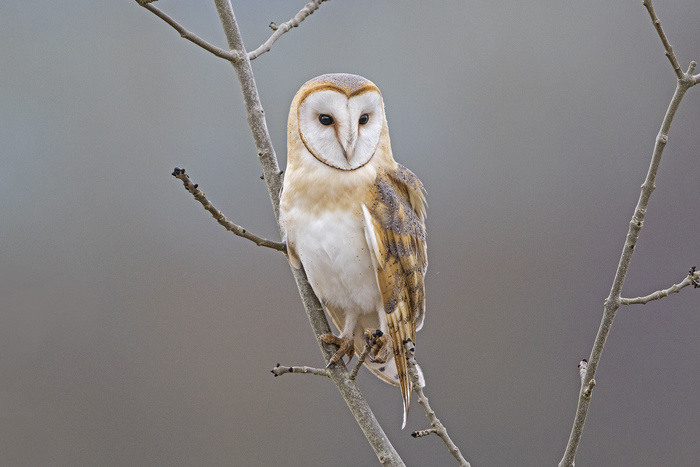
and once again I photographed it in many poses.
These moments should be treasured because they may not happen again in a lifetime. Then after a minute the Owl flew off the perch into the roost and that was the end of another wonderful day. I hardly noticed the mud on my way back, I must have been floating!!
After processing I had another set of lovely images and an experience I will never forget - what a bird!!
For more images please see Latest Images Barn Owl.
These birds inspire me, they epitomise our countryside and having seen one in the above circumstances gives me a sense of satisfaction. Then after this lovely experience to stroll to a country pub and sit outside with a pint of real ale is my perfect end to a day!
This winter there has been a Barn Owl roosting near Llangors Lake in the Brecon Beacons. I have been watching its habits for a week trying to see if I could form some sort of pattern to its behaviour in order to find a way to photograph this beautiful bird. The recent inclement weather has not been kind to this Owl and it has been battered by wind and rain, as I mentioned in my previous blog post. I have seen the Owl struggle with the elements as it tries to find food to survive the winter. The time of day it appears from its ‘Day Roost’ varies greatly and that in itself is a big challenge because one day you could have a four hour wait and another day you are too late and the bird is out and gone. Add to this the bird’s super eyesight and hearing and unpredictable perching regime and you have some idea of the problems involved in obtaining a photograph.
However, after extensive observation and planning I felt I was ready to try and get close up. Because of the horrendous mud in the area I could not carry my normal portable hide to where I wanted to be, so I rigged up a temporary hide made from some old wood from packaging - I never throw wood away. I fixed a foot of Bamboo bean stick to the bottom of each piece of wood so that the hide frame could be pushed into the soft ground. I then covered the wood with Camo netting, this was very lightweight and portable allowing me to get through the mud.
My first attempt at photographing this bird went much better than I expected, I had set my little 3’ cubed frame up in a gap in a hedge near to where I had seen the Owl perching during my previous observations. I had been waiting for three hours and I was getting quite cold when suddenly I spotted the Owl flying in the distance across the meadows, I hadn’t realised that it was already out from roost! This was a bit worrying because it may have seen me setting up my hide and therefore avoid coming near. I nevertheless decided to sit tight and I could now see it making its way across the meadow towards me. The low sun was shining very brightly from the west directly on where I was hoping the Owl would perch. These moments are really adrenalin fuelled and I could feel my heart beating faster. Even after all these years the thought of 'capturing' a beautiful bird such as this is still very exciting.
I had to use an aperture of around f10 to reduce the exposure because of the bright sunlight. It’s ironic that after all the gloom we have been experiencing over the previous months here I was on the one day I didn’t need bright sun!! I always shoot in RAW format, some people won’t do this because of the processing involved and the media space large RAW files take up. However, RAW allows me to deliberately and consistently under-expose by up to one stop. This, in addition to a small aperture is my main tool to combat excessive light. The images look dark on first inspection but all the data is still there, unlike Jpeg images! and they fully recover in Photoshop. Always better to under rather than over expose!! Another invaluable feature I use is the silent shooting mode on the Canon 7Dii camera. This really dampens down the noise from the shutter but it reduces the frames per second down to about four. Hopefully when a bird is perched frames per second won’t matter but shutter noise will. These Owls are hyper aware of any little unfamiliar noise.
Suddenly across the meadow the Owl flew inexorably towards me, quartering to and fro as it came until it was just a matter of yards away. I thought it was going to fly past when suddenly it veered left and perched right where I had hoped.
I very carefully moved the lens to focus on it, praying it wouldn’t fly off - these are very tense moments indeed. The shutter fired and the Owl didn’t react at all - the silent shooting mode was working. I was able to take shot after shot in various poses as the Owl seemed oblivious to me. I now believe the Owl didn’t know I was there. This is the perfect scenario for taking a photograph without disturbing the bird. Then it casually flew off and I didn’t see it again that day. I packed up and left feeling very contented indeed!!
When I got home and viewed the images they were beyond all my expectations - the bright sunlight had actually done me a favour highlighting this wonderful bird to a new level. To say I was pleased is an understatement.
The following two days were blighted with wind and rain again, however, after this bad weather had blown through I decided to try once more because the light was different - more diffused. I trudged through the mud to set up in the same place and I had been waiting for three and a half hours when I could hear what I thought was a Water Rail squeaking - but it was quite loud. What happened next totally threw me. As I slowly looked to my left the Owl was sitting about six feet away on a post - just looking at me. I really thought the game was up, but it just stayed there looking around and I began to believe it hadn’t seen me. This was incredible, to be looking at a wild Barn Owl six feet away was unreal! Then again it just casually flew away to the fields behind me. I waited another hour, at the time still not sure whether or not it had seen me. I turned around to look behind me to see what was going on. To my total surprise the Owl was heading towards me. I thought it would fly over me and hopefully perch nearby - but what happened next was just unbelievable - it landed on the same post again!! I was frozen to the spot, afraid to make a sound. I could see the Owl reflected in my camera screen. It appeared totally unaware of me. The Owl looked around the area and then just flew off to hunt the field in front of me.
I was in shock after this encounter but I had to quickly compose myself because I could now see the Owl flying towards me again. What an experience this was turning out to be! Closer and closer it flew, a feeling of déjà vu swept over me - would the Owl land on the perch? This question was quickly answered as yet again it perched perfectly,
and once again I photographed it in many poses.
These moments should be treasured because they may not happen again in a lifetime. Then after a minute the Owl flew off the perch into the roost and that was the end of another wonderful day. I hardly noticed the mud on my way back, I must have been floating!!
After processing I had another set of lovely images and an experience I will never forget - what a bird!!
For more images please see Latest Images Barn Owl.
Difficult times for a local Barn Owl.
08th February 2016
08th February 2016
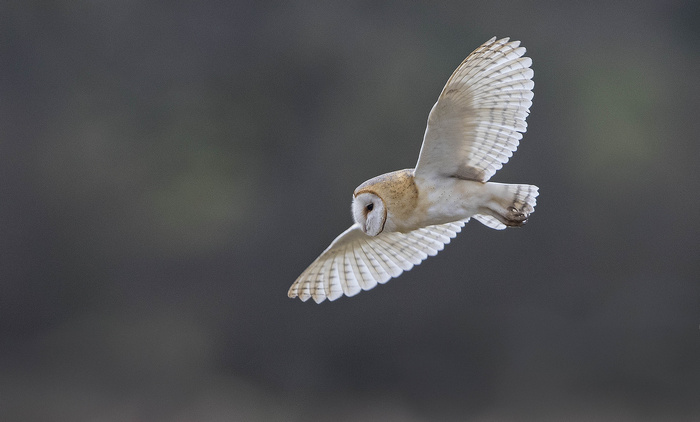
At the moment there is a Barn Owl living nearby, it is roosting and hunting in the surrounding fields near Llangors Lake. However, with this appalling spell of weather forecast to continue life is becoming very difficult indeed for this lovely bird. I have watched it being blown about by strong winds and upset by squally showers making hunting a very difficult task. If these birds get wet it is estimated that their body weight can increase by an incredible seventy percent! This is really bad news because Barn Owls depend on the large surface area of their wings in combination with their small body weight to fly very slowly and still keep on the wing, this is essential for efficient hunting. Increased body weight and wet wings removes both of these fundamental hunting tools and can lead to starvation and ultimately death. In addition to this, strong gusty winds make it very difficult for them to hear their prey rustling in the grass, negating their most useful hunting aid - Hearing!!
Barn Owls lead a very fragile existence at the best of times so these conditions are a veritable nightmare.
I am really hoping this beautiful and iconic bird can get through this winter.
Here it is flying on one of the very few dry evenings.
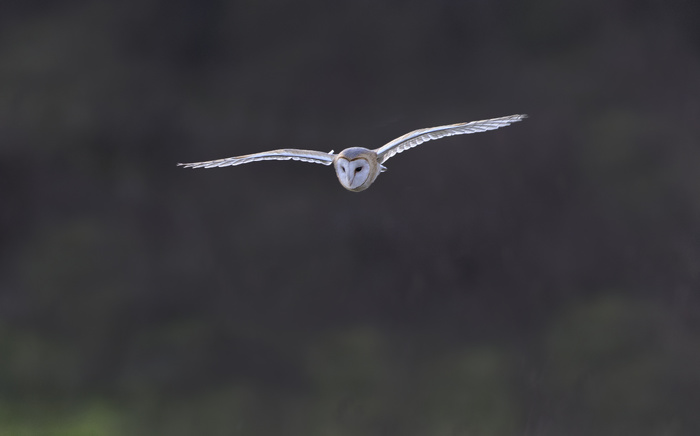
Barn Owls lead a very fragile existence at the best of times so these conditions are a veritable nightmare.
I am really hoping this beautiful and iconic bird can get through this winter.
Here it is flying on one of the very few dry evenings.
Norfolk, Winter 2016.
25th January 2016
25th January 2016
We have just returned from a week on the North Norfolk coast, just had to get away from this horrible spell of weather. The whole week was dry and fairly sunny but cold with daytime temperatures staying between two and four celcius. In order to spend any amount of time outside many layers were necessary, espscially near the sea. However, it was infinitely more preferable to the constant rain and gloom we left behind. We stayed in the little cottage we have been using for the last twenty five years, it is so convenient for all the birding on the Norfolk coast. The nearest coast is just a ten minute walk away and there are also some nice places to eat in the village. Although there is a modern central heating system in the cottage I lit a log fire in the evenings which is very comforting after a cold day outside and there is just something about a nice roaring fire. One thing about Norfolk is that it is never birdless and there is always something to see unlike back home in Wales.
We didn't chase around after birds, those days I'm glad to say are gone! We just went for some nice walks and visited the old haunts along the coast. One night we ate out in a pub called the Gin Trap in the nearby village of Ringstead, we have passed this pub countless times over the years but had never gone inside. We should have tried it before because the top notch food and friendly efficient service was superb, we can highly recommend it.
Our bird total was quite modest but the Highlights were; Pallid Harrier, Rough legged Buzzard and Grey Phalarope.
There were two birds that I particularly wanted to see, Tree Sparrow which is very uncommon in the Brecon Beacons and if possible the very elusive Twite, the latter having been a real bogey bird of ours over the years with very few sightings indeed.
In addition it is always a bonus if I can get to photograph a Barn Owl, no visit to Norfolk is complete without a few 'Barny' shots!!
I managed to photograph Tree Sparrow in a place called Flitcham Abbey Farm and this is a place that is well worth a visit just to see the efforts the management have put in to sustain birdlife. Wintering crops and seed barrels are located all arouind the farm and you can hear birds everywhere you go. It's not difficult to achieve, all that's required is the will to do it, and lessons could be learned from this farm.
There had been a wintering flock of Twite in one of the harbours close to our accommodation but although they were seen daily feeding on Sea Lavender seed heads they were always extremely mobile and flighty. In an effort to see them I went to this harbour every evening for an hour for the whole week in an attempt to pin them down and I was very relieved to finally photograph a flock of twenty five birds. These lovely little birds are on the 'Red List' and that is a real shame, I do hope they can recover their numbers soon.
We saw some Barn Owls at our usual locations, however, one day we were driving along and came across an Owl sitting on a post near a rough pasture. It took off as we slowed down to view it but we could see the potential for a photograph immediately. The following day we returned and were tucked into a hedge hopefully waiting for it to hunt, we had some reasonable views as it quartered the pasture and I'm pleased to say I managed a few half decent photographs.
All in all it was a very enjoyable week away and it helps to break up the gloomy weather back home.
Please see Latest Images Norfolk 2016.
We didn't chase around after birds, those days I'm glad to say are gone! We just went for some nice walks and visited the old haunts along the coast. One night we ate out in a pub called the Gin Trap in the nearby village of Ringstead, we have passed this pub countless times over the years but had never gone inside. We should have tried it before because the top notch food and friendly efficient service was superb, we can highly recommend it.
Our bird total was quite modest but the Highlights were; Pallid Harrier, Rough legged Buzzard and Grey Phalarope.
There were two birds that I particularly wanted to see, Tree Sparrow which is very uncommon in the Brecon Beacons and if possible the very elusive Twite, the latter having been a real bogey bird of ours over the years with very few sightings indeed.
In addition it is always a bonus if I can get to photograph a Barn Owl, no visit to Norfolk is complete without a few 'Barny' shots!!
I managed to photograph Tree Sparrow in a place called Flitcham Abbey Farm and this is a place that is well worth a visit just to see the efforts the management have put in to sustain birdlife. Wintering crops and seed barrels are located all arouind the farm and you can hear birds everywhere you go. It's not difficult to achieve, all that's required is the will to do it, and lessons could be learned from this farm.
There had been a wintering flock of Twite in one of the harbours close to our accommodation but although they were seen daily feeding on Sea Lavender seed heads they were always extremely mobile and flighty. In an effort to see them I went to this harbour every evening for an hour for the whole week in an attempt to pin them down and I was very relieved to finally photograph a flock of twenty five birds. These lovely little birds are on the 'Red List' and that is a real shame, I do hope they can recover their numbers soon.
We saw some Barn Owls at our usual locations, however, one day we were driving along and came across an Owl sitting on a post near a rough pasture. It took off as we slowed down to view it but we could see the potential for a photograph immediately. The following day we returned and were tucked into a hedge hopefully waiting for it to hunt, we had some reasonable views as it quartered the pasture and I'm pleased to say I managed a few half decent photographs.
All in all it was a very enjoyable week away and it helps to break up the gloomy weather back home.
Please see Latest Images Norfolk 2016.
Short Eared Owls.
16th December 2015
16th December 2015
2015 has been a good breeding year for Short Eared Owls. In certain years when the rodent populations in Scandinavia have an 'Explosion' there is consequently a massive increase in food for these lovely birds. Some of these birds migrate to the UK because of the harsh winter conditions in these northern countries and end up typically on coastal marshes where the temperatures can be relatively mild and rodent populations are healthy.
This week I met up with a friend of mine on some marshland on the outskirts of Cardiff, this area has been historically a good wintering area for these Owls.
We set up behind some Camo netting strung up on poles underneath a tree and just waited for the birds to start hunting. The weather, or more particularly the light was grim to say the least, the low grey cloud prevailed all day and the light got progressively worse from the time we were there. We arrived at 13.00 and by 14.30 conditions were so bad we had to abandon our shoot. Quite disappointing because the Owls were showing off and on, however, when you are using iso speeds of over 1000 your images are going to suffer and for me it really isn't worth carrying on.
I managed a few grainy shots but at times like these it's good to just watch these birds hunting for Field Voles in what is quite a challenging environment for them.
Perhaps we will try again if the sun comes out over the Xmas holidays!!
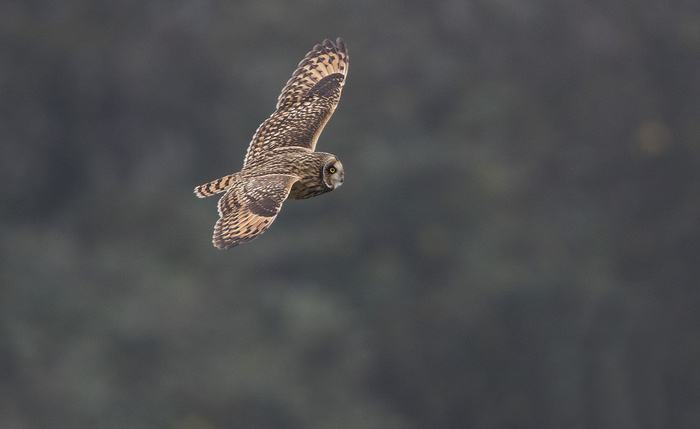
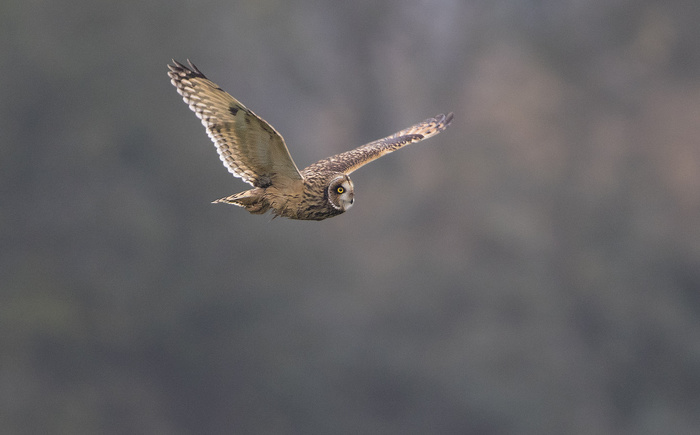
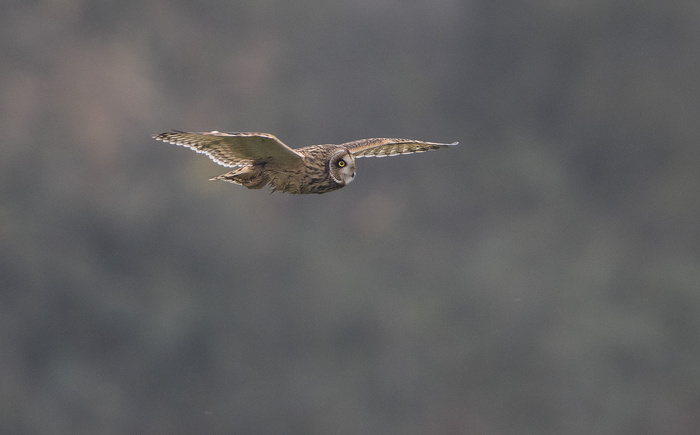
This week I met up with a friend of mine on some marshland on the outskirts of Cardiff, this area has been historically a good wintering area for these Owls.
We set up behind some Camo netting strung up on poles underneath a tree and just waited for the birds to start hunting. The weather, or more particularly the light was grim to say the least, the low grey cloud prevailed all day and the light got progressively worse from the time we were there. We arrived at 13.00 and by 14.30 conditions were so bad we had to abandon our shoot. Quite disappointing because the Owls were showing off and on, however, when you are using iso speeds of over 1000 your images are going to suffer and for me it really isn't worth carrying on.
I managed a few grainy shots but at times like these it's good to just watch these birds hunting for Field Voles in what is quite a challenging environment for them.
Perhaps we will try again if the sun comes out over the Xmas holidays!!
Sunrise and sunset in Mallorca 2.
29th October 2015
29th October 2015
Sunsets, however, are much more difficult to capture than sunrises because you know where the sun rises every day and if you are at the location in plenty of time you can get a similar image fairly regularly. With sunsets although the same geography applies the red skies tend to be a bit more uncertain. Some evenings there are none at all and sometimes the colour is in a different place, it usually depends on where the cloud formations are. I went out one evening about an hour before sunset to try and pin down where the best place was to see the sun setting and after a bit of driving around I could see the best viewpoint was in the garden of a large private villa. I only had to stand just inside the front gates to get the shot and there appeared to be no one around so I waited until the sky became coloured and just went inside and took the shot.
Tramuntana Mountains.
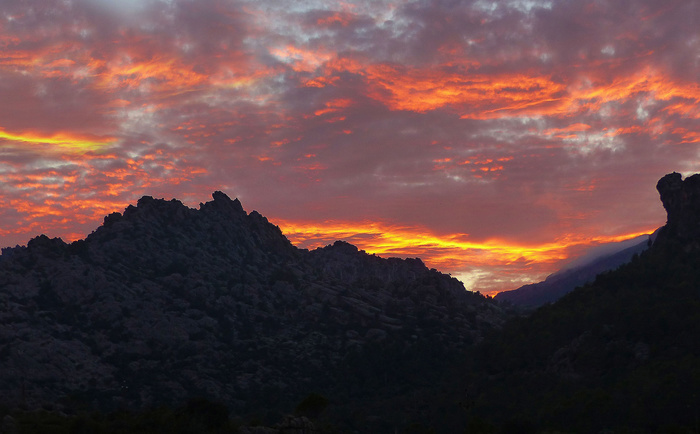
I saw no one and we were on our way without any problem.
These mountains really are spectacular and I'm sure there were many better vantage points known to the locals but this was the most convenient for us.
Tramuntana Mountains.
I saw no one and we were on our way without any problem.
These mountains really are spectacular and I'm sure there were many better vantage points known to the locals but this was the most convenient for us.
Sunrise and sunset in Mallorca 1.
29th October 2015
29th October 2015
This autumn for most mornings and evenings I could see a nice sunrise and sunset from the terrace of our holiday villa in Pollenca, Mallorca. The sunrises looked to be over Port de Pollenca, about seven miles away, so one morning I got up extra early and drove to the sea front there. This place was jam packed with tourists from mid-morning onwards and was not a place I wanted to be, but it was quite pleasant at first light. I waited for the sun to just peep over the horizon and then took a shot straight away.
Port de Pollenca.
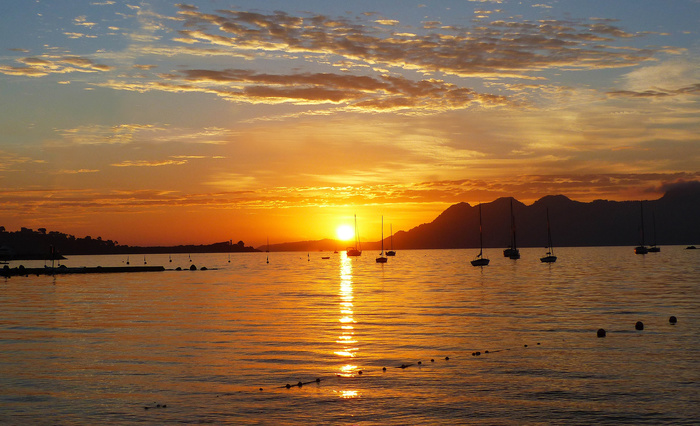
If you wait for the full sunrise the chance is gone because the sun just blows everything. A few people arrived after the sun had risen and took photographs but they would be no good against such a strong sunlight.
Name of the game as always - get up early!!
Port de Pollenca.
If you wait for the full sunrise the chance is gone because the sun just blows everything. A few people arrived after the sun had risen and took photographs but they would be no good against such a strong sunlight.
Name of the game as always - get up early!!
Firecrest, a photographer's nightmare!!
21st October 2015
21st October 2015
Along with Goldcrests, Firecrests are the smallest birds in Europe, their diminutive size combined with their relentless movement is a big problem for a birdwatcher and an even bigger problem for a photographer.
All it takes is one leaf in the wrong place and they are either obscured or even fully hidden. Their feeding habits draw them to thickly wooded areas as they search relentlessly for insects in every nook and cranny. However, there is one way to try and locate them because they have a great liking for Holm Oak trees, unfortunately there aren't many of these trees in this part of the country. Norfolk has many and that is likely where you will find Firecrests, as an alternative you can try Sycamore but wherever they are, they are always difficult to pin down.
On the Balearic island of Mallorca Firecrests are numerous and again they favour Holm Oak, but they are in virtually every wooded area. I have never heard so many calling and singing birds, but still they are terribly difficult to photograph. I even had two birds briefly fighting over territory on the roadside not ten feet from where I stood.
I spent an hour most days trying to pin these birds down, often I could see them moving around the tree canopy and sometimes coming right down to eye level. Because of their small size it would be ideal to use a 1.4 tele-converter on your lens but this makes focussing too slow because of the dim areas where these birds operate. Therefore, it was the bare lens on f4 and an elevated ISO to create a decent shutter speed in order to try and get a reasonably sharp shot.
I managed to isolate birds a few times away from too much dense cover and here is one of the results.
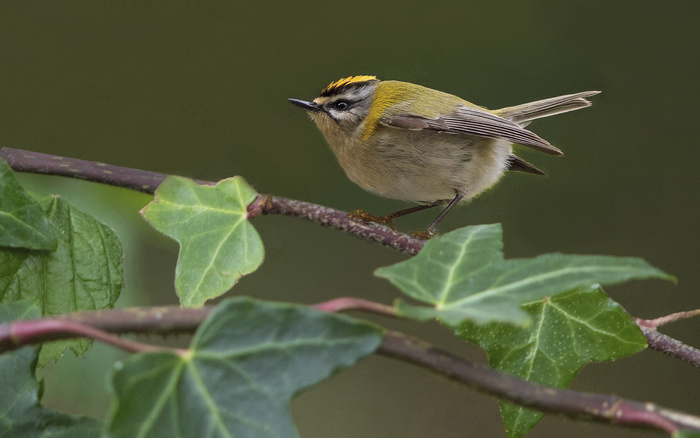
All it takes is one leaf in the wrong place and they are either obscured or even fully hidden. Their feeding habits draw them to thickly wooded areas as they search relentlessly for insects in every nook and cranny. However, there is one way to try and locate them because they have a great liking for Holm Oak trees, unfortunately there aren't many of these trees in this part of the country. Norfolk has many and that is likely where you will find Firecrests, as an alternative you can try Sycamore but wherever they are, they are always difficult to pin down.
On the Balearic island of Mallorca Firecrests are numerous and again they favour Holm Oak, but they are in virtually every wooded area. I have never heard so many calling and singing birds, but still they are terribly difficult to photograph. I even had two birds briefly fighting over territory on the roadside not ten feet from where I stood.
I spent an hour most days trying to pin these birds down, often I could see them moving around the tree canopy and sometimes coming right down to eye level. Because of their small size it would be ideal to use a 1.4 tele-converter on your lens but this makes focussing too slow because of the dim areas where these birds operate. Therefore, it was the bare lens on f4 and an elevated ISO to create a decent shutter speed in order to try and get a reasonably sharp shot.
I managed to isolate birds a few times away from too much dense cover and here is one of the results.
Autumn Colours on the River Usk.
20th October 2015
20th October 2015
I have been out trying to take advantage of the now rapidly developing autumnal colours around this area. The river Usk is remarkably low at the moment and this low level is allowing access to areas of the river that would normally be under water.
Today this situation allowed me to get a better view through the middle arch of Brynich aquaduct looking up-river to Brynich road bridge near Brecon.
Looking through the aquaduct arch the riverside trees were bathed in sunlight and the river was just lazily moving over the exposed river stones. There was a distant Grey Heron on the river bank about a hundred yards away and it wasn't bothered by me in the slightest, this bird is always in this area.
I felt this was an ideal opportunity to use an ND filter to slow the water up and make it look even more tranquil.
Again I set the camera to f10 and ISO 100, a small aperture and the lowest ISO on the camera. I exposed the scene at 1/25 of a second on these settings then did my calculation for the ND 200 filter using my smartphone AP, (mentioned in previousl Blog post on ND filters), and this came out at around 10 seconds. I switched the camera setting to manual and then switched off the auto focus and attached the ND filter, covered the eyepiece with a piece of tape and tried a few exposures around this shutter speed.
This was the result;
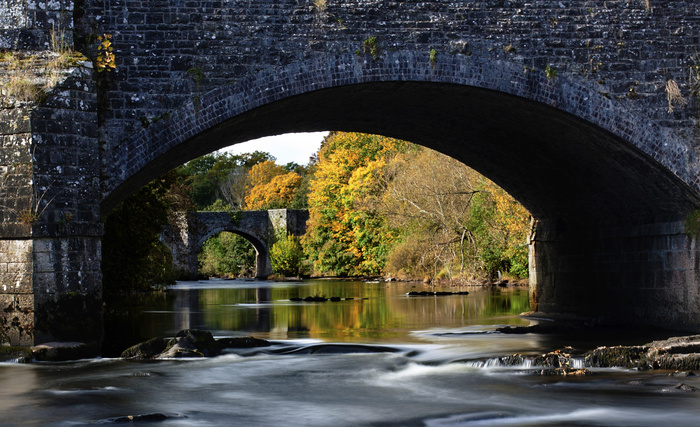
Today this situation allowed me to get a better view through the middle arch of Brynich aquaduct looking up-river to Brynich road bridge near Brecon.
Looking through the aquaduct arch the riverside trees were bathed in sunlight and the river was just lazily moving over the exposed river stones. There was a distant Grey Heron on the river bank about a hundred yards away and it wasn't bothered by me in the slightest, this bird is always in this area.
I felt this was an ideal opportunity to use an ND filter to slow the water up and make it look even more tranquil.
Again I set the camera to f10 and ISO 100, a small aperture and the lowest ISO on the camera. I exposed the scene at 1/25 of a second on these settings then did my calculation for the ND 200 filter using my smartphone AP, (mentioned in previousl Blog post on ND filters), and this came out at around 10 seconds. I switched the camera setting to manual and then switched off the auto focus and attached the ND filter, covered the eyepiece with a piece of tape and tried a few exposures around this shutter speed.
This was the result;
Canon 7D Mkii and 600 f4 Mkii V Eleonoras Falcons.
19th October 2015
19th October 2015
We have just returned from an autumn break on the Balearic Island of Mallorca. There was not a lot of birdlife there but that was not the point, it was just to spend some time in different surroundings and enjoy some warm weather. We did some touring around by day in our hire car and saw some spectacular scenery. Then most evenings we just chilled out along the seafronts and harbours relaxing with a cold beer…or two!
However, one day we drove up to a place called ‘Cap De Formentor’ a bit of a tourist hotspot and to be avoided at all costs after about 11.00am any day. Most tourists head for a lighthouse where the road ends but about two miles before that there is a cliff where Eleonora’s Falcons breed and as the sun comes up it stirs the Dragonflies into action and these are the basic prey of these falcons. From a very small pull-in off the road we could see them come swooping across the cliffs at great speed, a very impressive sight. At one stage they came past reasonably closely and I thought there might be a chance of a flight shot at some time in the coming days. The following morning broke with a fabulous sunrise and we decided to try our luck with the Falcons, there was no time to waste because we didn’t know if they were going to hang-around.
As I mentioned in my review of the Canon ef600 f4 Mk ii lens, because of its dramatic weight reduction it can now be carried in your hand baggage on a plane. This is perfect for me because it doesn’t affect my hold luggage on non-birding trips such as this.
We were at the small pull-in very early and had the place to ourselves, after about half an hour the birds began their daily flight routine, swooping and diving across the cliffs and sea in their hunt for Dragonflies. I quickly assembled my gear and I just had the bare lens at f4 and the IS setting on mode 3, (please see review). I was using my Canon 7D Mk ii and now was the ultimate test for the auto focus system on the camera and the IS system on the lens.
I had been watching these birds hunt and they were coming across the cliffs and assessing where their prey was and then they stooped down below the cliffs and then swept up at super speed and snatched the unsuspecting prey before it had time to react. This meant I had only a few seconds to track them and then focus before they were too distant. This was not an easy task but slowly and surely as I got into the rhythm, the auto focus of the 7D Mk ii was snapping onto them and because the lens was on mode 3 it didn’t stabilize until the camera had focussed and the shutter was released.
I was very impressed with how both the lens and camera performed in this difficult situation.
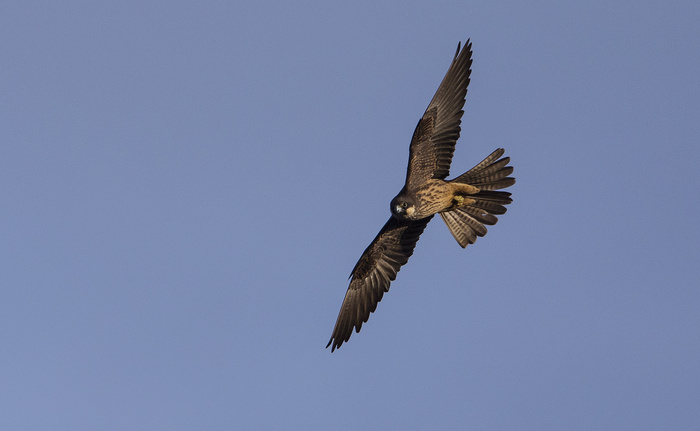
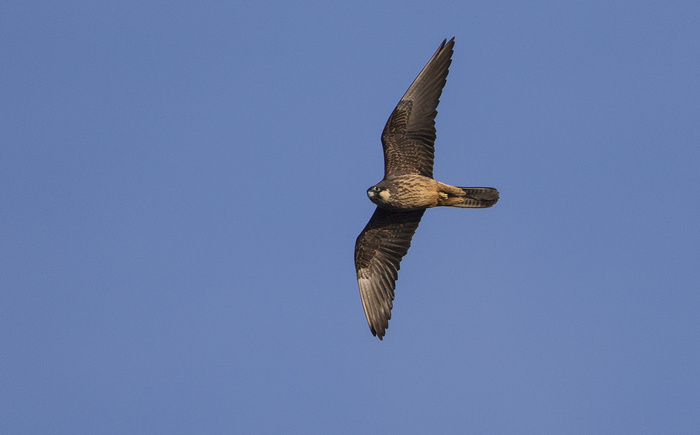
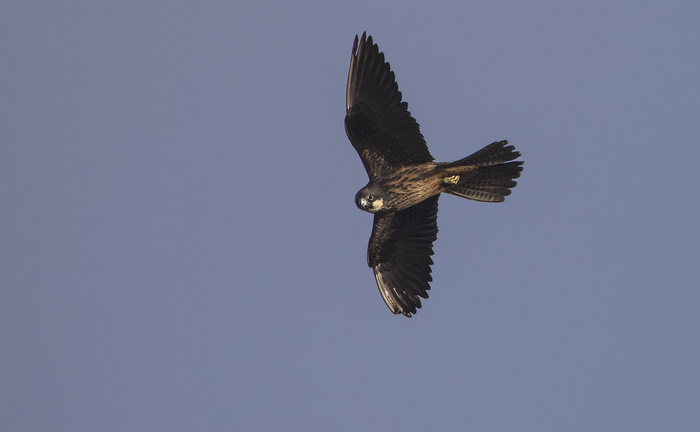
However, one day we drove up to a place called ‘Cap De Formentor’ a bit of a tourist hotspot and to be avoided at all costs after about 11.00am any day. Most tourists head for a lighthouse where the road ends but about two miles before that there is a cliff where Eleonora’s Falcons breed and as the sun comes up it stirs the Dragonflies into action and these are the basic prey of these falcons. From a very small pull-in off the road we could see them come swooping across the cliffs at great speed, a very impressive sight. At one stage they came past reasonably closely and I thought there might be a chance of a flight shot at some time in the coming days. The following morning broke with a fabulous sunrise and we decided to try our luck with the Falcons, there was no time to waste because we didn’t know if they were going to hang-around.
As I mentioned in my review of the Canon ef600 f4 Mk ii lens, because of its dramatic weight reduction it can now be carried in your hand baggage on a plane. This is perfect for me because it doesn’t affect my hold luggage on non-birding trips such as this.
We were at the small pull-in very early and had the place to ourselves, after about half an hour the birds began their daily flight routine, swooping and diving across the cliffs and sea in their hunt for Dragonflies. I quickly assembled my gear and I just had the bare lens at f4 and the IS setting on mode 3, (please see review). I was using my Canon 7D Mk ii and now was the ultimate test for the auto focus system on the camera and the IS system on the lens.
I had been watching these birds hunt and they were coming across the cliffs and assessing where their prey was and then they stooped down below the cliffs and then swept up at super speed and snatched the unsuspecting prey before it had time to react. This meant I had only a few seconds to track them and then focus before they were too distant. This was not an easy task but slowly and surely as I got into the rhythm, the auto focus of the 7D Mk ii was snapping onto them and because the lens was on mode 3 it didn’t stabilize until the camera had focussed and the shutter was released.
I was very impressed with how both the lens and camera performed in this difficult situation.
Harvest Moon.
28th September 2015
28th September 2015
Last night the moonlight was really intense, the fields were lit up as though it was still daylight. Bad news for the local rodents as the Tawny Owls were out in force. They were hooting all around because this time of year the young Owls are being forced by their parents to find their own territories.
Down at Llangors Lake a Harvest Moon was glowing large in the sky, a so called 'Super Moon'!
The lake and surrounding sky were bathed in a silver moonlight, fabulous!
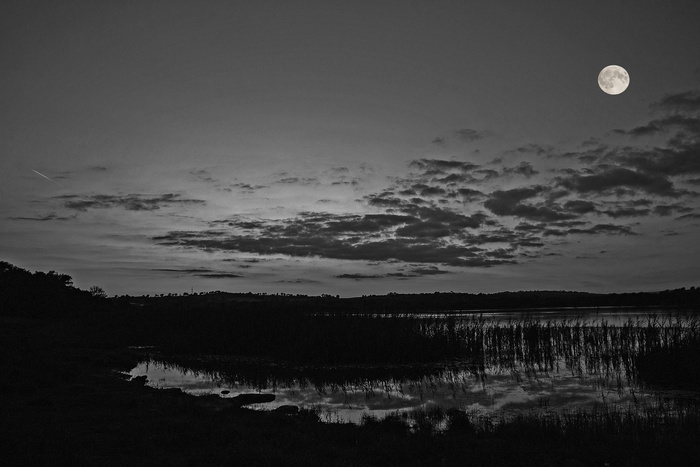
Canon 1D Mk ii.
Canon EF 17-40 f4 Lens.
Hoya ND256 Filter.
Down at Llangors Lake a Harvest Moon was glowing large in the sky, a so called 'Super Moon'!
The lake and surrounding sky were bathed in a silver moonlight, fabulous!
Canon 1D Mk ii.
Canon EF 17-40 f4 Lens.
Hoya ND256 Filter.
Autumn Sunsets.
28th September 2015
28th September 2015
In the Brecon Beacons as the year draws on into Autumn the sunsets start to become more vibrant, and although it is a very short window of opportunity it is well worth getting out to try and capture these beautiful evenings.
Near our cottage is a mountain called Allt yr Esgair, translated into english as The Wooded Ridge, this is a well known landmark and also the place where the sun sets in this part of the Beacons. I was out at 18.30 this evening waiting in a field for the sunset and at 19.00 it started, first a slight pink glow then orange and then what I had been hoping for, at 19.15, an intense flame red sunset. What a sight it is when this happens, it gives me a real thrill to see the sky painted as though it was an artist's canvas.
Then as quickly as it appeared it was gone, a fleeting glimpse of nature at it's best!
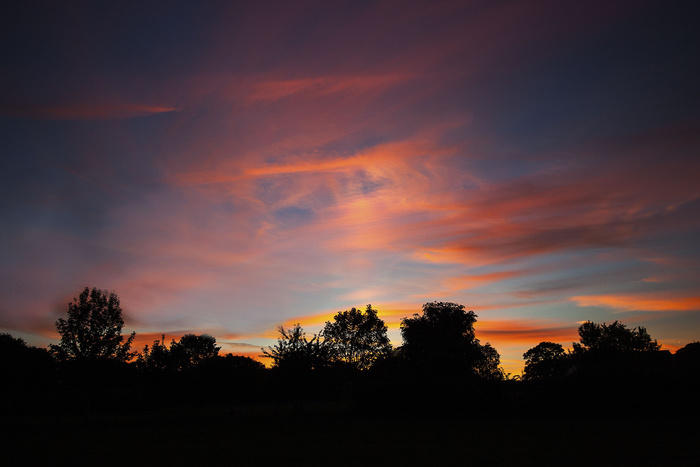
Canon 1D Mk ii.
Canon EF 17-40 f4 Lens.
Hoya circular polarizing filter.
Near our cottage is a mountain called Allt yr Esgair, translated into english as The Wooded Ridge, this is a well known landmark and also the place where the sun sets in this part of the Beacons. I was out at 18.30 this evening waiting in a field for the sunset and at 19.00 it started, first a slight pink glow then orange and then what I had been hoping for, at 19.15, an intense flame red sunset. What a sight it is when this happens, it gives me a real thrill to see the sky painted as though it was an artist's canvas.
Then as quickly as it appeared it was gone, a fleeting glimpse of nature at it's best!
Canon 1D Mk ii.
Canon EF 17-40 f4 Lens.
Hoya circular polarizing filter.
Black Shuck, a Norfolk legend.
21st September 2015
21st September 2015
For hundreds of years legend has told of a huge black dog that haunts North Norfolk’s quiet lanes and marshes, terrorising unwary nocturnal travellers. This Norfolk legend has become known as ‘Black Shuck’ the devil's dog. The word ‘Shuck’ probably derived from the old Anglo Saxon word ‘Scucca’ meaning devil or demon.
Those unlucky enough to see him will either have bad luck or even worse befall them or their family members. Shuck usually appears as a huge black hound with glowing red eyes and he has been reported to follow and sometimes appear to those who are foolish enough to be abroad at night on these lonely lanes and marsh tracks.
I have read about this Norfolk legend for many years and I must admit to being a devotee of a good well written ‘Ghost Story’, stories written by such luminaries as M.R.James for example.
I am certainly not a fan of this modern rubbish, full of blood, guts and screaming.
Recently I came across a novel written about this legend while I was browsing wildlife sites in North Norfolk. The book is written by Piers Warren a Norfolk wildlife film maker who obviously loves that part of the country.
If you like a good story of this genre, with the natural world as a backdrop, then this is definitely worth a read. If you are familiar with the North Norfolk coast around Blakeney, Cley and Salthouse then that is a bonus, but either way this book can become a real page turner. As the nights grow longer and Autumn tightens its grip, imagine yourself on the windswept North Norfolk coast, those 300 pages will not take long to read!
It is without doubt worth the £7.99 retail price.
It can be ordered on-line from www.black-shuck.co.uk.
Delivery is quick and reliable.
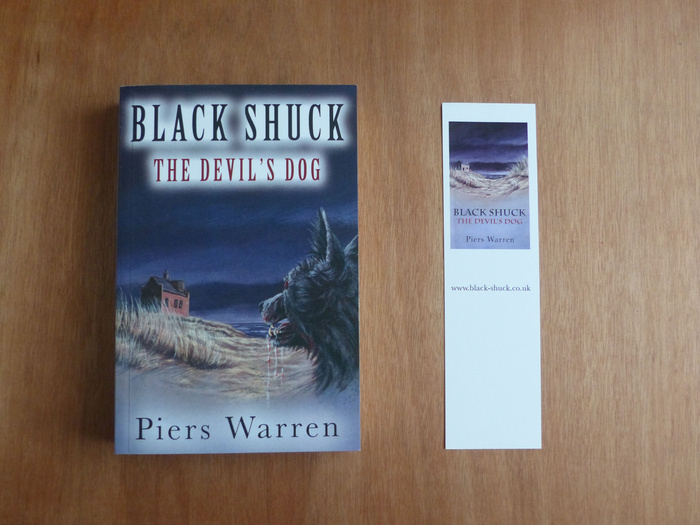
Those unlucky enough to see him will either have bad luck or even worse befall them or their family members. Shuck usually appears as a huge black hound with glowing red eyes and he has been reported to follow and sometimes appear to those who are foolish enough to be abroad at night on these lonely lanes and marsh tracks.
I have read about this Norfolk legend for many years and I must admit to being a devotee of a good well written ‘Ghost Story’, stories written by such luminaries as M.R.James for example.
I am certainly not a fan of this modern rubbish, full of blood, guts and screaming.
Recently I came across a novel written about this legend while I was browsing wildlife sites in North Norfolk. The book is written by Piers Warren a Norfolk wildlife film maker who obviously loves that part of the country.
If you like a good story of this genre, with the natural world as a backdrop, then this is definitely worth a read. If you are familiar with the North Norfolk coast around Blakeney, Cley and Salthouse then that is a bonus, but either way this book can become a real page turner. As the nights grow longer and Autumn tightens its grip, imagine yourself on the windswept North Norfolk coast, those 300 pages will not take long to read!
It is without doubt worth the £7.99 retail price.
It can be ordered on-line from www.black-shuck.co.uk.
Delivery is quick and reliable.
Neutral Density filters.
05th August 2015
05th August 2015
Things are very quiet at the moment, a sort of ornithological hiatus is presiding. In addition to this the weather has been appalling throughout July and into early August, long periods of gloom compounded with drizzle and gusty winds have been the norm. To prevent going into a state of torpor I have been doing a lot of work in my garden during this period and now that I have completed all this work, I thought I'd get out for a walk.
I don't use many filters when shooting landscapes, usually just a circular polarizer, but I thought I'd have some fun with an ND filter today, just for the hell of it.
These filters basically allow the user to shoot long exposures without 'Blowing' the image and without these filters images tend to burn into a white-out when exposed for long periods. Basically these filters act like a strong pair of sunglasses over your lens.
They come in various strengths from lightly tinted right up to what are nicknamed the 'Big Stoppers'. These high density filters stop about 10 f stops of light and you cannot see through them at all. However if you want to just give your images some nice effects without going right over the top, a filter of about ND256 is fine. This stops around 7 stops of light and will smooth out water and accentuate cloud movement. These effects can give some drama and movement to a static image. Most importantly these filters do not affect the colour or balance of your images.
I have always used Hoya filters because I find they are well made and reasonably priced.
A note of warning;
As I have mentioned previously, cheap filters are not cheap really, they are just nasty and in this instance they will give a horrible colour cast to your images and possibly cause vignetting.
I set my gear up today on a shallow limestone pavement with water rushing over it to a depth of about a foot. I walked across onto a slightly raised dry area above the water. From here I could put my rucksack down safely and readily access my kit, this is very important to avoid accidents.
In this area I could hide quite effectively behind some bushes once I was set-up and this has previously allowed me to observe Kingfishers, Dippers, Grey Wagtails and Grey Herons.
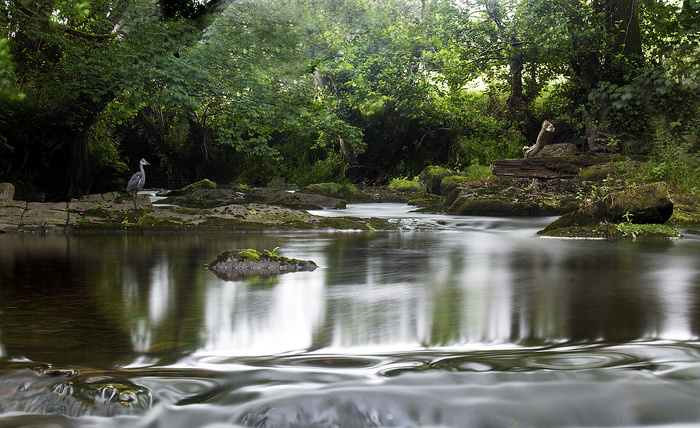
To set up the shot below;
Use the lowest ISO setting available on your camera and also use a small aperture, typically ISO 100 and f11.
i. Compose and focus as normal, use a remote shutter release.
ii. Note your settings, 'shutter speed'.
iii. Switch off the auto focus.
iv. Attach the ND filter.
v. Cover the camera eyepiece with a piece of black tape.
vi. Switch to manual exposure control.
There are some very useful apps around today and you can download from 'Google Play' an app which will accurately calculate your new shutter speed that you must use with the ND filter attached.
To use this 'FREE' app on your smartphone just key in your original shutter speed, prior to the ND filter, key in your ND filter strength eg ND256 and press calculate and your new shutter speed is provided. No pieces of paper with charts on and more importantly no trying to guess from memory.
vii. Dial in your new shutter speed.
vii. Take your shot remotely and ensure you dont move the camera.
Depending on what you want to achieve, check your image and try increasing or decreasing your shutter speed.
NB. If your revised shutter speed is above 30secs you must use the 'Bulb' mode on your camera, this means that when you press the remote shutter release and lock it, the shutter will remain open until it is released!!
You have to manually time this exposure.
It helps if you have a static Grey Heron in the shot!!
I don't use many filters when shooting landscapes, usually just a circular polarizer, but I thought I'd have some fun with an ND filter today, just for the hell of it.
These filters basically allow the user to shoot long exposures without 'Blowing' the image and without these filters images tend to burn into a white-out when exposed for long periods. Basically these filters act like a strong pair of sunglasses over your lens.
They come in various strengths from lightly tinted right up to what are nicknamed the 'Big Stoppers'. These high density filters stop about 10 f stops of light and you cannot see through them at all. However if you want to just give your images some nice effects without going right over the top, a filter of about ND256 is fine. This stops around 7 stops of light and will smooth out water and accentuate cloud movement. These effects can give some drama and movement to a static image. Most importantly these filters do not affect the colour or balance of your images.
I have always used Hoya filters because I find they are well made and reasonably priced.
A note of warning;
As I have mentioned previously, cheap filters are not cheap really, they are just nasty and in this instance they will give a horrible colour cast to your images and possibly cause vignetting.
I set my gear up today on a shallow limestone pavement with water rushing over it to a depth of about a foot. I walked across onto a slightly raised dry area above the water. From here I could put my rucksack down safely and readily access my kit, this is very important to avoid accidents.
In this area I could hide quite effectively behind some bushes once I was set-up and this has previously allowed me to observe Kingfishers, Dippers, Grey Wagtails and Grey Herons.
To set up the shot below;
Use the lowest ISO setting available on your camera and also use a small aperture, typically ISO 100 and f11.
i. Compose and focus as normal, use a remote shutter release.
ii. Note your settings, 'shutter speed'.
iii. Switch off the auto focus.
iv. Attach the ND filter.
v. Cover the camera eyepiece with a piece of black tape.
vi. Switch to manual exposure control.
There are some very useful apps around today and you can download from 'Google Play' an app which will accurately calculate your new shutter speed that you must use with the ND filter attached.
To use this 'FREE' app on your smartphone just key in your original shutter speed, prior to the ND filter, key in your ND filter strength eg ND256 and press calculate and your new shutter speed is provided. No pieces of paper with charts on and more importantly no trying to guess from memory.
vii. Dial in your new shutter speed.
vii. Take your shot remotely and ensure you dont move the camera.
Depending on what you want to achieve, check your image and try increasing or decreasing your shutter speed.
NB. If your revised shutter speed is above 30secs you must use the 'Bulb' mode on your camera, this means that when you press the remote shutter release and lock it, the shutter will remain open until it is released!!
You have to manually time this exposure.
It helps if you have a static Grey Heron in the shot!!
Kingfishers on the River Usk, Episode Three.
03rd July 2015
03rd July 2015
What a difference this morning;
I was out again at 05.00am but this time I had to wear wellingtons to get to my Kingfisher site. The other morning the grass was bone dry, this morning it was absolutely soaking and in addition the ferns seemed to be a foot higher today and were also sodden, the result of a heavy overnight mist. I got quite wet getting down to the river but I was under cover quickly and soon dried out. I had to wait for the light to improve, however, I was sure the gloom would lift as soon as the sun got up. Around 08.00am the Kingfishers started flying onto my perches, I shot both the male and female birds quite quickly, although disappointingly the light was still not the best. After some time, things began to slowly improve and I now had a juvenile bird on the perch, three different birds, quite nice. Unfortunately when the sun came up over the canopy things started to get more challenging on the lighting front. A harsh sunlight was now hitting my perch making correct exposure very difficult indeed. My only solution was to drop the ISO setting down and also underexpose by a stop and two thirds, using the camera exposure compensation, thereby taking some of the harshness away from the birds when they landed on the perch. As I always mention I try to get an uncluttered background if possible and I could achieve this because I set up the perches. I previously went into the river and removed all the stones that were just breaking the surface and in-line with my shooting area. I also cut down some straggly hanging branches that were over twenty yards away. These may seem insignificant but they will come back to haunt you because the stones show up like snowballs in the background of your images and the branches are like spaghetti, horrible!
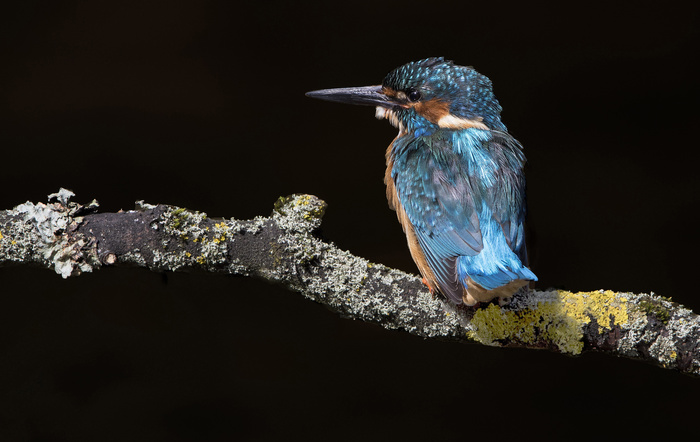
The result of this underexposure was the brown background of the woods now becoming black and the Kingfishers shining like beacons against it, very pleasing indeed!
For Info;
Camera settings;
ISO 200
AV Mode
Aperture f5.6
Focal Length 840mm
Under exposed by one and two third stops.
Shutter speed 1/640 sec.
If you have the opportunity to achieve this it is well worth the effort. I took many shots at various lights and it turned out to be a very productive morning.
Please see Favourites, Kingfishers.
I was out again at 05.00am but this time I had to wear wellingtons to get to my Kingfisher site. The other morning the grass was bone dry, this morning it was absolutely soaking and in addition the ferns seemed to be a foot higher today and were also sodden, the result of a heavy overnight mist. I got quite wet getting down to the river but I was under cover quickly and soon dried out. I had to wait for the light to improve, however, I was sure the gloom would lift as soon as the sun got up. Around 08.00am the Kingfishers started flying onto my perches, I shot both the male and female birds quite quickly, although disappointingly the light was still not the best. After some time, things began to slowly improve and I now had a juvenile bird on the perch, three different birds, quite nice. Unfortunately when the sun came up over the canopy things started to get more challenging on the lighting front. A harsh sunlight was now hitting my perch making correct exposure very difficult indeed. My only solution was to drop the ISO setting down and also underexpose by a stop and two thirds, using the camera exposure compensation, thereby taking some of the harshness away from the birds when they landed on the perch. As I always mention I try to get an uncluttered background if possible and I could achieve this because I set up the perches. I previously went into the river and removed all the stones that were just breaking the surface and in-line with my shooting area. I also cut down some straggly hanging branches that were over twenty yards away. These may seem insignificant but they will come back to haunt you because the stones show up like snowballs in the background of your images and the branches are like spaghetti, horrible!
The result of this underexposure was the brown background of the woods now becoming black and the Kingfishers shining like beacons against it, very pleasing indeed!
For Info;
Camera settings;
ISO 200
AV Mode
Aperture f5.6
Focal Length 840mm
Under exposed by one and two third stops.
Shutter speed 1/640 sec.
If you have the opportunity to achieve this it is well worth the effort. I took many shots at various lights and it turned out to be a very productive morning.
Please see Favourites, Kingfishers.