News
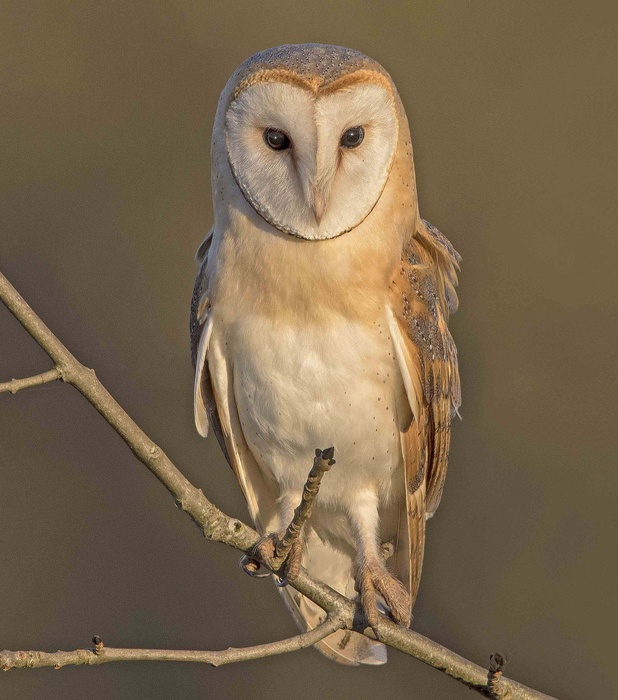
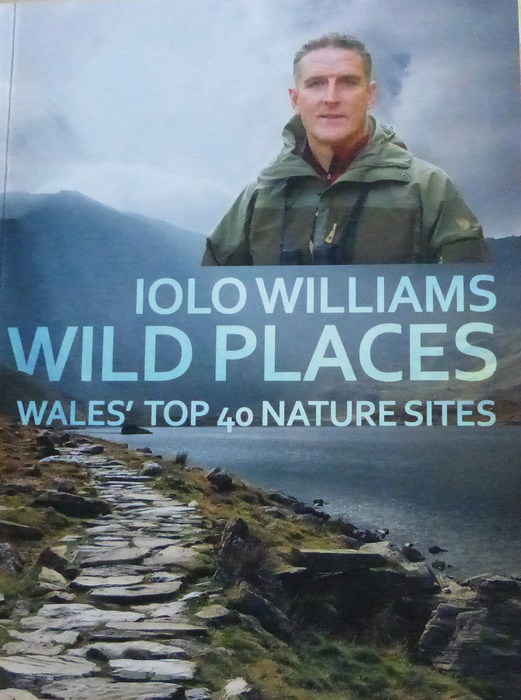
Barn Owl in Iolo Williams's Wild Places.
16th December 2016
16th December 2016
Just viewed Iolo Williams's new book 'Wild Places' while in Waterstones bookshop in Abergavenny and I was pleased to see a full page image of the female Barn Owl I had a few days with last winter. I haven't seen her this winter yet, I hope she's OK now that she's famous. There are a number of my images in the book which is good, highlighting the wildlife of this and other areas.
Partridges in my garden.
16th December 2016
16th December 2016
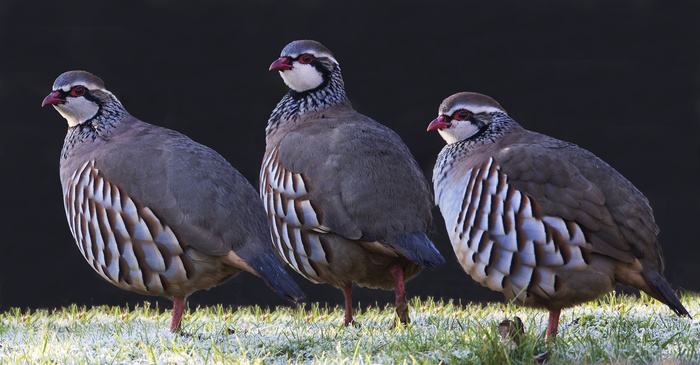
Red Legged Partridges are quite rare in this area, unlike Norfolk where they can be seen all along the roadsides and fields. However, six of these lovely birds have been coming to our garden in the last few weeks. I waited in hiding for them one morning and as they were feeding in a quiet area I managed to photograph them.
They are so comical!
They are so comical!
A Winter Shorelark.
21st November 2016
21st November 2016
Shorelarks are a winter visitor to the UK from the frozen north, typically Scandinavia. It is here the Shorelark breeds, high above the tree-line on exposed stoney ground. This very attractive bird usually appears in small numbers on the east coast of the UK in winter, typically Norfolk. They usually frequent coastal salt marshes feeding mainly on insects and seeds roosting near their feeding areas on the ground.
Their head tufts, small feathers, are somewhat stunted in winter but are more prominent in summer during the breeding season. They have a very distinctive head pattern, a contrasting creamy yellow and black and a well-defined black breast band making them pretty much unmistakable when seen well.
Over the last year two birds have turned up on isolated and quite high hills in this area. In March 2016 one appeared in atrocious weather above Llyn Y Fan Fawr in the Brecon Beacons, and now a bird on Garway Hill in Herefordshire. Both very rare or possibly ‘Firsts’ for the respective counties of Breconshire and Herefordshire.
Yesterday I met up with two birding friends and we decided to try and see the Garway bird. The Beacons bird had been too difficult to photograph because of the atrocious weather and a short stay of one day.
We drove up to the bottom of this quite isolated hill in a four/four jeep and made the trek up to a small pond where the bird had been seen. After a steep walk up to the pond we could see the bird feeding continuously around the muddy shoreline - living up to its name! Thankfully we were all able to get some shots despite the really bad light on a very grey and overcast day and in addition after about an hour in the freezing cold it started to rain heavily so we packed up and quickly descended the hill for a welcome cup of coffee.
It was well worth the trip to see this lovely little bird which is very rarely seen away from coastal marshes in the UK in winter.
Please see Latest Images, Shorelark.
Winter Bramblings.
09th November 2016
09th November 2016
This run of cold northerly winds have brought a lot of birds into the UK this autumn, nothing much in terms of rarities in the Brecon Beacons but that is not unusual. However, there has been a good wintering Thrush movement, Fieldfares, Redwings and Blackbirds but sadly the Ring Ouzel numbers were disappointing. I was hopeful of getting a few shots because of the super-abundance of Rowan berries in the area, but sadly it was not to be, I only saw four distant males.
Over the last few years there have not been many reports of Bramblings in the Beacons, probably because of the mild wet winters in northern Europe. These birds used to come in numbers and quite large flocks could be seen in places, sometimes in the hundreds. This year it has been colder and drier and I have been hoping for a few of these lovely Finches. They have a great affinity for Beech seeds and they can usually be seen feeding on the Beech ‘mast’ that has dropped to the floor, usually in the company of Chaffinches. Beech seeds are triangular and three dimensional and are quite large so the birds have to move them around in their beaks, shaving bits off until they are able to swallow manageable pieces.
Following up a report of a few birds in a local woodland nearby I was out walking early the next morning to investigate and I could see a flock of about thirty Finches feeding on the forest track and indeed there were about eight Bramblings amongst a majority of Chaffinches. They flew up into the trees as soon as I got anywhere near, the same old story, the only answer was to try from the car. Bramblings have a very conspicuous white rump patch and this is highly visible in flight. Therefore, if a large mixed flock of Finches fly up off the floor this is a good way of identifying them, they also have a wheezy, squeaky call that is quite distinctive.
I always carry a tub of seed in the boot and I sprinkled plenty of Peanuts and Sunflower seeds in amongst the Beech mast. They wouldn’t necessarily prefer these but they would be more conspicuous in amongst the leaf litter. I walked back down the track to the car and got my kit set up on the passenger seat and covered the window with ‘Camo’ netting. I waited ten minutes and then very slowly drove up the track and I could see the birds back down in the leaf litter. I crawled closer and just pulled off the track to the right so the passenger window was facing the area, about thirty feet from where they were feeding. They still flew up into the trees, they were still spooky, but if there is good feeding in an area they will return if you are quiet and still. I pushed my lens through a hole in the netting, resting it on a large bean bag and after about ten minutes the Chaffinches started to drift back down, then the Bramblings descended after a while and there now appeared to be about ten of these birds. If you are watching Finches feeding on the ground in a forest there is a kind of pecking order in reverse and it depends on shyness, first the Chaffinch comes down then the Brambling appears and then lastly the most shy of them all, the Hawfinch. Sadly there are very few Hawfinches seen in this area!
They all started to feed with confidence and the Bramblings were happily walking around and feeding about twenty feet from the car, it just goes to show what will happen if you are patient and quiet and this goes for the elusive Hawfinch too. After about five minutes, however, a Buzzard drifted over and spooked them back up into the trees. I could then see a few walkers appear in the distance so I called it a day because there would have been too much disturbance. The walkers wouldn’t even have noticed the Bramblings but they would spoil any further chance of a photograph.
Please see, Latest Images, Bramblings.
An autumn walk on the River Usk.
03rd November 2016
03rd November 2016
Yesterday morning dawned with clear blue skies, a welcome break from the anti-cyclonic grey skies of the past week. I had an early breakfast and went for a walk on the River Usk near to where I live. The air was clear and still and bright blue skies prevailed, a perfect morning for a walk. I just carried a photographic rucksack with a lightweight tripod and head attached, my walk stool and a thermos. This walk-stool is an invaluable piece of equipment as often there is nowhere dry to sit down this time of year. In addition it allows me to lower a tripod right down and still be able to look through the camera viewfinder. Because of the low rainfall this autumn, when I got down onto the river bank I could see the river was very tranquil. This is a big bonus for the Kingfishers and Dippers who rely on good river conditions to survive. I sat underneath my favourite tree, an old Beech, which has stood guard like a sentinel for a couple of hundred years. What tales this old tree could tell - floods, droughts, wars, poachers, lovers, it has seen it all.
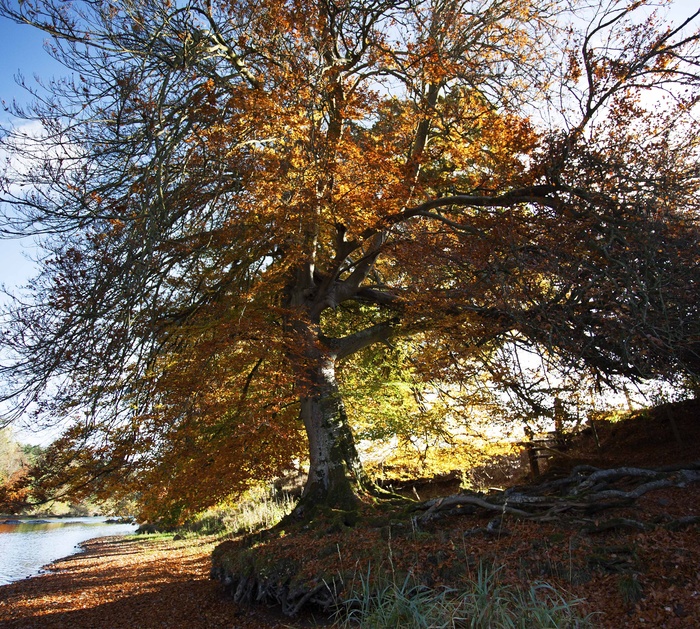
Some of its roots snake up the river bank in search of water, others are flooded by the river for months on end. I love to sit underneath its branches and watch river-life go by, while sipping a coffee from my small flask. I sometimes see the electric blue flash of Kingfishers as they fly up and down. Hunting Dippers perching on the exposed rocks nearby and Grey Wagtails rising up to pluck passing insects from the air. I spent an hour there and took a shot of the old aqueduct that carries the boats of the Monmouthshire and Brecon canal over the Usk.
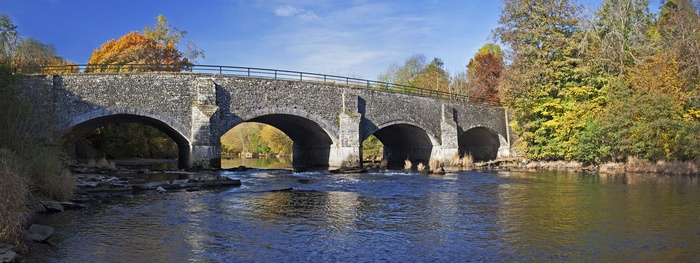
Finally I dragged myself away and carried on with my walk, looking for a place to stop and watch the river. I came across a small clearing near some rocks
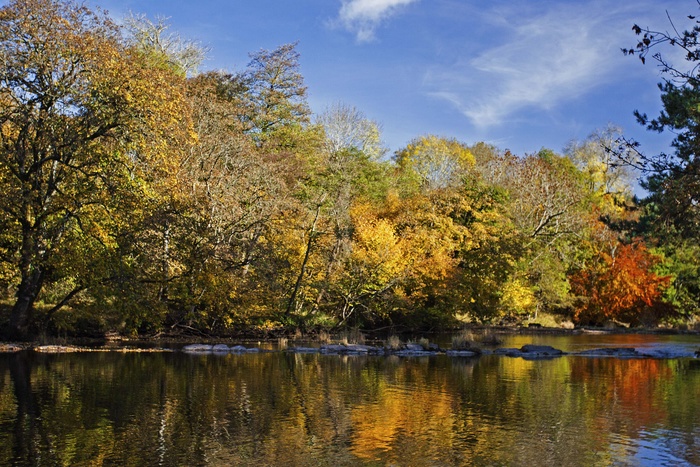
and I could see three Dippers chasing each other round and round until they all perched together on the same rocks. They then all threw their heads back and began a singing competition, obviously some sort of territorial posturing. I love little wildlife cameos like this, it makes a walk complete for me and to be in beautiful surroundings to see it is perfect.
Sometimes the river allows you to get an image in these calm conditions that you can't get otherwise, you have to take your chance when she offers it.
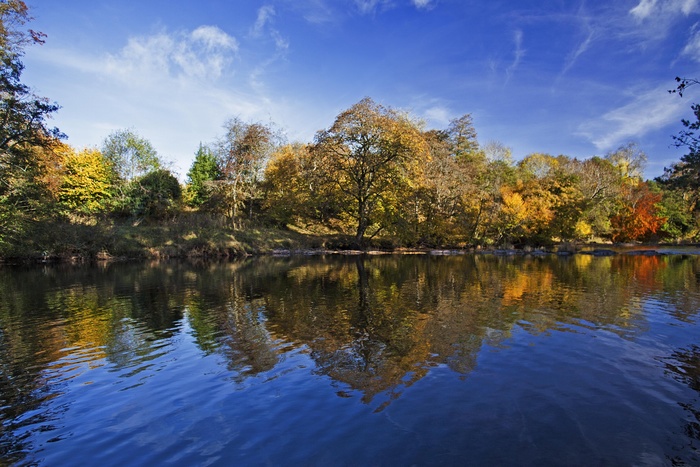
Canon 1D Mk2 DSLR.
Canon 17-40 f4 Lens.
Manfrotto 055 Tripod.
Manfrotto MHX Pro tilt and pan head.
Hoya circular polarizing filter.
Canon remote shutter release,
I didn’t see or hear anybody all morning and that was perfect, it’s good to escape the hustle and bustle of modern life, if only for a few hours.
Some of its roots snake up the river bank in search of water, others are flooded by the river for months on end. I love to sit underneath its branches and watch river-life go by, while sipping a coffee from my small flask. I sometimes see the electric blue flash of Kingfishers as they fly up and down. Hunting Dippers perching on the exposed rocks nearby and Grey Wagtails rising up to pluck passing insects from the air. I spent an hour there and took a shot of the old aqueduct that carries the boats of the Monmouthshire and Brecon canal over the Usk.
Finally I dragged myself away and carried on with my walk, looking for a place to stop and watch the river. I came across a small clearing near some rocks
and I could see three Dippers chasing each other round and round until they all perched together on the same rocks. They then all threw their heads back and began a singing competition, obviously some sort of territorial posturing. I love little wildlife cameos like this, it makes a walk complete for me and to be in beautiful surroundings to see it is perfect.
Sometimes the river allows you to get an image in these calm conditions that you can't get otherwise, you have to take your chance when she offers it.
Canon 1D Mk2 DSLR.
Canon 17-40 f4 Lens.
Manfrotto 055 Tripod.
Manfrotto MHX Pro tilt and pan head.
Hoya circular polarizing filter.
Canon remote shutter release,
I didn’t see or hear anybody all morning and that was perfect, it’s good to escape the hustle and bustle of modern life, if only for a few hours.
Wintering Thrushes flooding in.
22nd October 2016
22nd October 2016
I knew it was going to be a good day when my garden was full of migrant Blackbirds first thing this morning. With this in mind we headed up to the Elan Valley, north of Powys where there is always a super abundance of Rowan berries. It was misty earlier on but as we arrived the mist lifted and revealed a glorious day.
View fron Garreg Ddu dam.
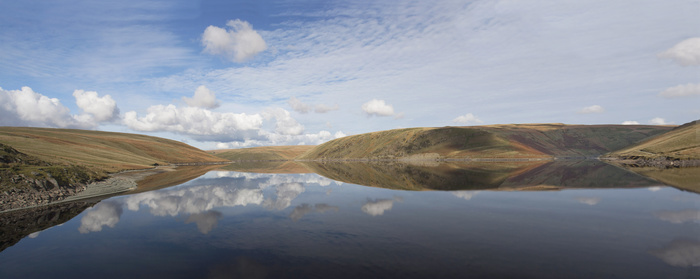
Hundreds of fieldfares were flying around. In amongst them were a few Redwings. Fieldfares vastly outnumber Redwings but they exist happily together. They are both very spooky birds and are very difficult to approach and patience is required to photograph them, however, I managed to take a few half decent shots.
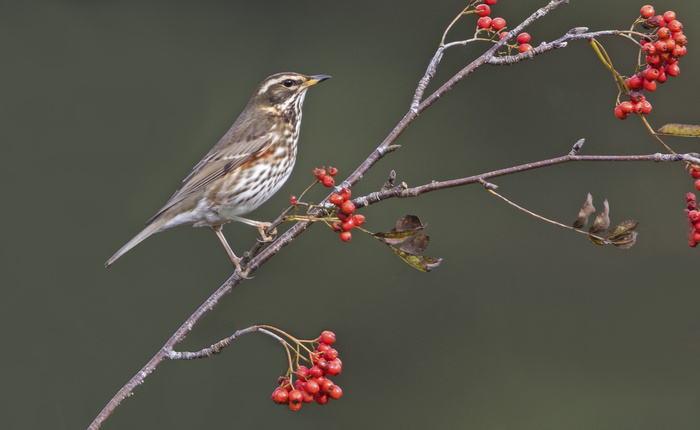
Redwing
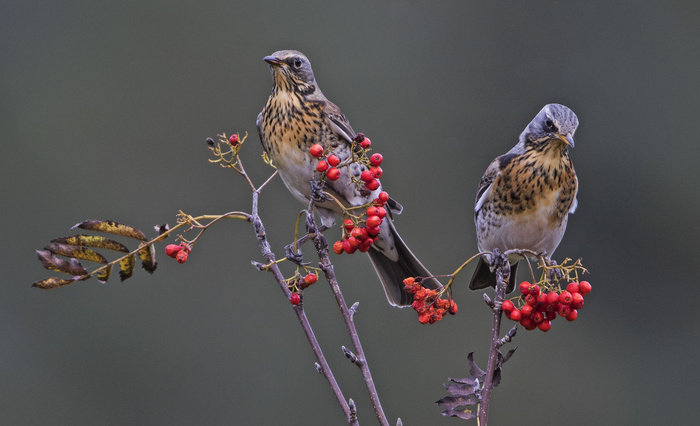
Fieldfares
There were also a few Ring Ouzels and some Brambling in the area, altogether it was quite a spectacle. With regard to Ouzels it is best to wait until the berries have become depleted and then it is easier to track them down. It is worth the effort because they look very photogenic contrasting with the Rowan berries and leaves.

View fron Garreg Ddu dam.
Hundreds of fieldfares were flying around. In amongst them were a few Redwings. Fieldfares vastly outnumber Redwings but they exist happily together. They are both very spooky birds and are very difficult to approach and patience is required to photograph them, however, I managed to take a few half decent shots.
Redwing
Fieldfares
There were also a few Ring Ouzels and some Brambling in the area, altogether it was quite a spectacle. With regard to Ouzels it is best to wait until the berries have become depleted and then it is easier to track them down. It is worth the effort because they look very photogenic contrasting with the Rowan berries and leaves.
Twitching, not for the impatient!
15th October 2016
15th October 2016
A remarkable 36 Siberian Accentors have been 'Displaced' this autumn, a first for the UK found on Shetland and now a week later another in Easington, East Yorkshire.
Many missed the Shetland bird due to its relatively short stay and the logistics and cost of getting there. It was therefore predicted that this bird, the second for the UK, would attract a lot of attention.

I don't know where either end of this queue is but over a thousand birders were present and only around twenty at a time could see the bird, a long stressful wait!
Many missed the Shetland bird due to its relatively short stay and the logistics and cost of getting there. It was therefore predicted that this bird, the second for the UK, would attract a lot of attention.
I don't know where either end of this queue is but over a thousand birders were present and only around twenty at a time could see the bird, a long stressful wait!
Norfolk Autumn 2016.
13th October 2016
13th October 2016
Just spent a couple of weeks on the north Norfolk coast, staying in our usual haunt of Thornham. North Norfolk, over the last 5-6 years, in particular Thornham, has changed dramatically. Where the marshes used to be the province of birdwatchers, they are now overwhelmed by people from their second homes. At one time walking along the marsh tracks and beaches you would only encounter birdwatchers, now all you see is people in designer clothes walking designer dogs! Massive house building is taking place in villages like Thornham where typically homes are starting at £600,000. No place for the locals anymore - Thornham is now the domain of the merchant banker and hedge fund manager. With easy access to beautiful beaches and quaint little villages you can see the attraction. However, during the winter villages such as Holme Next The Sea are half empty, which can't be a good thing. These people generally have no interest in nature - it's just a fashionable place to be, hence the new name for Burnham Market - Chelsea on Sea.
With regard to the birding, the first week we were there winds blew from the south west and balmy conditions prevailed. Whilst this was not particularly good for birds it allowed us to have nice long walks on sunny days. The second week, winds blew from the east and birds flooded in: Dusky, Radde's, Greenish, Arctic, Barred, Yellow Browed and Pallas's Warblers were all reported. A Black Browed Albatross meandered up and down the coast from Northumberland to Suffolk and various other birds such as Hoopoe, Lapland Bunting, Richards's Pipit, Red Backed and Great Grey Shrikes were all reported. It seemed a bit like the old days when falls of birds were regular. It was a very nice couple of weeks away and despite the changes Norfolk will always be a special place for us.
A few casually taken images from the trip can be seen in Lastest Images, Norfolk Autumn 2016.
Iolo Williams's new book, 'Wild Places'.
12th October 2016
12th October 2016
I was contacted this week by the publishers of this forthcoming book and a number of my images are to be featured in the publication. It's good to again have images featured in a published book, it suggests I'm doing something right!!
Choughs in West Wales.
08th September 2016
08th September 2016
In an effort to lift the spirits we decided to have an ad hoc ’Get-Away’ to the west Wales coast yesterday. A bit of sea air and a change of scenery, away from the grey skies of late. We left home at 06.00 and arrived at Martin’s Haven in Pembrokeshire at 08.15, a good journey with light traffic all the way. It was quite misty on the way there but very quickly the sun came up and it turned into a glorious morning. I decided to take a lens just on the off chance of there being some birds around and as we walked along the cliff tops we briefly saw two Rock Pipits but they soon disappeared, about twenty ‘fly-over’ Grey Wagtails, a few Wheatears and around twenty Turnstones flying below us on the sea. There were also a couple of Fulmars and Gannets out on the sea.
There are huge amounts of Jackdaws in this area and also a good number of Ravens but we wanted to see some Choughs. We haven’t seen any Choughs for many years and it was pleasing to hear their characteristic calling as they flew around the cliffs. These quaint birds like areas of short grass where they probe the soft earth with their beaks searching for food. They are reasonably confiding and if you are quiet and patient it is possible to approach them. We saw about five birds flying around early on but they became more wary as the flow of people and dogs increased. However, in a quiet spot we could see two birds feeding in the typically short grass. If you want to see these birds well just wait near some short grass and be patient and it is also essential to be there early to avoid disturbance.
We made our way slowly towards them, they could see us but they were not particularly bothered because we were being quiet. I took a few shots then moved a little closer until I felt we were at the limit of their tolerance. We enjoyed watching them feeding and calling to each other, they really are very nice birds.
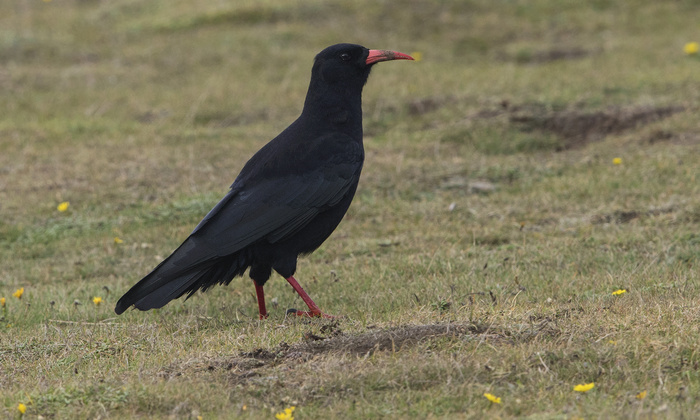
Then the inevitable dog walker appeared and they took flight, this is the usual pattern of events, thankfully we had watched them for some time. We enjoyed the rest of the day just strolling around looking at the Seals and their pups and having a nice picnic until we finally called it a day and made the journey back.
A very nice day out.
For more shots; Please see Latest Images Choughs.
There are huge amounts of Jackdaws in this area and also a good number of Ravens but we wanted to see some Choughs. We haven’t seen any Choughs for many years and it was pleasing to hear their characteristic calling as they flew around the cliffs. These quaint birds like areas of short grass where they probe the soft earth with their beaks searching for food. They are reasonably confiding and if you are quiet and patient it is possible to approach them. We saw about five birds flying around early on but they became more wary as the flow of people and dogs increased. However, in a quiet spot we could see two birds feeding in the typically short grass. If you want to see these birds well just wait near some short grass and be patient and it is also essential to be there early to avoid disturbance.
We made our way slowly towards them, they could see us but they were not particularly bothered because we were being quiet. I took a few shots then moved a little closer until I felt we were at the limit of their tolerance. We enjoyed watching them feeding and calling to each other, they really are very nice birds.
Then the inevitable dog walker appeared and they took flight, this is the usual pattern of events, thankfully we had watched them for some time. We enjoyed the rest of the day just strolling around looking at the Seals and their pups and having a nice picnic until we finally called it a day and made the journey back.
A very nice day out.
For more shots; Please see Latest Images Choughs.
Photographing Kingfishers.
09th August 2016
09th August 2016
Importantly and without equivocation;
If you see Kingfishers carrying fish in the spring and summer and going back and fore an area of river or pond banking for example, then don’t approach that area because it is a criminal offence to disturb them near their nest site.
More importantly and from a personal point of view think about the sad fact that most Kingfishers do not survive their first year of life. They have an inordinately high mortality rate during this period and this is primarily because of the adult bird’s lack of care and tuition but it is also compounded by their hazardous lifestyle and the environment they exist in.
Having taking both these facts into consideration, to successfully photograph these iconic water birds it is essential to do your homework. You must study their habits and watch what they do and more importantly where they do it. Kingfishers are like most birds, creatures of habit. They are highly territorial so they will always be in ‘their area’, having said that their territories frequently are up to a mile in length on a river! However, they still have their favourite fishing spots and it is essential to identify these areas in order to have any success photographing them.
The first thing to do is to watch them for a few days and when you are sure you are not disturbing them, (if in doubt don’t go there). If possible erect some favourable perches for yourself and more importantly for the birds. The very least you can do is provide them with an extra means of fishing that perhaps nature hasn’t. After erecting these perches retreat to a safe distance and just watch and after a while they will inevitably fly past and if the new perch is inviting they will use it straight away. I read from one person advertising ‘Kingfisher Workshops’ that he had to wait six months for the birds to get used to his perches. What an unadulterated load of codswallop! It should take as little as an hour if you have erected them in a favourable position. He was obviously trying to justify the extortionate prices he was charging.
If your perches are successful then come back in the next couple of days and get undercover early, a hide is essential, and just be patient. If there are people frequenting the area and your perches are indicating that there are Kingfishers there then remove them before you leave. There are some nasty unscrupulous people around and I read recently of two so-called ‘wildlife photographers’ erecting perches right outside a Kingfisher’s nest site causing the adults to abandon the young. This is intolerable and given the two facts mentioned previously it beggars belief how selfish these people are. Go to a Kingfisher workshop if you want ‘that image’, it’s a plastic situation but at least the birds are not disturbed.
One method I use to combat disturbance is to add extensions to existing branches, that way no one knows you have been there. I also have a medium sized garden plant pot that I filled with concrete. In the middle I have made a hole about an inch in diameter. I place this pot strategically in the river and fit various perches into it and before I leave I remove it and hide it away. I put it back at my next session and the birds are perching on it very quickly. I only do this during periods of fish abundance and obviously I leave the extensions there to help the birds all year round.
It is a great feeling when you have birds confidently landing on ‘your perches’ and as long as you are totally ethical in the way you go about it both you and the birds can benefit.
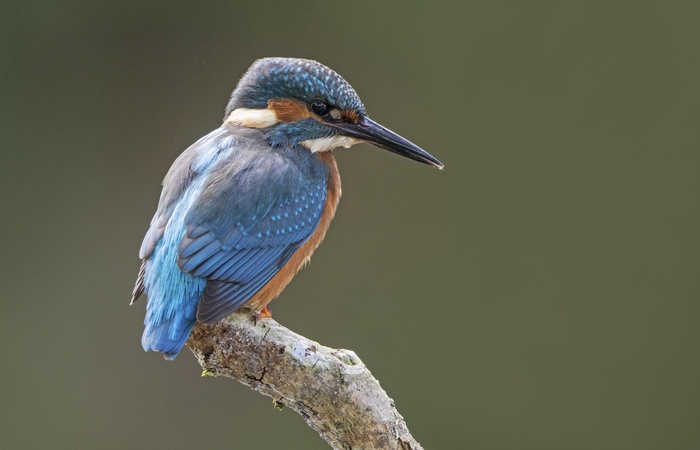
If you see Kingfishers carrying fish in the spring and summer and going back and fore an area of river or pond banking for example, then don’t approach that area because it is a criminal offence to disturb them near their nest site.
More importantly and from a personal point of view think about the sad fact that most Kingfishers do not survive their first year of life. They have an inordinately high mortality rate during this period and this is primarily because of the adult bird’s lack of care and tuition but it is also compounded by their hazardous lifestyle and the environment they exist in.
Having taking both these facts into consideration, to successfully photograph these iconic water birds it is essential to do your homework. You must study their habits and watch what they do and more importantly where they do it. Kingfishers are like most birds, creatures of habit. They are highly territorial so they will always be in ‘their area’, having said that their territories frequently are up to a mile in length on a river! However, they still have their favourite fishing spots and it is essential to identify these areas in order to have any success photographing them.
The first thing to do is to watch them for a few days and when you are sure you are not disturbing them, (if in doubt don’t go there). If possible erect some favourable perches for yourself and more importantly for the birds. The very least you can do is provide them with an extra means of fishing that perhaps nature hasn’t. After erecting these perches retreat to a safe distance and just watch and after a while they will inevitably fly past and if the new perch is inviting they will use it straight away. I read from one person advertising ‘Kingfisher Workshops’ that he had to wait six months for the birds to get used to his perches. What an unadulterated load of codswallop! It should take as little as an hour if you have erected them in a favourable position. He was obviously trying to justify the extortionate prices he was charging.
If your perches are successful then come back in the next couple of days and get undercover early, a hide is essential, and just be patient. If there are people frequenting the area and your perches are indicating that there are Kingfishers there then remove them before you leave. There are some nasty unscrupulous people around and I read recently of two so-called ‘wildlife photographers’ erecting perches right outside a Kingfisher’s nest site causing the adults to abandon the young. This is intolerable and given the two facts mentioned previously it beggars belief how selfish these people are. Go to a Kingfisher workshop if you want ‘that image’, it’s a plastic situation but at least the birds are not disturbed.
One method I use to combat disturbance is to add extensions to existing branches, that way no one knows you have been there. I also have a medium sized garden plant pot that I filled with concrete. In the middle I have made a hole about an inch in diameter. I place this pot strategically in the river and fit various perches into it and before I leave I remove it and hide it away. I put it back at my next session and the birds are perching on it very quickly. I only do this during periods of fish abundance and obviously I leave the extensions there to help the birds all year round.
It is a great feeling when you have birds confidently landing on ‘your perches’ and as long as you are totally ethical in the way you go about it both you and the birds can benefit.
Kingfishers on a rainy day.
02nd August 2016
02nd August 2016
A look at the weather forecast on Sunday for the coming week made my mind up very quickly. If I wanted to photograph my local Kingfishers it would have to be at first light on Monday morning. Heavy and prolonged rain was predicted from mid-morning and throughout the rest of the day and the rest of the week was also unsettled with further wind and rain.
I made my usual preparations the night before, charged my camera batteries, made some sandwiches and a drink, packed my hide, machete and wellingtons in the boot of my car. I also got my head torch ready, checked its batteries got my birding clothes ready, put them in a spare bedroom set the alarm on my phone, (it seems pedantic but you haven’t got time to mess about at 04.30 in the morning). I was awake prior to the alarm going off, I got up quietly and made some tea and a slice of toast, (even that takes some eating at that time). It was still dark when I left at 05.00 and the early morning was quite still and dry although a little fresher than of late, a sign of things to come no doubt!
I love being up at first light when most people are in bed, it’s so ‘new’ and quite special for me. I left quietly in the car and made my way down empty roads to where I park for access to the River Usk. I had packed a thicker fleece for today just in case I got caught in the predicted rain, it is a bit warm but the weather forecast warranted it. I got into my wellingtons locked the car and hauled my kit, (portable hide, large camera bag, tripod, food and drink), down to the river, phew!!
Walking through the woods in semi darkness and approaching the river I could hear a Blackbird alarm calling, it could obviously hear and see me coming, although I thought I was being very careful. My head torch is really invaluable in these situations it leaves your hands free to move branches to one side etc. As I neared the Kingfisher site I hoped my perches were still intact, that’s why I always carry a machete to cut new ones if necessary. I needn’t have worried because everything was how I’d left it. The perches I have made are above the river and are just extensions of the existing overhanging trees and are therefore not affected by flooding. I knew the river would be very benign anyway because we have had no rain since my last visit. These perches will hopefully be unaffected by the inevitable rise in river levels after the forecasted heavy rain.
It was breaking light and I quickly set my hide up in a previously decided spot, this is another thing I always do beforehand, (more planning). It’s no good trying to find your best position on the day of your shoot, I covered my camera bag with two bin liners to try to keep it dry because it’s too big to fit inside my portable hide. I got into my hide with my tripod and camera and zipped everything closed, I relaxed and just waited. It was now about 05.45 and the light was beginning to build, although I could see there would be cloud all day. However, I wasn’t complaining after my last experience with the sun and heat, (previous blog).
It was now 06.15 and suddenly there was a Kingfisher on one of the perches.
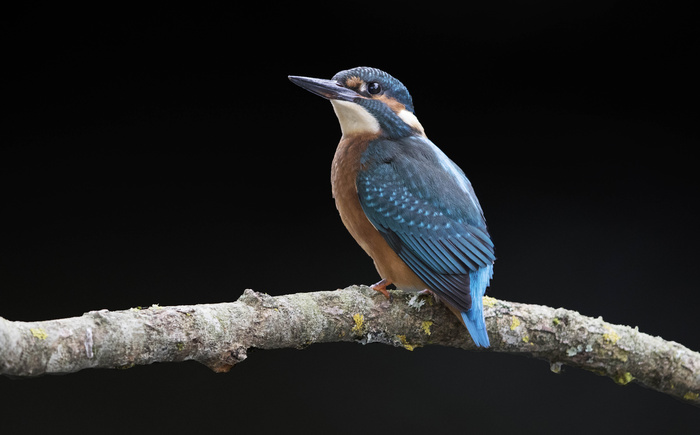
It’s quite remarkable with these birds, sometimes there is no warning, no ‘peeping’ they just appear, that’s why you have to concentrate 100% of the time or you will miss a shot. The light was now steadily increasing with the background a pleasing light early-morning grey.
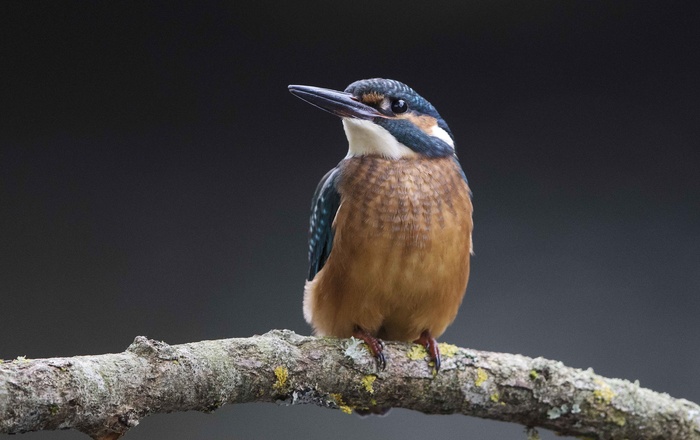
If I have enough light I like to deliberately under-expose in these situations because it darkens the background even further and highlights the subject.
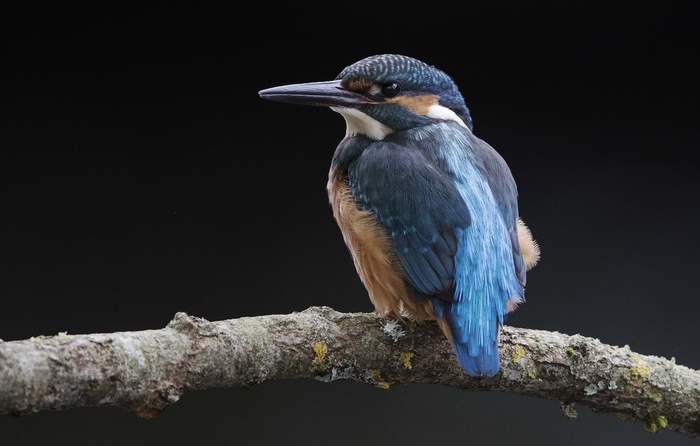
I managed to take a number of shots as the birds came back and fore to the perches.
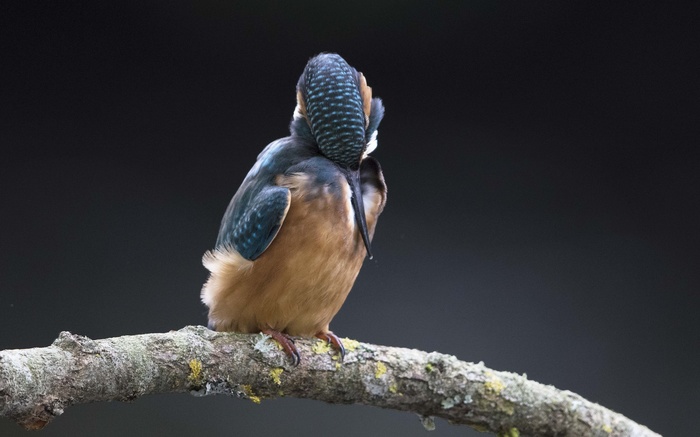
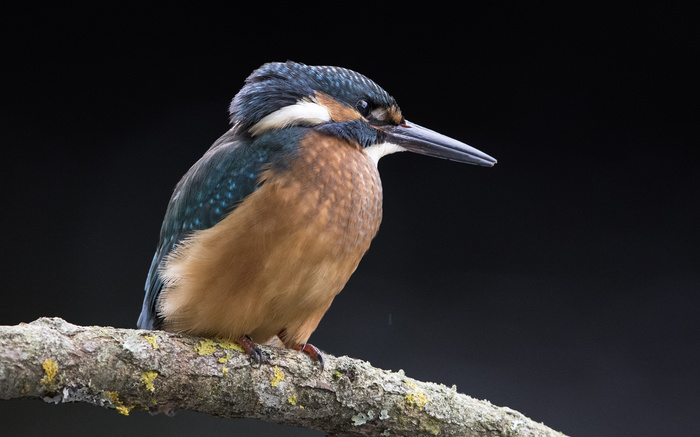
It’s really pleasing to see them doing this when you have created the situation, I despair at these so-called photographers that go to these manufactured sites for birds. I saw on the internet this week a site in Norfolk charging between £150 and £250 a day for Kingfisher ‘Tuition’! One site charging £420 for a one to one session to photograph these birds, these people must have too much money. In addition I don’t think they are birders, they have served little or no birding apprenticeship and they are either too lazy or useless to go out and find their own birds. You can always tell them they don’t even carry binoculars. I’m afraid, however, that this is the way it’s going, known as chequebook birding etc. I for one will always do it the old way!!
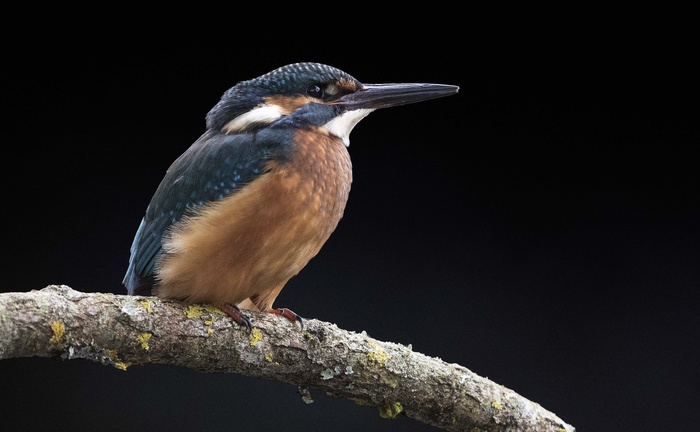
Rant over; By 08.00 there were a few spots of rain in the air and this steadily increased until it began to rain really heavily. This was a test for my portable hide and apart from a few drips it held up quite well. The birds had also disappeared because the effect of the rain hitting the river was breaking up the surface and preventing clear views of the small fish. I suppose there’s not much point sitting out on a perch getting soaking wet if you can’t see anything. In between one of the now really heavy showers I quickly packed up and left. I will have to wait for river levels to subside before my next session with these lovely birds.
I made my usual preparations the night before, charged my camera batteries, made some sandwiches and a drink, packed my hide, machete and wellingtons in the boot of my car. I also got my head torch ready, checked its batteries got my birding clothes ready, put them in a spare bedroom set the alarm on my phone, (it seems pedantic but you haven’t got time to mess about at 04.30 in the morning). I was awake prior to the alarm going off, I got up quietly and made some tea and a slice of toast, (even that takes some eating at that time). It was still dark when I left at 05.00 and the early morning was quite still and dry although a little fresher than of late, a sign of things to come no doubt!
I love being up at first light when most people are in bed, it’s so ‘new’ and quite special for me. I left quietly in the car and made my way down empty roads to where I park for access to the River Usk. I had packed a thicker fleece for today just in case I got caught in the predicted rain, it is a bit warm but the weather forecast warranted it. I got into my wellingtons locked the car and hauled my kit, (portable hide, large camera bag, tripod, food and drink), down to the river, phew!!
Walking through the woods in semi darkness and approaching the river I could hear a Blackbird alarm calling, it could obviously hear and see me coming, although I thought I was being very careful. My head torch is really invaluable in these situations it leaves your hands free to move branches to one side etc. As I neared the Kingfisher site I hoped my perches were still intact, that’s why I always carry a machete to cut new ones if necessary. I needn’t have worried because everything was how I’d left it. The perches I have made are above the river and are just extensions of the existing overhanging trees and are therefore not affected by flooding. I knew the river would be very benign anyway because we have had no rain since my last visit. These perches will hopefully be unaffected by the inevitable rise in river levels after the forecasted heavy rain.
It was breaking light and I quickly set my hide up in a previously decided spot, this is another thing I always do beforehand, (more planning). It’s no good trying to find your best position on the day of your shoot, I covered my camera bag with two bin liners to try to keep it dry because it’s too big to fit inside my portable hide. I got into my hide with my tripod and camera and zipped everything closed, I relaxed and just waited. It was now about 05.45 and the light was beginning to build, although I could see there would be cloud all day. However, I wasn’t complaining after my last experience with the sun and heat, (previous blog).
It was now 06.15 and suddenly there was a Kingfisher on one of the perches.
It’s quite remarkable with these birds, sometimes there is no warning, no ‘peeping’ they just appear, that’s why you have to concentrate 100% of the time or you will miss a shot. The light was now steadily increasing with the background a pleasing light early-morning grey.
If I have enough light I like to deliberately under-expose in these situations because it darkens the background even further and highlights the subject.
I managed to take a number of shots as the birds came back and fore to the perches.
It’s really pleasing to see them doing this when you have created the situation, I despair at these so-called photographers that go to these manufactured sites for birds. I saw on the internet this week a site in Norfolk charging between £150 and £250 a day for Kingfisher ‘Tuition’! One site charging £420 for a one to one session to photograph these birds, these people must have too much money. In addition I don’t think they are birders, they have served little or no birding apprenticeship and they are either too lazy or useless to go out and find their own birds. You can always tell them they don’t even carry binoculars. I’m afraid, however, that this is the way it’s going, known as chequebook birding etc. I for one will always do it the old way!!
Rant over; By 08.00 there were a few spots of rain in the air and this steadily increased until it began to rain really heavily. This was a test for my portable hide and apart from a few drips it held up quite well. The birds had also disappeared because the effect of the rain hitting the river was breaking up the surface and preventing clear views of the small fish. I suppose there’s not much point sitting out on a perch getting soaking wet if you can’t see anything. In between one of the now really heavy showers I quickly packed up and left. I will have to wait for river levels to subside before my next session with these lovely birds.
A hot summer's morning on the River Usk.
22nd July 2016
22nd July 2016
Last week I was walking on the River Usk close to where I live and I was fortunate to see a pair of Kingfishers near a historical nest site for these birds. I immediately backed off from the area not wanting to disturb them during the breeding season. Kingfishers are a Schedule 1 bird and it is an offence to knowingly cause disturbance to them, particularly near a nest site. However, this is not the reason I backed off, it is because I have a genuine regard for these birds and I want to see them proliferate because there is no better sight on a river than the electric blue plumage of a Kingfisher.
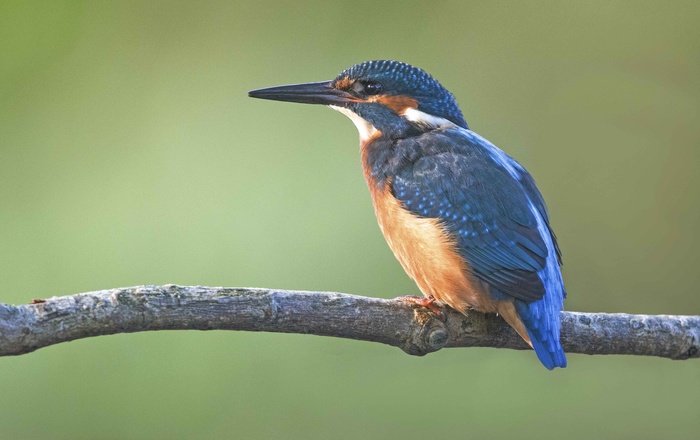
I positioned myself about two hundred yards further away and just watched as they hovered and dived into the river, hunting fish for what is usually by now their second brood of the season. I started to wonder what had happened to their first brood because they are driven away after about a week to make room for the next brood. If they hadn’t died, which is a distinct possibility because they have a high mortality rate among young birds, they might be around the area away from the nest site.
I returned the following morning at first light and got under cover and after about an hour I could hear the tell-tale ‘Peep Peep’ of a Kingfisher. I could see two birds landing in some overhanging Willow trees about ten yards away and through my binoculars I could see they were juvenile birds by the white tip to their beaks and their smokey coloured feet.
Male.
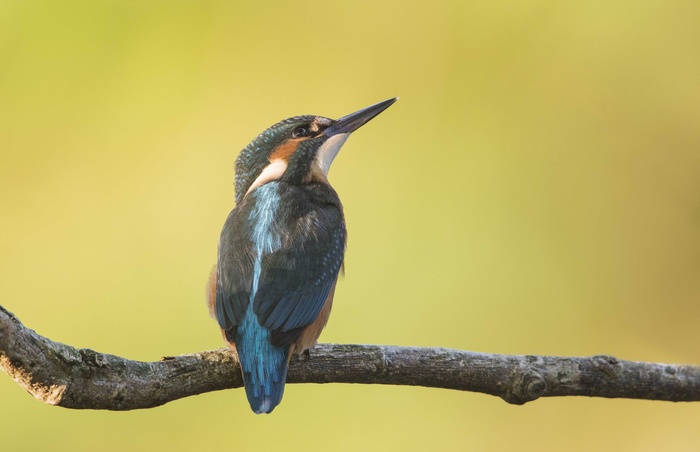
Female.
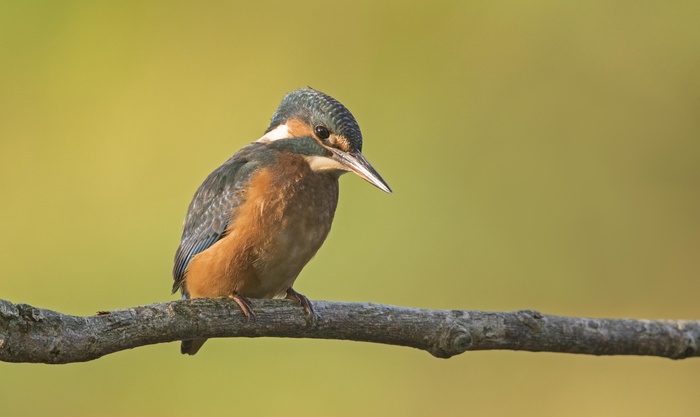
These were obviously two birds from the earlier brood mentioned above, they were fishing and chasing each other around in typical fashion. I always like to photograph Kingfishers so I decided to come back in a few days after the forecasted rain. The river would rise and become coloured after the rain and would take a few days for the level to drop back down again.
Before I left I waded into the river and erected a sharpened tree branch near to the Willows and made it secure with some river stones. I always carry a machete with me to cut and shape fallen branches.
The rain duly arrived with a very dull showery couple of days and I didn’t bother to look at the river because I knew from experience what the level would be like. However, for the following Tuesday the weather forecast was lovely, warm and sunny and river levels would be back down, therefore I decided that would be the day. I was up at 04.00 on a stunningly beautiful morning, to quote H.E.Bates’s Uncle Silas, ‘Not a breath of wind stirring an ear of corn’ and as I made my way to the river the temperature gauge in my car read 18C. An early morning mist lay over the river but that suited me because it meant the birds wouldn’t be fishing and I could set up my hide without them seeing me and I knew it would soon burn off.
I was quickly under cover and very soon the mist did indeed burn off but I was unprepared for what was about to happen later. The birds were about soon after and I watched them hovering in front of the Willows but returning back to land without achieving anything. They then typically chased each other down river and I immediately went to see what they had been doing and I could see a large shoal of Minnows in front of the Willows but just too far into the river for them to fish from a perch. Fishing from a perch is always easier than hovering that is obvious so I decided to give them a hand. I found a fallen willow branch and cut it to shape and attached it to an existing branch, thereby creating an extension that overhung the Minnows, that is why I always carry some tools with me.
I quickly returned to my hide and the birds came back up river about half an hour later landing on my extension without hesitation and beginning to dive with immediate results.
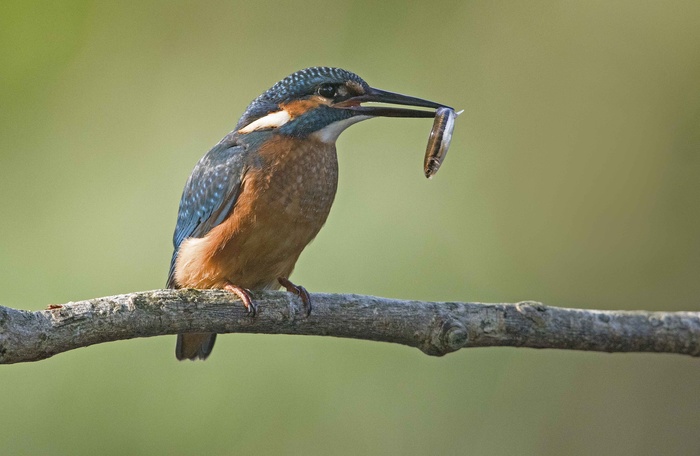
It was very pleasing to see this, the more fish they catch the better their chance of survival.
It had now become a glorious morning and the woods were loud with birdsong. The sun's golden moted rays shone through the resplendent canopy and danced upon the clear rippling Usk. Chiffchaffs and Marsh Tits chased each other and a Green Woodpecker ‘Yaffled’ from the trees. Six juvenile Goosanders flew downstream and Grey and Pied Wagtails probed the gaps between pebbles in search of their breakfast. A loud continuous peeping echoed up river and to my surprise three Common Sandpipers landed right outside my hide and began feeding in the shallows. They were too close to photograph, which was frustrating, but two flew off quite quickly, they looked like a pair, and one stayed and just walked into my focusing range which was ideal.
It fed, preened and then fell asleep on one leg for ten minutes before it too flew away.
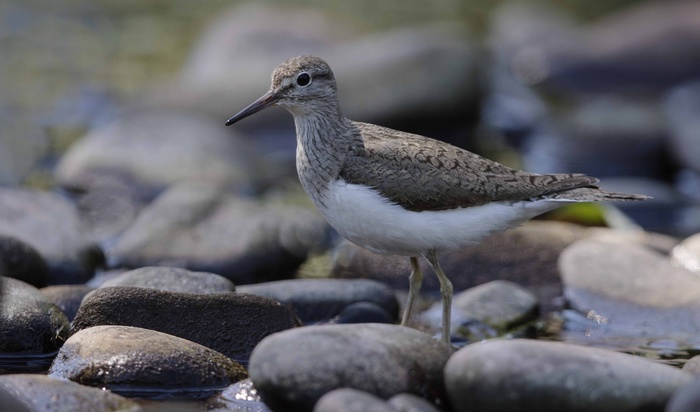
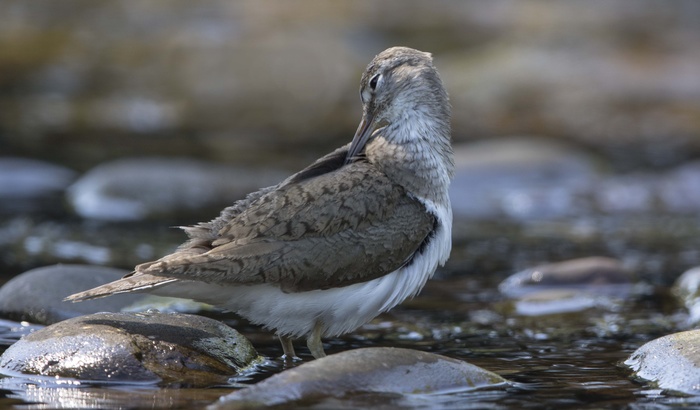
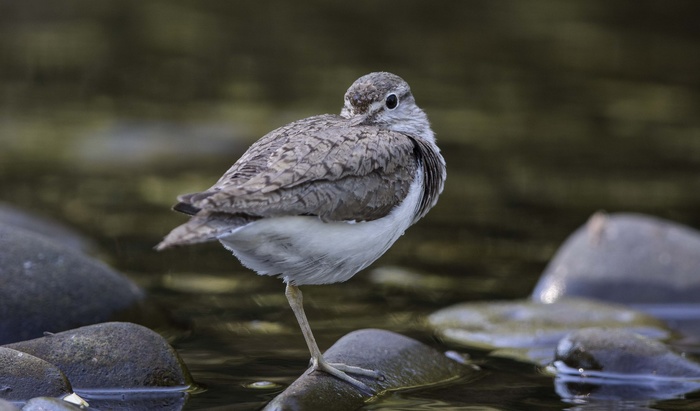
I continued to photograph the Kingfishers as they caught Bullheads, Gudgeon and Minnows.
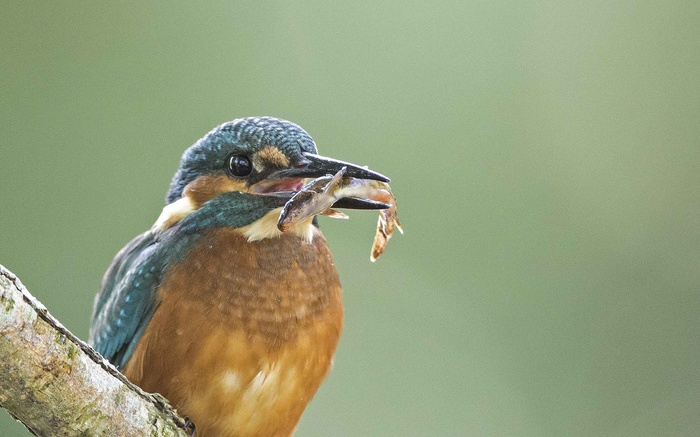
Unfortunately for me the sun had now began to really intensify and I was dressed in a light fleece, long trousers tucked into walking socks, wellingtons and in a small portable hide. Although it is important to cover up near a river if you are going to sit in one place for long periods because you can get some nasty insect bites, it can be uncomfortable. As a result of my circumstances and the now incredibly hot sun I was really suffering and after I got some more kingfisher shots I had to pack in, my drinking water had run out and I was baking. The walk back to the car carrying all my kit was horrendous, it was now 11.00am and blisteringly hot.
When I returned home I couldn’t wait to off-load my kit and get under a very cool shower. I spent the rest of the afternoon watching the Tour De France, with a cooling fan pointing at me. (Cycling being my other passion having been a keen road cyclist for many years I can only gasp at these athlete’s fitness). It was a tough day in that heat and I am going to wait until this warm spell ends before I have another try. The sun was too strong for any decent images but it was great to see these iconic birds on my local river.
I positioned myself about two hundred yards further away and just watched as they hovered and dived into the river, hunting fish for what is usually by now their second brood of the season. I started to wonder what had happened to their first brood because they are driven away after about a week to make room for the next brood. If they hadn’t died, which is a distinct possibility because they have a high mortality rate among young birds, they might be around the area away from the nest site.
I returned the following morning at first light and got under cover and after about an hour I could hear the tell-tale ‘Peep Peep’ of a Kingfisher. I could see two birds landing in some overhanging Willow trees about ten yards away and through my binoculars I could see they were juvenile birds by the white tip to their beaks and their smokey coloured feet.
Male.
Female.
These were obviously two birds from the earlier brood mentioned above, they were fishing and chasing each other around in typical fashion. I always like to photograph Kingfishers so I decided to come back in a few days after the forecasted rain. The river would rise and become coloured after the rain and would take a few days for the level to drop back down again.
Before I left I waded into the river and erected a sharpened tree branch near to the Willows and made it secure with some river stones. I always carry a machete with me to cut and shape fallen branches.
The rain duly arrived with a very dull showery couple of days and I didn’t bother to look at the river because I knew from experience what the level would be like. However, for the following Tuesday the weather forecast was lovely, warm and sunny and river levels would be back down, therefore I decided that would be the day. I was up at 04.00 on a stunningly beautiful morning, to quote H.E.Bates’s Uncle Silas, ‘Not a breath of wind stirring an ear of corn’ and as I made my way to the river the temperature gauge in my car read 18C. An early morning mist lay over the river but that suited me because it meant the birds wouldn’t be fishing and I could set up my hide without them seeing me and I knew it would soon burn off.
I was quickly under cover and very soon the mist did indeed burn off but I was unprepared for what was about to happen later. The birds were about soon after and I watched them hovering in front of the Willows but returning back to land without achieving anything. They then typically chased each other down river and I immediately went to see what they had been doing and I could see a large shoal of Minnows in front of the Willows but just too far into the river for them to fish from a perch. Fishing from a perch is always easier than hovering that is obvious so I decided to give them a hand. I found a fallen willow branch and cut it to shape and attached it to an existing branch, thereby creating an extension that overhung the Minnows, that is why I always carry some tools with me.
I quickly returned to my hide and the birds came back up river about half an hour later landing on my extension without hesitation and beginning to dive with immediate results.
It was very pleasing to see this, the more fish they catch the better their chance of survival.
It had now become a glorious morning and the woods were loud with birdsong. The sun's golden moted rays shone through the resplendent canopy and danced upon the clear rippling Usk. Chiffchaffs and Marsh Tits chased each other and a Green Woodpecker ‘Yaffled’ from the trees. Six juvenile Goosanders flew downstream and Grey and Pied Wagtails probed the gaps between pebbles in search of their breakfast. A loud continuous peeping echoed up river and to my surprise three Common Sandpipers landed right outside my hide and began feeding in the shallows. They were too close to photograph, which was frustrating, but two flew off quite quickly, they looked like a pair, and one stayed and just walked into my focusing range which was ideal.
It fed, preened and then fell asleep on one leg for ten minutes before it too flew away.
I continued to photograph the Kingfishers as they caught Bullheads, Gudgeon and Minnows.
Unfortunately for me the sun had now began to really intensify and I was dressed in a light fleece, long trousers tucked into walking socks, wellingtons and in a small portable hide. Although it is important to cover up near a river if you are going to sit in one place for long periods because you can get some nasty insect bites, it can be uncomfortable. As a result of my circumstances and the now incredibly hot sun I was really suffering and after I got some more kingfisher shots I had to pack in, my drinking water had run out and I was baking. The walk back to the car carrying all my kit was horrendous, it was now 11.00am and blisteringly hot.
When I returned home I couldn’t wait to off-load my kit and get under a very cool shower. I spent the rest of the afternoon watching the Tour De France, with a cooling fan pointing at me. (Cycling being my other passion having been a keen road cyclist for many years I can only gasp at these athlete’s fitness). It was a tough day in that heat and I am going to wait until this warm spell ends before I have another try. The sun was too strong for any decent images but it was great to see these iconic birds on my local river.
A spooky encounter on Allt yr Esgair.
13th July 2016
13th July 2016
Near where I live there is a hill named Allt yr Esgair and hidden away deep in the woods surrounding it is an old derelict hunting lodge which has stood there for almost two hundred years, gradually falling to ruins. It is a spooky place on a bright day but on an overcast and gloomy day I find it particularly eerie. I have often felt uneasy when I have been there - as if I’m not totally alone - but I’ve always told myself not to be so silly and just carried on.
However, yesterday morning I intended walking to the hilltop but near to the final ascent I felt myself being inexplicably drawn down into the woods, down the path leading to this old hunting lodge. The day seemed to darken and to become more foreboding as I made my way through the dense summer foliage, the light dimming with every passing step. I kept telling myself that there wouldn’t be any point in taking photographs because of the gloom, and that I should turn back.
Ridiculous as it may seem, I could not resist the force that appeared to inexorably draw me closer and closer to the overgrown copse where the old lodge stood. I arrived at the last junction where I could possibly take another path, a path leading to the open hill and daylight. I hesitated, but no, the attraction remained too strong and demanding, I had to see the old lodge once again.
To my relief when I finally arrived everything seemed normal, why wouldn’t it? I erected my tripod and camera and shot a few images and then slowly but surely, that old intangible feeling of being watched crept over me. The hairs on the back of my neck stood up and I must admit to feeling singularly disinclined to remain there - but this was ridiculous, or was it? were there indeed a pair of eyes from the distant past observing me?
Finally I could stand it no longer and I quickly packed up my kit. As I was leaving I looked back over my shoulder and predictably there was nothing to see. I hurried back through the woods and out once more into the welcome daylight.
However, the final chilling part of this encounter was yet to be revealed because when I processed the images I had taken I was shocked to my very core. In one of the doorways of the old lodge there appeared to be a very unpleasant figure, in fact a dreadful apparition of a woman, just standing there, watching - watching me?
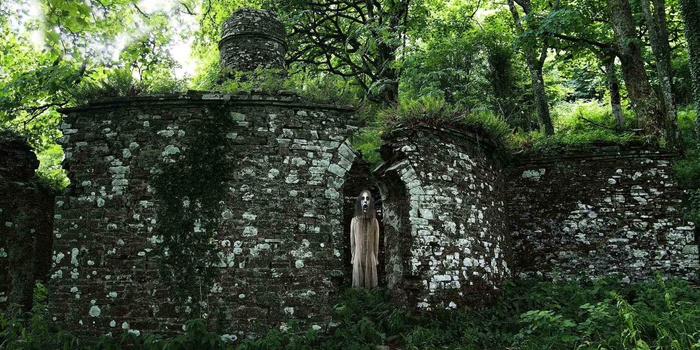
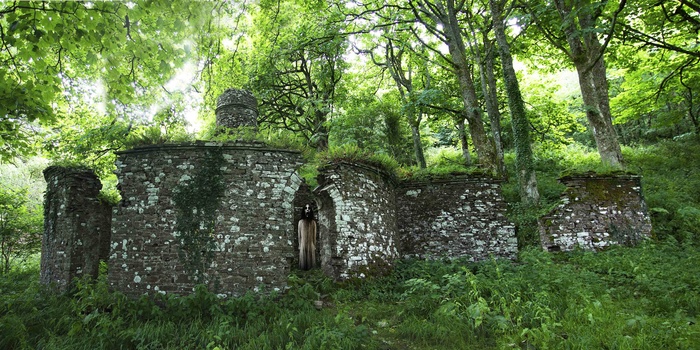
It will be a long time before I venture anywhere near that place again………….
However, yesterday morning I intended walking to the hilltop but near to the final ascent I felt myself being inexplicably drawn down into the woods, down the path leading to this old hunting lodge. The day seemed to darken and to become more foreboding as I made my way through the dense summer foliage, the light dimming with every passing step. I kept telling myself that there wouldn’t be any point in taking photographs because of the gloom, and that I should turn back.
Ridiculous as it may seem, I could not resist the force that appeared to inexorably draw me closer and closer to the overgrown copse where the old lodge stood. I arrived at the last junction where I could possibly take another path, a path leading to the open hill and daylight. I hesitated, but no, the attraction remained too strong and demanding, I had to see the old lodge once again.
To my relief when I finally arrived everything seemed normal, why wouldn’t it? I erected my tripod and camera and shot a few images and then slowly but surely, that old intangible feeling of being watched crept over me. The hairs on the back of my neck stood up and I must admit to feeling singularly disinclined to remain there - but this was ridiculous, or was it? were there indeed a pair of eyes from the distant past observing me?
Finally I could stand it no longer and I quickly packed up my kit. As I was leaving I looked back over my shoulder and predictably there was nothing to see. I hurried back through the woods and out once more into the welcome daylight.
However, the final chilling part of this encounter was yet to be revealed because when I processed the images I had taken I was shocked to my very core. In one of the doorways of the old lodge there appeared to be a very unpleasant figure, in fact a dreadful apparition of a woman, just standing there, watching - watching me?
It will be a long time before I venture anywhere near that place again………….
Cuckoo in the rain.
14th June 2016
14th June 2016
Spring 2016 has been very good for Cuckoos in the Beacons, I have seen about twenty birds over the last month or so. I always seek out Cuckoos because they are a particular favourite of mine. Many people just don’t see them, they hear them calling but don’t know where to look and sometimes they have seen a Cuckoo but don’t realise it!
Yesterday when I was hidden underneath a Hawthorn tree I could see a Cuckoo sat up in another Hawthorn tree, perched quite prominently and as I watched a few people walked past and just didn’t even react when the bird started calling less than thirty yards from them. I can’t understand what these people come into the countryside for when you don’t even look when one of the most iconic sounds of spring is echoing around you,
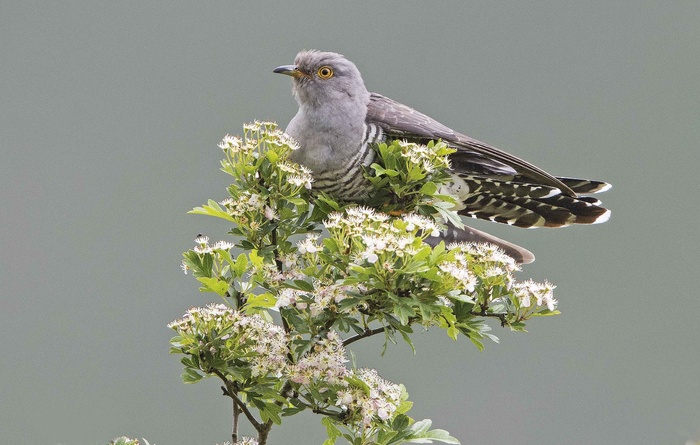
I despair at them, you don’t have to be a birdwatcher but come on!!
After a convoy of outdoor pursuits vehicles had roared through and these other people had gone things became quiet again. These so called 'outdoor pursuits’ people really are quite a nuisance, they have no regard for anyone else trying to enjoy the countryside. They just roll up and pile out of their vehicles making noise and disturbance, they have no knowledge of the natural world it’s all about using the countryside for a play-ground. I’m all for getting children into the countryside but I think a primary objective should be to teach them about what lives there and how to identify and appreciate it.
However, I could now see two male Cuckoos and this usually means they will start flying after each other. This they duly did and I could see one bird periodically landing on some bare branches. There was a Hawthorn bush not too far from these bare branches and I thought if I could tuck-in under it I might get a shot. I’m always looking for options to hide, you have to with Cuckoos they are so crafty.
I put my Gore-Tex waterproof lens cover over my kit because it looked showery and I got underneath this Hawthorn. I sat on my ‘Walk-stool’, an invaluable piece of kit, and waited. It began to rain, a light drizzle, these two male birds were interacting again, I could hear their squawking and I then realised that one bird was sitting in the top of the bush I was under about eight feet above me. I kept still and quiet and then he fluttered, as I had hoped, right onto the bare branches he had been on previously.
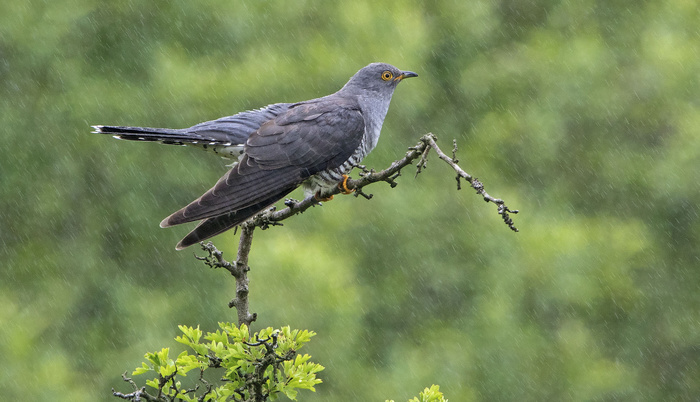
I shot him in the drizzle and then the other bird came in again and they flew off. Another nice Cuckoo encounter, if only these people realised what they are missing!
Yesterday when I was hidden underneath a Hawthorn tree I could see a Cuckoo sat up in another Hawthorn tree, perched quite prominently and as I watched a few people walked past and just didn’t even react when the bird started calling less than thirty yards from them. I can’t understand what these people come into the countryside for when you don’t even look when one of the most iconic sounds of spring is echoing around you,
I despair at them, you don’t have to be a birdwatcher but come on!!
After a convoy of outdoor pursuits vehicles had roared through and these other people had gone things became quiet again. These so called 'outdoor pursuits’ people really are quite a nuisance, they have no regard for anyone else trying to enjoy the countryside. They just roll up and pile out of their vehicles making noise and disturbance, they have no knowledge of the natural world it’s all about using the countryside for a play-ground. I’m all for getting children into the countryside but I think a primary objective should be to teach them about what lives there and how to identify and appreciate it.
However, I could now see two male Cuckoos and this usually means they will start flying after each other. This they duly did and I could see one bird periodically landing on some bare branches. There was a Hawthorn bush not too far from these bare branches and I thought if I could tuck-in under it I might get a shot. I’m always looking for options to hide, you have to with Cuckoos they are so crafty.
I put my Gore-Tex waterproof lens cover over my kit because it looked showery and I got underneath this Hawthorn. I sat on my ‘Walk-stool’, an invaluable piece of kit, and waited. It began to rain, a light drizzle, these two male birds were interacting again, I could hear their squawking and I then realised that one bird was sitting in the top of the bush I was under about eight feet above me. I kept still and quiet and then he fluttered, as I had hoped, right onto the bare branches he had been on previously.
I shot him in the drizzle and then the other bird came in again and they flew off. Another nice Cuckoo encounter, if only these people realised what they are missing!
Redstart, our smartest spring migrant?
12th June 2016
12th June 2016
The Common Redstart is a beautiful bird; that is not open to conjecture. Although the female also has lovely subtle colours and in her own right is very attractive, it is the male that is the show stopper. His plumage is veritably stunning, that orange red tail, his slate blue back and head that black face finished off with a blazing white forehead elevate him right up to the forefront of our smartest spring migrants.
These birds can be shy and are reluctant to show themselves fully, sometimes all we see is a tantalising flash of that red tail as they disappear over a hedge or wall and then frustratingly they vanish. However, when they do show, particularly the male, he is a difficult bird to expose accurately. The main problem for a photographer lies with the Redstart’s face and forehead, if you expose for the black face then the bright white forehead is 'blown' and appears bleached right out and you can see this with most Redstart images. We all suffer with this exposure problem; conversely if you expose for the white forehead then you lose the bird’s eye in his black face. The secret is to strike a happy medium, not easy and you may be constricted by the ambient light anyway, which can limit your choices.
You can try different options, (if you have time), because these birds don’t usually hang around for too long. However, the best method I find is by shooting in RAW format, (which I do anyway). If I deliberately under-expose thereby ‘damping’ down his white forehead although I get a dark image and his eye is lost in his black face, the image when processed and ’lightened-up’ brings his eye back out of his face and there is also not too much ‘blowing’ of his white forehead.
I have been watching a nesting pair, (from a sensible distance), who have young birds and this has given me a chance to see these lovely birds in great detail.
What a smart little bird!!
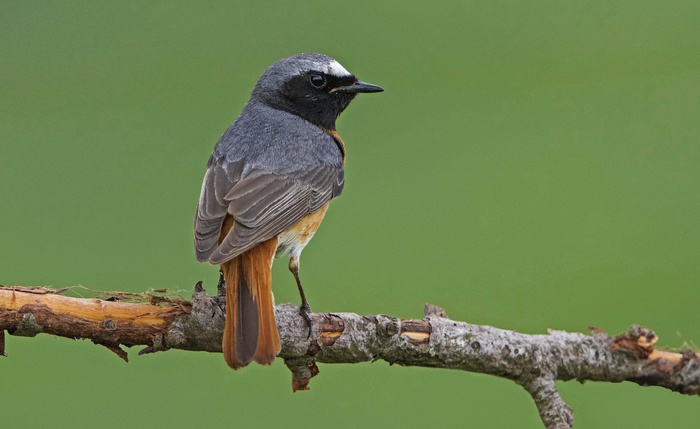
These birds can be shy and are reluctant to show themselves fully, sometimes all we see is a tantalising flash of that red tail as they disappear over a hedge or wall and then frustratingly they vanish. However, when they do show, particularly the male, he is a difficult bird to expose accurately. The main problem for a photographer lies with the Redstart’s face and forehead, if you expose for the black face then the bright white forehead is 'blown' and appears bleached right out and you can see this with most Redstart images. We all suffer with this exposure problem; conversely if you expose for the white forehead then you lose the bird’s eye in his black face. The secret is to strike a happy medium, not easy and you may be constricted by the ambient light anyway, which can limit your choices.
You can try different options, (if you have time), because these birds don’t usually hang around for too long. However, the best method I find is by shooting in RAW format, (which I do anyway). If I deliberately under-expose thereby ‘damping’ down his white forehead although I get a dark image and his eye is lost in his black face, the image when processed and ’lightened-up’ brings his eye back out of his face and there is also not too much ‘blowing’ of his white forehead.
I have been watching a nesting pair, (from a sensible distance), who have young birds and this has given me a chance to see these lovely birds in great detail.
What a smart little bird!!
Cuckoo Nirvana.
10th June 2016
10th June 2016
I have previously mentioned in my blog posts that Cuckoos are one of my top five birds and I have always been fascinated by their enigmatic existence. Once April comes around I am always listening for that tell-tale sound, for days there is nothing and then one morning you think you can hear that faint ‘Cuckoo-Cuckoo’ borne on the wind, you listen again and then ‘yes’ there it is your first Cuckoo. For me personally these birds are true heralds of spring and it always uplifts me to hear them. However, for anybody aspiring to photograph these wonderful birds this is when the hard work begins!
Cuckoos are very shy and wary birds, they are also very ‘street wise’ and as a result they are very difficult to approach and subsequently photograph. This does not deter me because I like a challenge and they are such attractive birds, seen up close their plumage is stunningly beautiful. In addition to them being so difficult to approach they are always being harassed by small birds like Meadow Pipits etc.
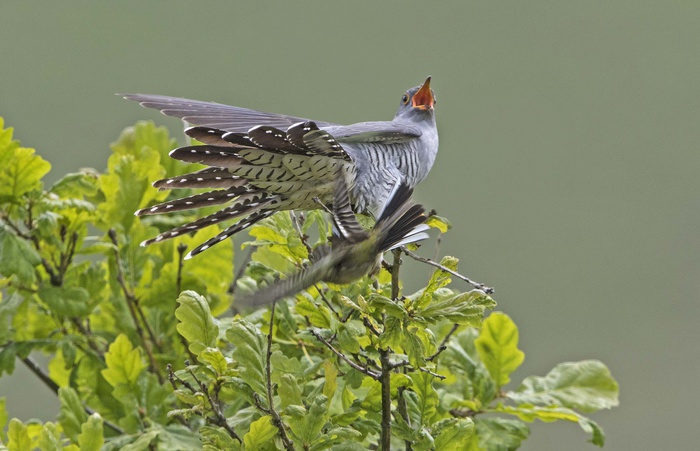
This constant harassment doesn’t help the spectator or the photographer of which I am both! No other birds like a Cuckoo given its parasitic behaviour and that’s fair enough, would you? They don’t even like each other they are constantly squabbling over mates and territories.
All these factors make the ‘how to photograph Cuckoos equation’ particularly difficult to solve. These birds are at their most frustrating when they are at the top of a tree calling, as if to say ‘you’ve got no chance matey’. However, there is one thing in the photographer’s favour and that is at some time they have to come down, firstly to find food and secondly to pursue their mating and egg laying activities. They are like all birds creatures of habit and have their favourite perches - be it a gate post, a particular bush or a prominent bare branch.
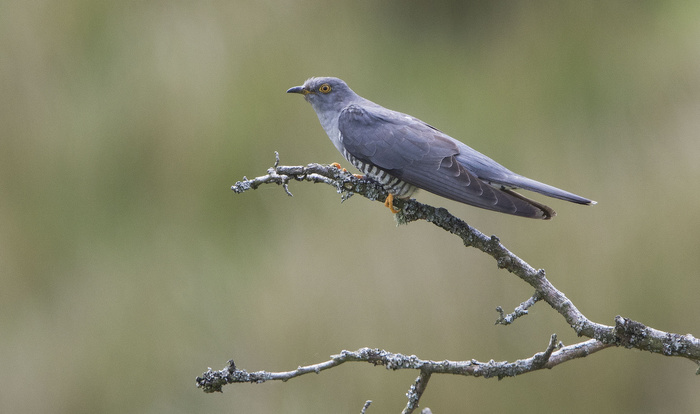
In the Beacons Cuckoos like elevated open areas interspersed with low trees and bushes. This is where planning comes into operation. I always observe a Cuckoo’s habits in detail before attempting to photograph them because anybody just trying to photograph these birds by chance is usually (without a huge slice of luck) going to be disappointed.
There is a secluded area up on the Beacons where historically Cuckoos have spent the spring and summer. I have watched this area for many years, it is a typically open location sparsely populated with Rowan and Hawthorn bushes. However, here there is one advantage – there is one particular place where you can look at eye level to the top of some of these bushes. This is like the holy grail for me, to look across instead of up at a bird like a Cuckoo is everything!
Yesterday morning I made the trek up to this area, I knew there was a Cuckoo there because I had heard it previously. I approached very carefully and I could hear him calling distantly so I got under cover and settled in looking across at the tops of three bushes about fifteen yards away. If ever I needed a Meadow Pipit to start harassing a Cuckoo it was now. The calls started to come nearer getting my hopes up but then they would fade away again, very frustrating. I had been waiting about two hours when I could hear a commotion and a male Cuckoo landed on the top of the furthest Hawthorn bush. I was able to photograph him in very pleasing light amongst the Hawthorn blossom - a great feeling of satisfaction.
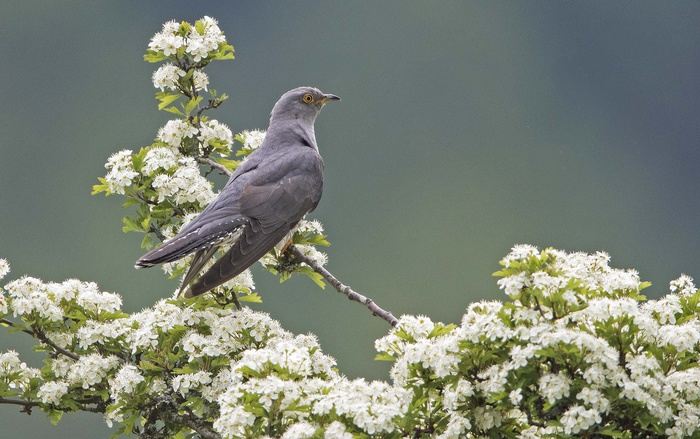
The light continued to improve and I was praying for him to perch on the nearer two Hawthorns. More activity ensued and then incredibly he perched right on top of the nearest bush!
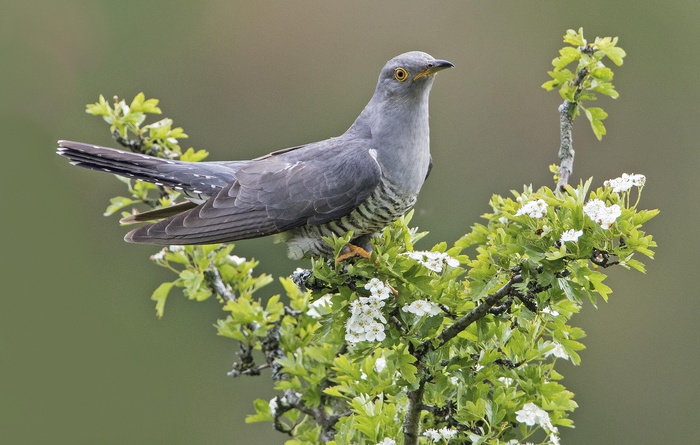
I couldn’t believe it, what a bird in wondrous light!! He stayed there for about a minute and I gratefully shot him in various poses then he was off again. I thought that was it, and that was fine, I knew I had many nice images – BUT!! He came back, another three times on different perches in the same bush – creature of habit? I shot him in many different poses until he finally flew off and didn’t return. What an experience with a magical bird!
Please see Latest Images, Cuckoos in the Beacons, Spring 2016
Cuckoos are very shy and wary birds, they are also very ‘street wise’ and as a result they are very difficult to approach and subsequently photograph. This does not deter me because I like a challenge and they are such attractive birds, seen up close their plumage is stunningly beautiful. In addition to them being so difficult to approach they are always being harassed by small birds like Meadow Pipits etc.
This constant harassment doesn’t help the spectator or the photographer of which I am both! No other birds like a Cuckoo given its parasitic behaviour and that’s fair enough, would you? They don’t even like each other they are constantly squabbling over mates and territories.
All these factors make the ‘how to photograph Cuckoos equation’ particularly difficult to solve. These birds are at their most frustrating when they are at the top of a tree calling, as if to say ‘you’ve got no chance matey’. However, there is one thing in the photographer’s favour and that is at some time they have to come down, firstly to find food and secondly to pursue their mating and egg laying activities. They are like all birds creatures of habit and have their favourite perches - be it a gate post, a particular bush or a prominent bare branch.
In the Beacons Cuckoos like elevated open areas interspersed with low trees and bushes. This is where planning comes into operation. I always observe a Cuckoo’s habits in detail before attempting to photograph them because anybody just trying to photograph these birds by chance is usually (without a huge slice of luck) going to be disappointed.
There is a secluded area up on the Beacons where historically Cuckoos have spent the spring and summer. I have watched this area for many years, it is a typically open location sparsely populated with Rowan and Hawthorn bushes. However, here there is one advantage – there is one particular place where you can look at eye level to the top of some of these bushes. This is like the holy grail for me, to look across instead of up at a bird like a Cuckoo is everything!
Yesterday morning I made the trek up to this area, I knew there was a Cuckoo there because I had heard it previously. I approached very carefully and I could hear him calling distantly so I got under cover and settled in looking across at the tops of three bushes about fifteen yards away. If ever I needed a Meadow Pipit to start harassing a Cuckoo it was now. The calls started to come nearer getting my hopes up but then they would fade away again, very frustrating. I had been waiting about two hours when I could hear a commotion and a male Cuckoo landed on the top of the furthest Hawthorn bush. I was able to photograph him in very pleasing light amongst the Hawthorn blossom - a great feeling of satisfaction.
The light continued to improve and I was praying for him to perch on the nearer two Hawthorns. More activity ensued and then incredibly he perched right on top of the nearest bush!
I couldn’t believe it, what a bird in wondrous light!! He stayed there for about a minute and I gratefully shot him in various poses then he was off again. I thought that was it, and that was fine, I knew I had many nice images – BUT!! He came back, another three times on different perches in the same bush – creature of habit? I shot him in many different poses until he finally flew off and didn’t return. What an experience with a magical bird!
Please see Latest Images, Cuckoos in the Beacons, Spring 2016
Duelling Cuckoos.
10th June 2016
10th June 2016
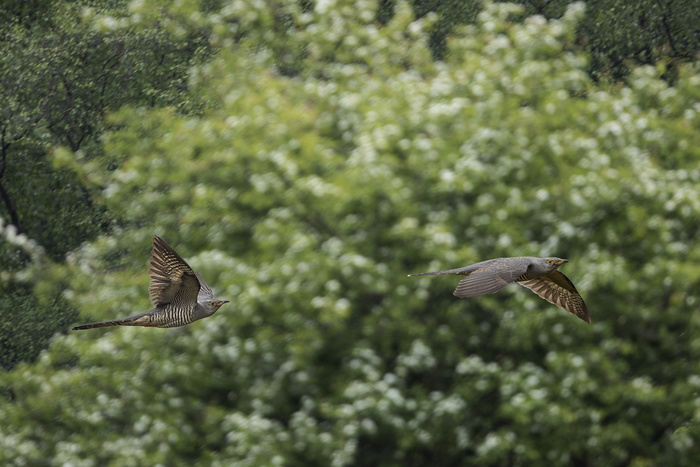
Situated near to where I live there is an upland area that is a reliable site for one or two Cuckoos every spring. This year again there has been a female bird there but she was quiet for a week until we saw a male bird there yesterday. While we were watching this male bird another male appeared and then all hell broke loose. Cuckoos are quite territorial and there ensued a monumental ‘dog - fight’ between them. When Cuckoos are agitated they can perform some incredible aerial acrobatics and they really can shift. The two of them were ripping through the trees at incredible speed with only a couple of feet between them. Every so often they would perch in a tree to catch their breath.
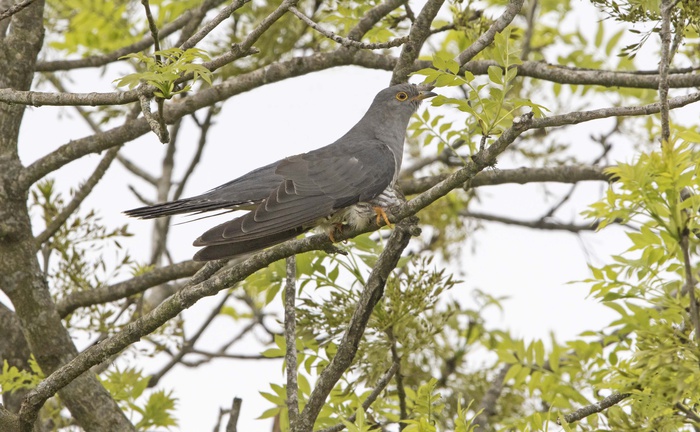
This didn’t last long because as soon as they recovered one bird would swoop in and knock the other of its perch and battle would recommence. This encounter lasted for about ten minutes before one of the birds had had enough and left, we were left stunned by it all but it was great to see nature at its best for a short while.
They flew at such speed that it was almost impossible to get a shot of them because they would suddenly appear through the trees and before you could react they were gone again. You can’t do anything about it when this happens because it is all over in a second. However, the best way I find to lock onto birds flying fast and low is to, (if you can see them coming), first focus on them manually using the lens focus ring and then you will be in the right area. Hopefully the lens autofocus system will then take over and track them. Use the shutter speed priority mode on your camera and select a speed of at least 1000/sec, higher speeds may be necessary. These two Cuckoos were shot at 1250/sec at f4.
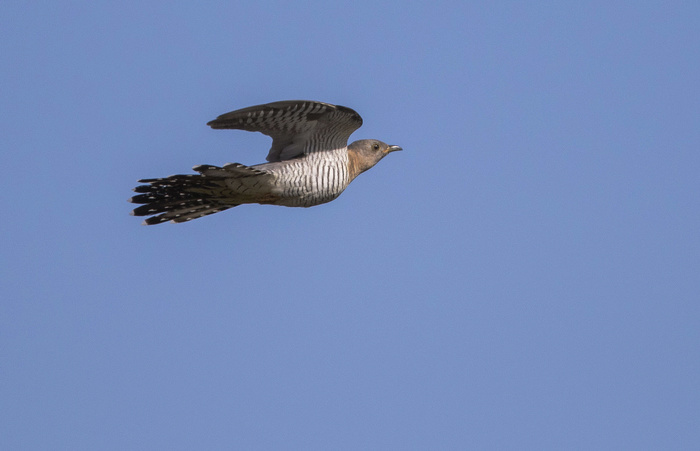
The female bird that was present was the reason for all the males’ aerobatics. However, she just looked on and left them to it and after a while she departed at a more leisurely pace which made it easier for me to photograph her.
This wasn’t much of a photo session but the spectacle was really enthralling!
This didn’t last long because as soon as they recovered one bird would swoop in and knock the other of its perch and battle would recommence. This encounter lasted for about ten minutes before one of the birds had had enough and left, we were left stunned by it all but it was great to see nature at its best for a short while.
They flew at such speed that it was almost impossible to get a shot of them because they would suddenly appear through the trees and before you could react they were gone again. You can’t do anything about it when this happens because it is all over in a second. However, the best way I find to lock onto birds flying fast and low is to, (if you can see them coming), first focus on them manually using the lens focus ring and then you will be in the right area. Hopefully the lens autofocus system will then take over and track them. Use the shutter speed priority mode on your camera and select a speed of at least 1000/sec, higher speeds may be necessary. These two Cuckoos were shot at 1250/sec at f4.
The female bird that was present was the reason for all the males’ aerobatics. However, she just looked on and left them to it and after a while she departed at a more leisurely pace which made it easier for me to photograph her.
This wasn’t much of a photo session but the spectacle was really enthralling!
Crested Tit, punk rocker of the pine forest!
10th May 2016
10th May 2016
De Hoge Veluwe nature reserve near Arnhem in the Netherlands is a hugely diverse area.
Walking through this multi habitat reserve is quite an experience with large numbers of Wood Warblers singing and Hawfinches calling from the broad leaf canopy. The forests also contain huge amounts of Willow Warblers and Chiffchaffs; herds of Wild Boar and Red Deer also roam here. On the grasslands Woodlarks sing from on high, Cuckoos call fom all over and Hobbies relentlessly hunt insects.
A bird which is not uncommon in Europe, relatively speaking, is the Black Woodpecker, never recorded in the UK it would provoke a mega twitch should it ever appear over here!!
After talking to a very friendly park ranger he told us that if we walked a certain forest track near his home we might get a sighting of one of these birds. We readily took up his offer and sure enough we had two great, albeit brief flight views of two birds as they flew back and fore their nest. However, walking in this forest is prohibited because of the wild animals so we had to be content with these views, but I'm not complaining, what a spectacular bird they are.
There is also a large area of drift sand in the reserve and it is quite unusual to see this in the middle of the grasslands.
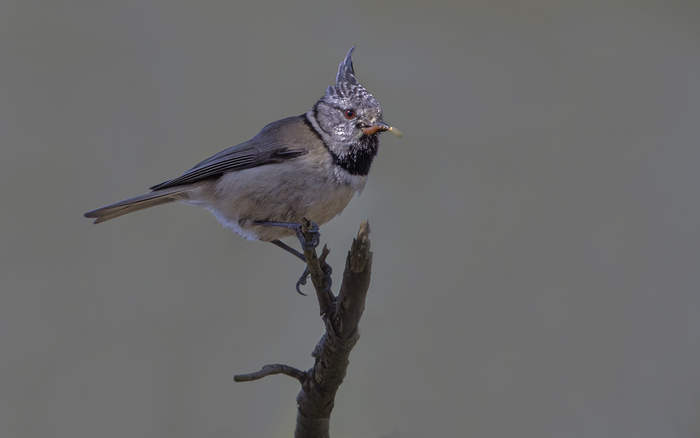
The pine woods in this fantastic nature reserve are home to large numbers of Crested Tit, a bird only usually found in the north of the UK and principally Scotland. This was our target but they are extremely difficult to pin down. To hear them singing and calling is easy but to photograph them ia another thing. They are so small and are constantly on the move probing everywhere for grubs and insects.
At last after locating a farily static pair of birds I managed to get a reasonable shot of a bird with a grub in its beak.
With that crest you can see why its like a Punk rocker!
Walking through this multi habitat reserve is quite an experience with large numbers of Wood Warblers singing and Hawfinches calling from the broad leaf canopy. The forests also contain huge amounts of Willow Warblers and Chiffchaffs; herds of Wild Boar and Red Deer also roam here. On the grasslands Woodlarks sing from on high, Cuckoos call fom all over and Hobbies relentlessly hunt insects.
A bird which is not uncommon in Europe, relatively speaking, is the Black Woodpecker, never recorded in the UK it would provoke a mega twitch should it ever appear over here!!
After talking to a very friendly park ranger he told us that if we walked a certain forest track near his home we might get a sighting of one of these birds. We readily took up his offer and sure enough we had two great, albeit brief flight views of two birds as they flew back and fore their nest. However, walking in this forest is prohibited because of the wild animals so we had to be content with these views, but I'm not complaining, what a spectacular bird they are.
There is also a large area of drift sand in the reserve and it is quite unusual to see this in the middle of the grasslands.
The pine woods in this fantastic nature reserve are home to large numbers of Crested Tit, a bird only usually found in the north of the UK and principally Scotland. This was our target but they are extremely difficult to pin down. To hear them singing and calling is easy but to photograph them ia another thing. They are so small and are constantly on the move probing everywhere for grubs and insects.
At last after locating a farily static pair of birds I managed to get a reasonable shot of a bird with a grub in its beak.
With that crest you can see why its like a Punk rocker!
Bluethroats in Oostvaardersplassen, Netherlands.
08th May 2016
08th May 2016
If there is one bird that I’ve been keen to get some images of for some time it’s the Bluethroat. I have seen many on my travels, some in the UK, Poland and a huge fall of 400 birds in China, with eight sitting in one small bush. Frustratingly, however, I have never been in a position to photograph them.
Bluethroats are such a charismatic little bird, so colourful with their light ochre undertail sides, a large rusty breastband with another smaller breastband above, delicately fringed with black and white and that intense ‘blue throat’. They also have a broad and conspicuous creamy white supercilium’.
There are three races of Bluethroat; white spotted birds which are found in southern and central Europe; red spotted birds found in northern Europe and birds with no spot typically found in eastern Turkey.
In the UK the red and white spotted races are sometimes seen, although very infrequently, with perhaps one or two birds a year and with many years none at all. The Netherlandss has become a hotspot for the white spotted race with a large increase in population over the last twenty years. With this in mind last week we flew from Cardiff to Schiphol airport in Amsterdam, a flight of only 55mins. Picked up a hire car and drove the 60km or so to a little thatched cottage we had booked near Harderwijke.
We chose this area because it is fairly close to the Oostvaardersplassen nature reserve, a famous Bluethroat location, in south Flevoland. After picking up some supplies from a local store we unpacked and went for a walk in the local countryside. After showering and having supper, feeling tired we got an early night and were up at first light the next morning full of anticipation. We drove to the reserve in about 40mins and went straight in to the reedbeds where the Bluethroats breed.
In theory you could leave Cardiff, and in under four hours be at Oostvaardersplassen amongst Bluethroats.
Getting there is straightforward, (if you have the confidence to drive in Dutch traffic), more about that in the full trip report!!
Photographing these enigmatic birds, however, at this site is far from straightforward. They exist almost exclusively in the reedbeds where you can hear their song which characteristically starts with a repeated squeak which has been likened to a wheel on a child’s bicycle. This is followed by a series of rapid twittering notes interspersed with sharp whistles and creaky calls, it sounds difficult but once heard it is quite easy to identify.
Walking along we met a Dutch birder and said good morning, we asked him if there were any (Blauwborsten), Bluethroats. He said he had seen one bird only that morning, we thanked him and carried on to the reed beds. After about twenty minutes a bird started singing and flew into the top of a small tree, it was badly silhouetted against the bright sky but nevertheless there were birds there.
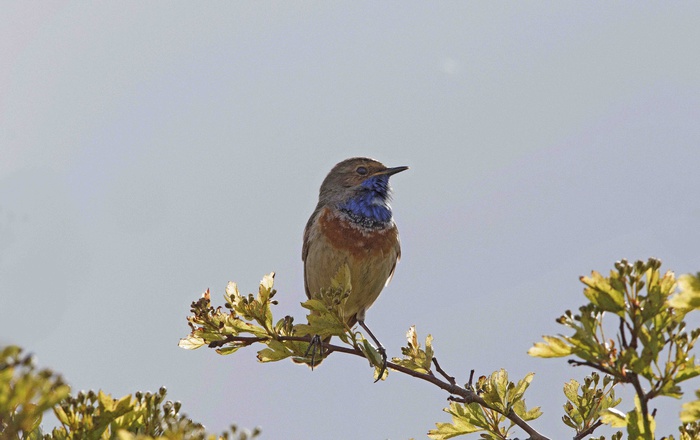
We walked the track between the reed beds and although we could hear several birds no further sightings were had. We left disappointed but decided to try again the following day.
The next day we were up early again and at the reed beds, where we saw another, much older Dutch birder who said it was too windy and like other reed bed birds they keep down in these conditions. He also told us the birds like the sun to come up just above the horizon on a calm morning and then they would usually show. His one caveat was that the birds wouldn’t show for long, about an hour, then they usually went quiet. These observations were based on his thirty years birding there. He said the forecast was good for the next morning and wished us luck, we left and went for a walk around. This reserve is pretty amazing with huge amounts of birds and animals, one area was basically a field of Comfrey and Dock which held hundreds of Whitethroats, many Grasshopper Warblers and Blue Headed Wagtails.
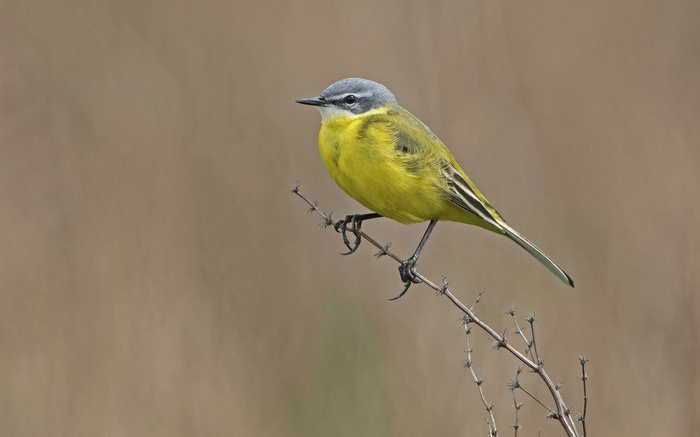
A truly lovely spectacle.
The next morning just after first light we were there again and the same bird was singing, silhouetted at the top of its favourite tree. However, as the sun rose higher, up the track we could see birds starting to fly around and we could now finally see the ‘Blauwborsten’. The grizzled old Dutch birder was right, you can’t beat local knowledge!! There was an estimated ten birds flying around the reeds along a hundred yard stretch of track. We just stood still and waited until a bird started to sing from a perch and then slowly walked along and took some photographs. It was an absolutely glorious morning there was no one else around and some of the birds were really confiding, it really was special. Some birds even flew onto the grassy track to feed and were walking towards us completaly unconcerned.
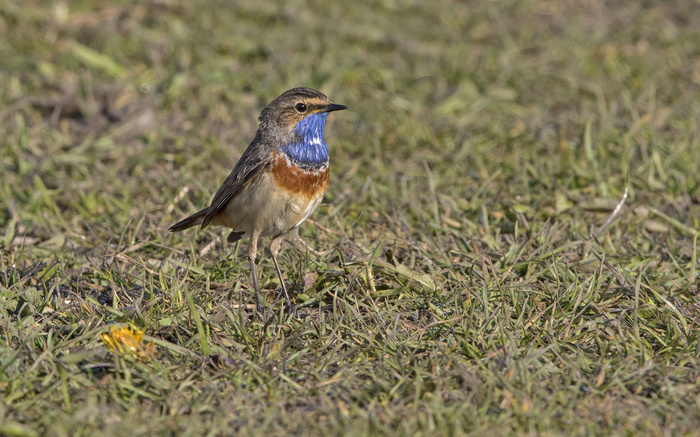
One male bird perched really close to us on an old dead stick amongst the reeds and allowed me to take some lovely images it was a dream finally come true.
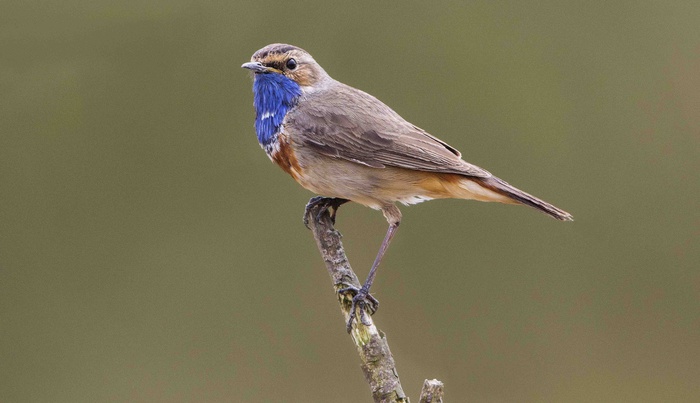
It was an hour we will never forget and yes after about an hour they started to go quiet!
Please see Latest Images, Bluethroats, for more photos.
Bluethroats are such a charismatic little bird, so colourful with their light ochre undertail sides, a large rusty breastband with another smaller breastband above, delicately fringed with black and white and that intense ‘blue throat’. They also have a broad and conspicuous creamy white supercilium’.
There are three races of Bluethroat; white spotted birds which are found in southern and central Europe; red spotted birds found in northern Europe and birds with no spot typically found in eastern Turkey.
In the UK the red and white spotted races are sometimes seen, although very infrequently, with perhaps one or two birds a year and with many years none at all. The Netherlandss has become a hotspot for the white spotted race with a large increase in population over the last twenty years. With this in mind last week we flew from Cardiff to Schiphol airport in Amsterdam, a flight of only 55mins. Picked up a hire car and drove the 60km or so to a little thatched cottage we had booked near Harderwijke.
We chose this area because it is fairly close to the Oostvaardersplassen nature reserve, a famous Bluethroat location, in south Flevoland. After picking up some supplies from a local store we unpacked and went for a walk in the local countryside. After showering and having supper, feeling tired we got an early night and were up at first light the next morning full of anticipation. We drove to the reserve in about 40mins and went straight in to the reedbeds where the Bluethroats breed.
In theory you could leave Cardiff, and in under four hours be at Oostvaardersplassen amongst Bluethroats.
Getting there is straightforward, (if you have the confidence to drive in Dutch traffic), more about that in the full trip report!!
Photographing these enigmatic birds, however, at this site is far from straightforward. They exist almost exclusively in the reedbeds where you can hear their song which characteristically starts with a repeated squeak which has been likened to a wheel on a child’s bicycle. This is followed by a series of rapid twittering notes interspersed with sharp whistles and creaky calls, it sounds difficult but once heard it is quite easy to identify.
Walking along we met a Dutch birder and said good morning, we asked him if there were any (Blauwborsten), Bluethroats. He said he had seen one bird only that morning, we thanked him and carried on to the reed beds. After about twenty minutes a bird started singing and flew into the top of a small tree, it was badly silhouetted against the bright sky but nevertheless there were birds there.
We walked the track between the reed beds and although we could hear several birds no further sightings were had. We left disappointed but decided to try again the following day.
The next day we were up early again and at the reed beds, where we saw another, much older Dutch birder who said it was too windy and like other reed bed birds they keep down in these conditions. He also told us the birds like the sun to come up just above the horizon on a calm morning and then they would usually show. His one caveat was that the birds wouldn’t show for long, about an hour, then they usually went quiet. These observations were based on his thirty years birding there. He said the forecast was good for the next morning and wished us luck, we left and went for a walk around. This reserve is pretty amazing with huge amounts of birds and animals, one area was basically a field of Comfrey and Dock which held hundreds of Whitethroats, many Grasshopper Warblers and Blue Headed Wagtails.
A truly lovely spectacle.
The next morning just after first light we were there again and the same bird was singing, silhouetted at the top of its favourite tree. However, as the sun rose higher, up the track we could see birds starting to fly around and we could now finally see the ‘Blauwborsten’. The grizzled old Dutch birder was right, you can’t beat local knowledge!! There was an estimated ten birds flying around the reeds along a hundred yard stretch of track. We just stood still and waited until a bird started to sing from a perch and then slowly walked along and took some photographs. It was an absolutely glorious morning there was no one else around and some of the birds were really confiding, it really was special. Some birds even flew onto the grassy track to feed and were walking towards us completaly unconcerned.
One male bird perched really close to us on an old dead stick amongst the reeds and allowed me to take some lovely images it was a dream finally come true.
It was an hour we will never forget and yes after about an hour they started to go quiet!
Please see Latest Images, Bluethroats, for more photos.