News
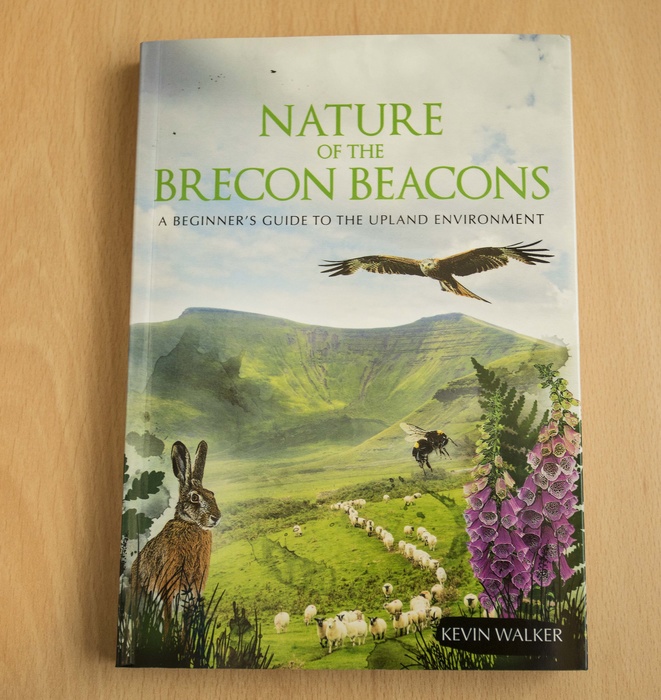
A new book - 'Nature of the Brecon Beacons'.
06th March 2019
06th March 2019
Nature of the Brecon Beacons.
By Kevin Walker
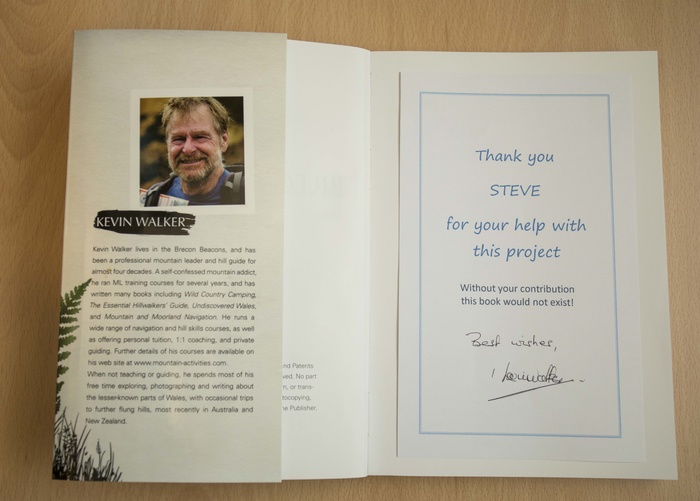
Last Saturday saw the release of the above book and I’m pleased to say that all the bird images featured were supplies by me. This is a very wide ranging and informative book covering most things you are likely to encounter on your walks in the Brecon Beacons. Kevin runs a local walking business featuring navigation and hill skills and also private guiding.
This is the third book that has featured my images of birds in the Brecon Beacons.
It’s nice to see my images in publication, especially highlighting the area where I live.
By Kevin Walker
Last Saturday saw the release of the above book and I’m pleased to say that all the bird images featured were supplies by me. This is a very wide ranging and informative book covering most things you are likely to encounter on your walks in the Brecon Beacons. Kevin runs a local walking business featuring navigation and hill skills and also private guiding.
This is the third book that has featured my images of birds in the Brecon Beacons.
It’s nice to see my images in publication, especially highlighting the area where I live.
The Forest of Dean on a Glorious Day.
28th February 2019
28th February 2019
We decided to visit the Forest of Dean yesterday to take advantage of this sublime spell of winter weather. Our first stop was Parkend Church to see if we could locate any Lesser Spotted Woodpeckers - and along one of the forestry tracks we could hear one drumming softly but we couldn’t see where - but that’s about par for the course with these enigmatic little birds. Also in this location Crossbills have been coming down to drink from some road – side puddles, but these puddles are now virtually dry. There was a man sat in his car there with a Camo jacket on and a lens, obviously waiting for these birds to hopefully come down to drink. Amusingly, in the very warm sunshine he was fast asleep and when we returned about an hour later he was still asleep. I hope no birds came down because he would have missed them. I say amusingly, because it has happened to me previously, especially when things are quiet. I was trying to photograph a Cuckoo one morning some years ago in similar weather and I had fallen asleep in my hide and when I woke up there was the Cuckoo on a branch of a tree a few feet away just staring at me.
In Parkend, in the woodland opposite the cricket pitch in Crown Lane Hawfinches can sometimes be seen, but this is a very noisy area and there is always disturbance from dog walkers, traffic and worst of all so-called birders and photographers who get out of their cars to try and see the Hawfinches. This behaviour inevitably spooks these very flighty birds and results in nobody seeing them. We parked under the trees and saw one male bird that was still in winter plumage but the light under there was quite frankly abysmal, and there was no real chance of a decent photograph because of these dire lighting conditions. This situation was compounded when a ‘photographer’ walked right up to this woodland and produced a picnic chair and sat down with his tripod and camera obviously with the intention of photographing Hawfinches – LOL – No Chance!! We decided to leave, reminded why we hate this location.
We then visited the New Fancy View lookout just up the road from Parkend, to see if there were any Goshawks displaying and there were only two very distant birds seen. New Fancy view is not what it was, even a few years ago. We can remember numbers of Crossbills landing in the tops of the pine trees and Hawfinches flying across the tree tops regularly. Yesterday there was hardly any bird song there and virtually no raptors in the air anywhere – in weather like this you would think birds would be out displaying and singing but I suppose it’s just a reflection of the way things are these days.
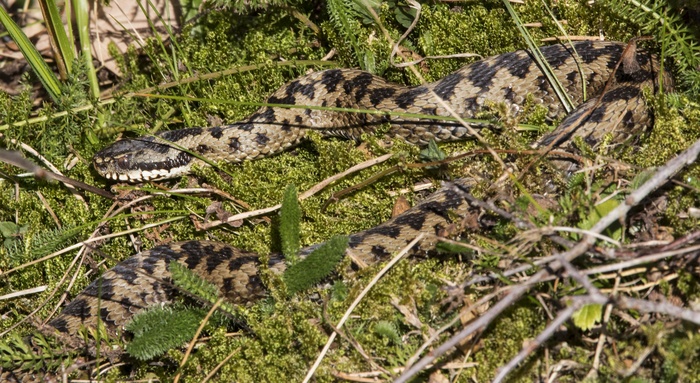
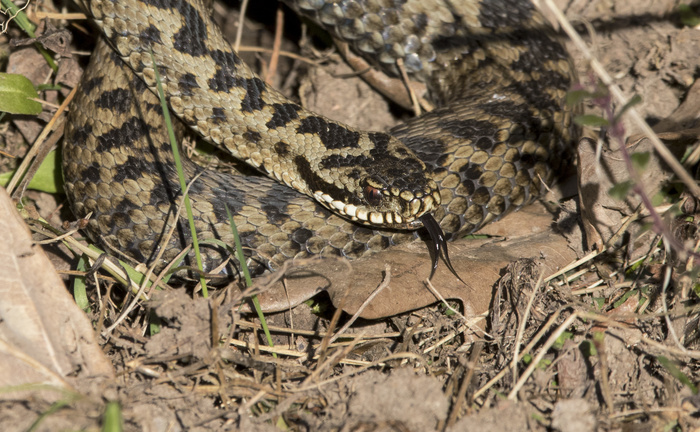
However, there was one saving grace in terms of wildlife – on the walk back down from New Fancy View, on the grassy banking by the side of the track, we came across some Adders – three in total – all males. I managed some shots as they warmed – up in the leaf litter. Seeing these lovely snakes always brings to mind just how small they are, and how they are easily missed most of the time as people walk by.
These snakes are recognizeable by their individual head patterns by people who monitor them.
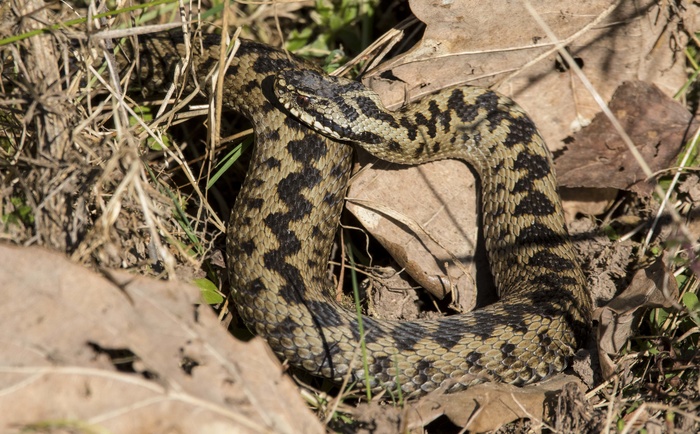
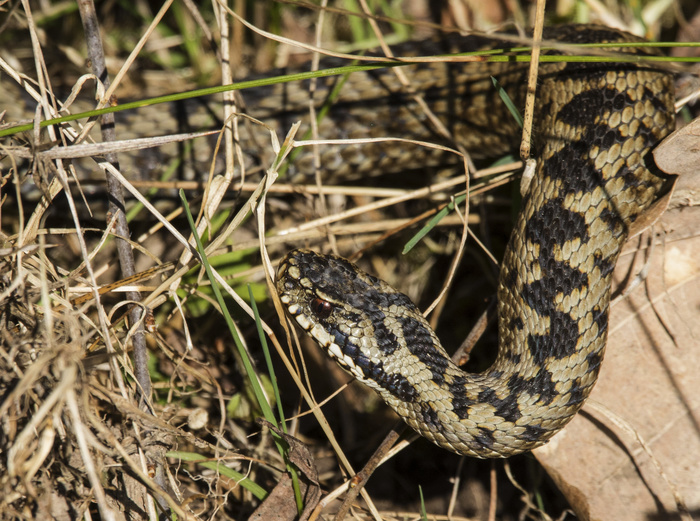
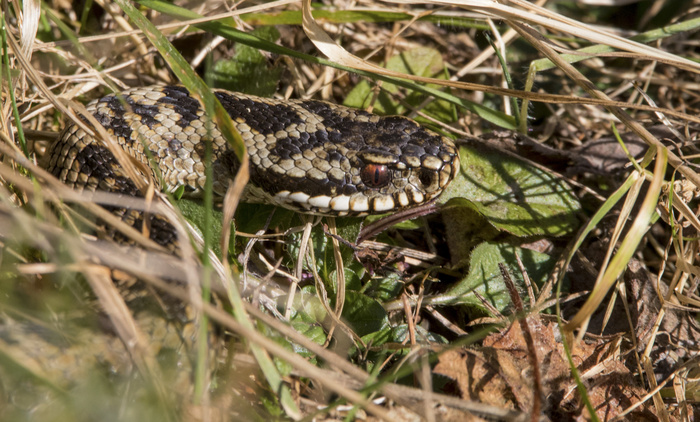
Despite the lack of birds it was still an absolute pleasure to be out walking around on such a glorious day.
In Parkend, in the woodland opposite the cricket pitch in Crown Lane Hawfinches can sometimes be seen, but this is a very noisy area and there is always disturbance from dog walkers, traffic and worst of all so-called birders and photographers who get out of their cars to try and see the Hawfinches. This behaviour inevitably spooks these very flighty birds and results in nobody seeing them. We parked under the trees and saw one male bird that was still in winter plumage but the light under there was quite frankly abysmal, and there was no real chance of a decent photograph because of these dire lighting conditions. This situation was compounded when a ‘photographer’ walked right up to this woodland and produced a picnic chair and sat down with his tripod and camera obviously with the intention of photographing Hawfinches – LOL – No Chance!! We decided to leave, reminded why we hate this location.
We then visited the New Fancy View lookout just up the road from Parkend, to see if there were any Goshawks displaying and there were only two very distant birds seen. New Fancy view is not what it was, even a few years ago. We can remember numbers of Crossbills landing in the tops of the pine trees and Hawfinches flying across the tree tops regularly. Yesterday there was hardly any bird song there and virtually no raptors in the air anywhere – in weather like this you would think birds would be out displaying and singing but I suppose it’s just a reflection of the way things are these days.
However, there was one saving grace in terms of wildlife – on the walk back down from New Fancy View, on the grassy banking by the side of the track, we came across some Adders – three in total – all males. I managed some shots as they warmed – up in the leaf litter. Seeing these lovely snakes always brings to mind just how small they are, and how they are easily missed most of the time as people walk by.
These snakes are recognizeable by their individual head patterns by people who monitor them.
Despite the lack of birds it was still an absolute pleasure to be out walking around on such a glorious day.
A pond in the air!!
21st February 2019
21st February 2019
I always thought it would be nice to have a pond where I could take photographs of birds reflected in the water but this is easier said than done. There are various problems, the main one being that you have to get down to eye level in order to do this. This means either lying on the floor for hours or digging a large pit – neither of these alternatives really appealed to me.
Then a few days ago it dawned on me – why couldn’t I raise a small pond up in the air. Ridiculous you may think, but no, not quite as it may seem!
I had a plan in mind:
As I have mentioned previously, I have already constructed a bird photography hide in my little wildlife garden, so firstly I knocked some treated roof battens into the ground about twenty feet away from the hide, then I attached some braces, also made with treated wood to stabilize them. I cut them off to the height I thought was appropriate and put a spirit level across them to make sure they were dead level. I had already bought a plastic octagonal tray that builders use to mix cement, it is about one metre around, I bought it on ebay for £15.00. I placed this tray on a piece of chipboard that I had and drew around it leaving about two inches to spare. I cut out the shape of the tray using a jigsaw and covered the exposed areas with some spare roofing felt that I had kept, I don’t throw things away! I then attached this platform onto the top of the roof battens and again checked for level. I placed the tray on top of the platform and then filled it right to the top with water and checked the view from my hide to make sure it was right for reflections. When I was satisfied I fixed the platform solidly to the battens to prevent any strong winds dislodging it and then also screwed the tray onto the platform. I placed some pieces of wood with Ivy wrapped around them into the tray to act as props.
For the first two days the birds completely ignored this construction and that’s the way they are with anything new – so no problem.
However, today they started to drink from the tray and as I hoped they were reflected in the water, as I intended. I will have to re – arrange the props from time to time, but the beauty of this is that I can put whatever props I like in the water – stones or wood, wrapped with flowers, berries, blossom etc. etc. I’m quite pleased with the way it’s started off – it’s cost me £30 and a little bit of work but I think it’s worth it because as the weather gets warmer and water becomes a priority for birds to drink there will be a lot more candidates for a reflection.
Here's the first reflection, a Siskin.
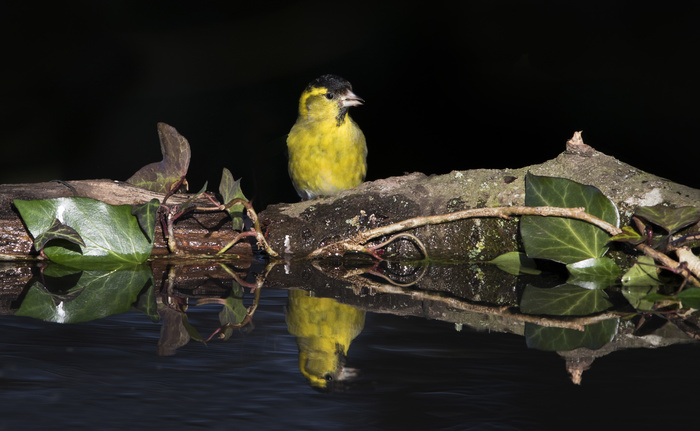
The background will always be dark which is good because it accentuates the subjects but the best images will be taken on calm days to maximise refections.
I can also have wider images, depending on what birds perch on the tray.
Then a few days ago it dawned on me – why couldn’t I raise a small pond up in the air. Ridiculous you may think, but no, not quite as it may seem!
I had a plan in mind:
As I have mentioned previously, I have already constructed a bird photography hide in my little wildlife garden, so firstly I knocked some treated roof battens into the ground about twenty feet away from the hide, then I attached some braces, also made with treated wood to stabilize them. I cut them off to the height I thought was appropriate and put a spirit level across them to make sure they were dead level. I had already bought a plastic octagonal tray that builders use to mix cement, it is about one metre around, I bought it on ebay for £15.00. I placed this tray on a piece of chipboard that I had and drew around it leaving about two inches to spare. I cut out the shape of the tray using a jigsaw and covered the exposed areas with some spare roofing felt that I had kept, I don’t throw things away! I then attached this platform onto the top of the roof battens and again checked for level. I placed the tray on top of the platform and then filled it right to the top with water and checked the view from my hide to make sure it was right for reflections. When I was satisfied I fixed the platform solidly to the battens to prevent any strong winds dislodging it and then also screwed the tray onto the platform. I placed some pieces of wood with Ivy wrapped around them into the tray to act as props.
For the first two days the birds completely ignored this construction and that’s the way they are with anything new – so no problem.
However, today they started to drink from the tray and as I hoped they were reflected in the water, as I intended. I will have to re – arrange the props from time to time, but the beauty of this is that I can put whatever props I like in the water – stones or wood, wrapped with flowers, berries, blossom etc. etc. I’m quite pleased with the way it’s started off – it’s cost me £30 and a little bit of work but I think it’s worth it because as the weather gets warmer and water becomes a priority for birds to drink there will be a lot more candidates for a reflection.
Here's the first reflection, a Siskin.
The background will always be dark which is good because it accentuates the subjects but the best images will be taken on calm days to maximise refections.
I can also have wider images, depending on what birds perch on the tray.
The Sparrowhawk gets more cocky.
21st February 2019
21st February 2019
The juvenile Sparrowhawk that is visiting our garden is getting outrageously bold because he doesn’t care about anybody, especially us. I was watching him through a window of our house as he was perched on the front garden fence and I could see the postman coming down the lane in his van. I thought that he was sure to fly as the van passed below him about ten feet away, but he just looked at the post van with distain and carried on sitting on the fence.
Sometime later he appeared at the back of the house chasing birds around the shrubs and he landed on a small wooden fence which is a border to a gravelled area. I thought I’d open the back door a small bit to test him out and he didn’t blink an eye, so I opened it wide and stepped forward until I was literally about six feet away from him. I expected him to surely fly off, but no he just stayed there looking at me, so I raised my camera with my Sigma 150 – 600 zoom lens attached which I had carried out just in case. A big prime lens would have been no use at all, he was just too close. I fired off a few shots and he just posed there with no fear whatsoever, I couldn’t believe it, then after a while he got bored and he continued chasing the birds again – I was astounded by him!
I don’t think this brazen attitude will continue as he becomes more street – wise, but I’m making the most of it while it lasts!!
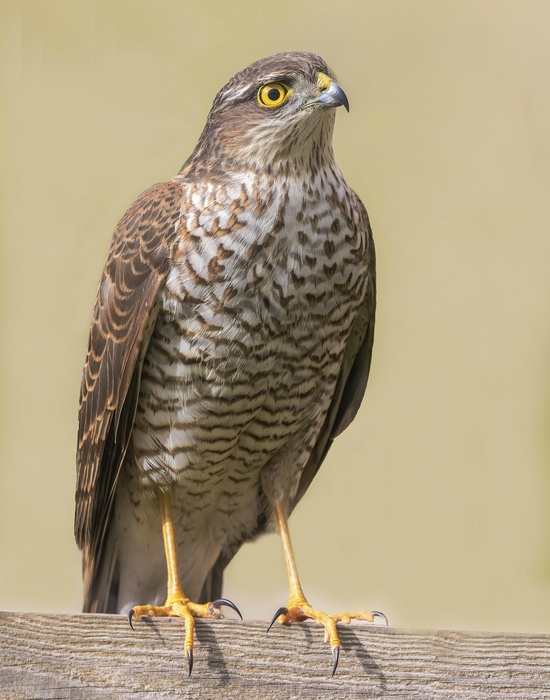
Sometime later he appeared at the back of the house chasing birds around the shrubs and he landed on a small wooden fence which is a border to a gravelled area. I thought I’d open the back door a small bit to test him out and he didn’t blink an eye, so I opened it wide and stepped forward until I was literally about six feet away from him. I expected him to surely fly off, but no he just stayed there looking at me, so I raised my camera with my Sigma 150 – 600 zoom lens attached which I had carried out just in case. A big prime lens would have been no use at all, he was just too close. I fired off a few shots and he just posed there with no fear whatsoever, I couldn’t believe it, then after a while he got bored and he continued chasing the birds again – I was astounded by him!
I don’t think this brazen attitude will continue as he becomes more street – wise, but I’m making the most of it while it lasts!!
Confident Sparrowhawk.
03rd February 2019
03rd February 2019
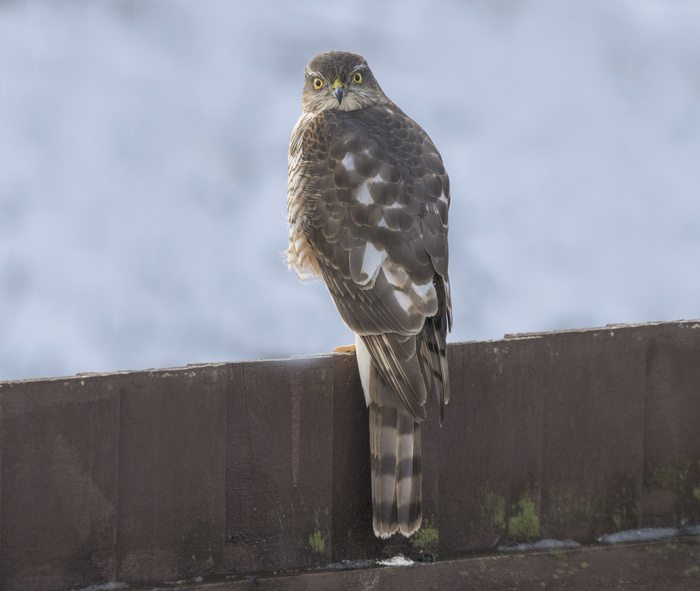
We have had a Juvenile Sparrowhawk visiting our garden for some time and I’m not sure whether it’s a male or female. It’s difficult to tell at this stage but it looks quite small so perhaps it’s a male. If it is he’s getting very confident and last week he perched in a small apple tree right by the side of me. He is still perching on the garden fence as in a previous blog when I shot him on a very wet day. Yesterday he was there again only this time he was dry, I thought that because he was so wet last time he couldn’t be bothered to fly away and this time he would be more wary. However, it’s obvious now that he doesn’t care about me watching him and I took more shots as he just perched there looking at me with distain. It will be interesting, if he continues to visit us, to see whether I am right about him?
A Winters Tale.
03rd February 2019
03rd February 2019
Yesterday Susan and I went for a drive and a walk around the area, with the aim of getting a few shots of the recent snow. We attempted to get up onto Mynydd Illtud but failed miserably because the road leading up there was a sheet of impassable ice. We then decided to drive along the A470 Brecon to Merthyr Tydfil road – big mistake!! I should know better, the scene which unfolded before us could only be described as madness. Literally hundreds of parked cars lined the road and all the layby’s were also rammed with vehicles. The Storey Arms car park was jam - packed and the newly constructed Pont Y Daf car park was also ‘chock a block’. Lines of people, reminiscent of ‘Marching Ants’ were going up and down the mountain in their quest to reach the summit of Pen y Fan. I had no doubt the Neuadd car park in the next valley was also rammed full. I cannot understand why everybody has to walk up to Pen Y Fan and nowhere else, they must have a ‘Lemming’ mentality. I fear my days of walking in that area are finished because the last thing I want to do is walk in a queue!
Fifty years ago, when I was just a kid my mates and I used to ride our bikes from Merthyr up the A470 road to the Storey Arms, it seemed like an epic adventure, traffic was light and the road was much more undulating. There were no car parks then, Storey Arms had a small pull – in for lorry drivers who wanted to get something to eat in the café there. We used to have a much anticipated hot pie and a cup of tea before we made the return journey to Merthyr, which was much easier because it was mostly downhill. When I started to walk the Beacons forty five years ago, in the aforementioned Neuadd valley you could park your vehicle outside the old water treatment works and walk from there, it was always very quiet. I could walk for three or four hours and not see anyone and there would still be no other cars parked where I had left mine. If you came across anyone walking, then odds – on you would know them because there was only a small core of walkers who did the Beacons regularly. I remember three old blokes who I used to see, they were getting on for seventy then, and one of them used to use a walking stick and if the mist was down really thickly you couldn’t see anything but I could hear the ‘Tap - Tap’ of his stick and I knew who it was without seeing them - they must be long gone now, also disappeared into the mists of time.
Those old mountain walkers, if they were alive today would be amazed at the current scene.
Apologies for the digression, Susan and I couldn’t wait to escape the mayhem and we slowly drove our way back to Brecon. I have had a shot in mind for some time now and it was from just outside Llanhamlach Church with the Beacons in the background.
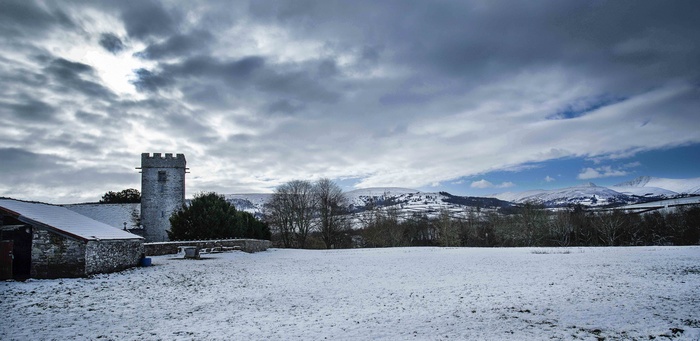
We pulled in near the church and after some thought on the best position I finally came up with a shot. It was now a very cold scene with a bitter breeze blowing so I took a few shots and we headed for home.
Fifty years ago, when I was just a kid my mates and I used to ride our bikes from Merthyr up the A470 road to the Storey Arms, it seemed like an epic adventure, traffic was light and the road was much more undulating. There were no car parks then, Storey Arms had a small pull – in for lorry drivers who wanted to get something to eat in the café there. We used to have a much anticipated hot pie and a cup of tea before we made the return journey to Merthyr, which was much easier because it was mostly downhill. When I started to walk the Beacons forty five years ago, in the aforementioned Neuadd valley you could park your vehicle outside the old water treatment works and walk from there, it was always very quiet. I could walk for three or four hours and not see anyone and there would still be no other cars parked where I had left mine. If you came across anyone walking, then odds – on you would know them because there was only a small core of walkers who did the Beacons regularly. I remember three old blokes who I used to see, they were getting on for seventy then, and one of them used to use a walking stick and if the mist was down really thickly you couldn’t see anything but I could hear the ‘Tap - Tap’ of his stick and I knew who it was without seeing them - they must be long gone now, also disappeared into the mists of time.
Those old mountain walkers, if they were alive today would be amazed at the current scene.
Apologies for the digression, Susan and I couldn’t wait to escape the mayhem and we slowly drove our way back to Brecon. I have had a shot in mind for some time now and it was from just outside Llanhamlach Church with the Beacons in the background.
We pulled in near the church and after some thought on the best position I finally came up with a shot. It was now a very cold scene with a bitter breeze blowing so I took a few shots and we headed for home.
Great Grey Shrike again!
30th January 2019
30th January 2019
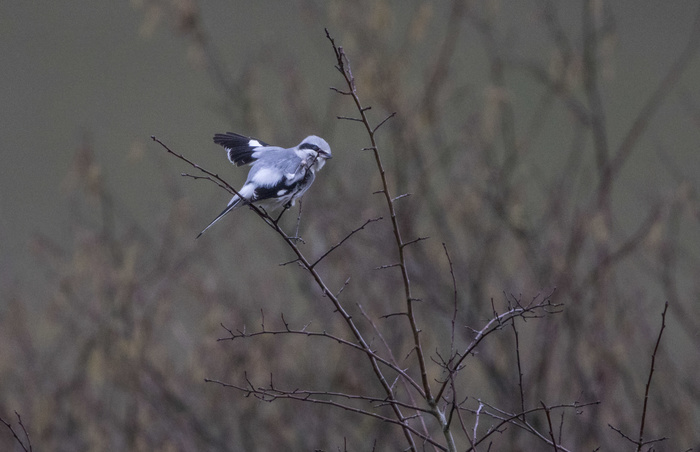
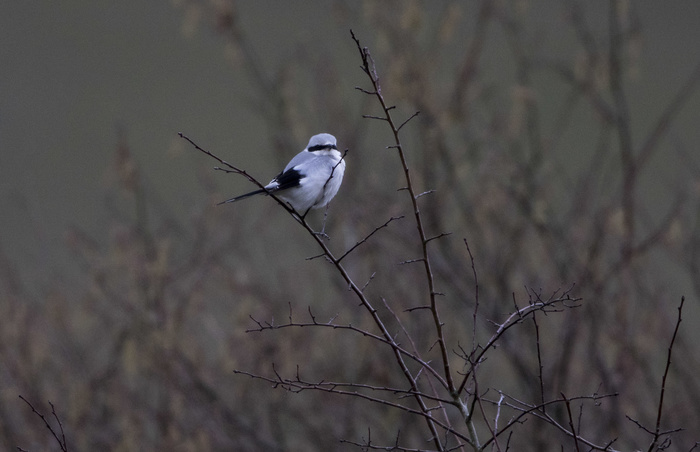
I didn’t think I would see the Great Grey Shrike outside my kitchen window again, I thought it was definitely a one - off. However, a fortnight to the day here it was again, in exactly the same bush! I’ve never known a Grey Shrike to be near our house before and to have it return is just incredible to see.
It stayed for one and a half days and now it’s disappeared again, I would love to know where it’s going - it’s intriguing. I can’t complain though, because just to see one of these elusive birds outside your house is some garden tick, there’s not many people who have Great Grey Shrike on their garden list!
I wonder if it will return again – I sincerely hope so!
Also a bonus for us of a female Kestrel at last light - what next?
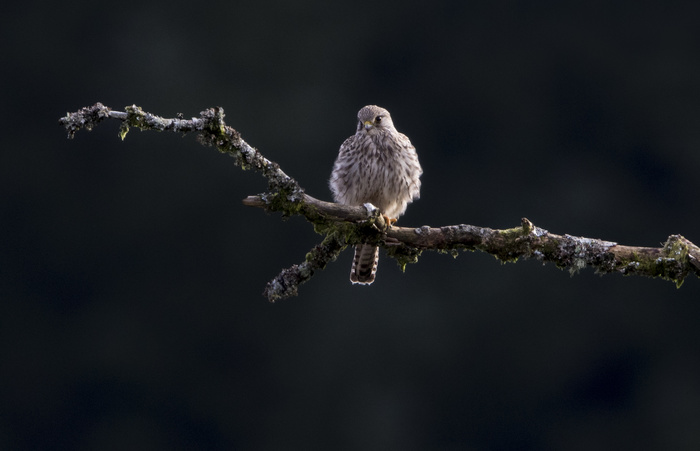
It stayed for one and a half days and now it’s disappeared again, I would love to know where it’s going - it’s intriguing. I can’t complain though, because just to see one of these elusive birds outside your house is some garden tick, there’s not many people who have Great Grey Shrike on their garden list!
I wonder if it will return again – I sincerely hope so!
Also a bonus for us of a female Kestrel at last light - what next?
Waxwings in the Brecon Beacons.
24th January 2019
24th January 2019
There hasn’t been a significant Waxwing irruption this winter and therefore it was a surprise to hear of seven birds feeding on mistletoe berries in a local town about seven miles from where I live.
There have been many reports from Scotland and northern England but that’s not unusual because they’re there every year. The norm is that it has to be a really big irruption before any are seen in this area. However, I was cautiously optimistic because there had been one or two birds reported in mid-Wales and also twelve in Hereford, just over the border.
These local birds were first spotted by a visiting birder on his way back home from this area, purely by chance, as is the norm.
Unfortunately these birds were feeding on mistletoe berries in some apple trees outside a primary school and judiciously I waited for the morning’s activities to subside and the children to go into school because you really can’t be too careful these days. Even if it is obvious what you are doing there is still an element in today’s society that will complain just for the sake of it.
When I arrived there was no one there and I could immediately see seven birds in the apple trees, there was no activity in the playground, so I filled my boots. Waxwings are easy to photograph because they are so confiding and it’s just a matter of isolating a bird or two for a photograph. Frustratingly there are very few red berries at the site so a colourful shot is not possible but it’s always a treat to see these special birds.
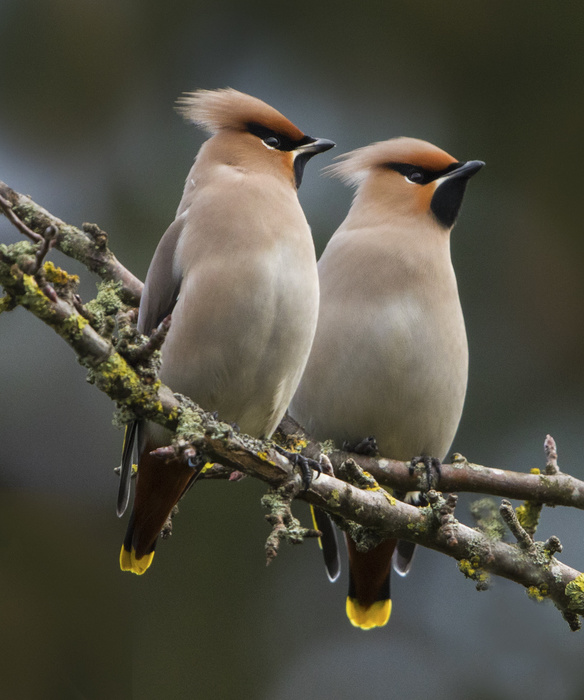
For more images see; Latest Images, Waxwings in the Brecon Beacons.
There have been many reports from Scotland and northern England but that’s not unusual because they’re there every year. The norm is that it has to be a really big irruption before any are seen in this area. However, I was cautiously optimistic because there had been one or two birds reported in mid-Wales and also twelve in Hereford, just over the border.
These local birds were first spotted by a visiting birder on his way back home from this area, purely by chance, as is the norm.
Unfortunately these birds were feeding on mistletoe berries in some apple trees outside a primary school and judiciously I waited for the morning’s activities to subside and the children to go into school because you really can’t be too careful these days. Even if it is obvious what you are doing there is still an element in today’s society that will complain just for the sake of it.
When I arrived there was no one there and I could immediately see seven birds in the apple trees, there was no activity in the playground, so I filled my boots. Waxwings are easy to photograph because they are so confiding and it’s just a matter of isolating a bird or two for a photograph. Frustratingly there are very few red berries at the site so a colourful shot is not possible but it’s always a treat to see these special birds.
For more images see; Latest Images, Waxwings in the Brecon Beacons.
Sunrise and a Shrike.
10th January 2019
10th January 2019
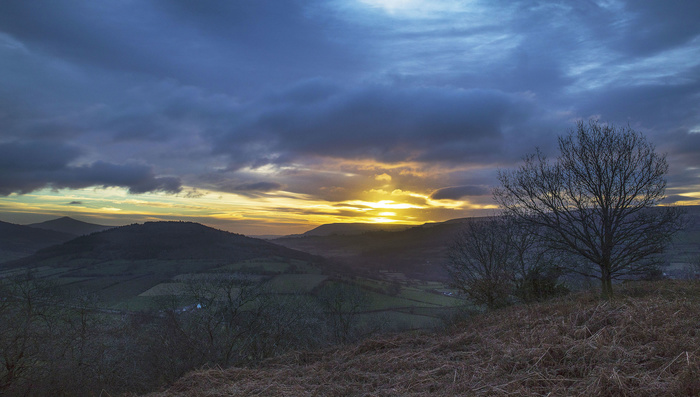
I was out at first light yesterday up on Buckland Hill, this hill is situated above a village near to where I live. It was quite cold with a chilly breeze blowing and fortunately I was not there long because I had timed it to just capture the sunrise. However, there was too much cloud for a colourful sunrise but there was some ‘Drama’ in the early morning sky. The sun appeared above Mynydd Llangattwg, below which are some of the most extensive cave systems in the UK. Having said that, caving is definitely not my cup of tea, I’m OK up to a point, but when you have to really squeeeeeze yourself through very small dark places then that’s it for me - I prefer fresh air and big open skies!
In the picture below you can see from the left, ‘Sugarloaf’ mountain, then Myarth in the centre and finally the sunrise above Mynydd Llangattwg on the right.
This morning I was up early again and up on top of Mynydd Llangynidr to try a different viewpoint for a sunrise. Disappointingly, nothing materialised despite the early morning looking promising. It was bitterly cold with a heavy frost and to be honest I was glad to come back home. When I arrived back home I cooked some breakfast to warm me up and afterwards when I was washing the dishes in my kitchen and I just casually looked across the field and I could see a light grey bird in the hedge row. I thought ‘What’s that?’ so I reached for my old Swift binoculars that I keep on the window sill, precisely for situations like this. I couldn’t believe what I was seeing, there was a Great Grey Shrike perched there looking across the field.
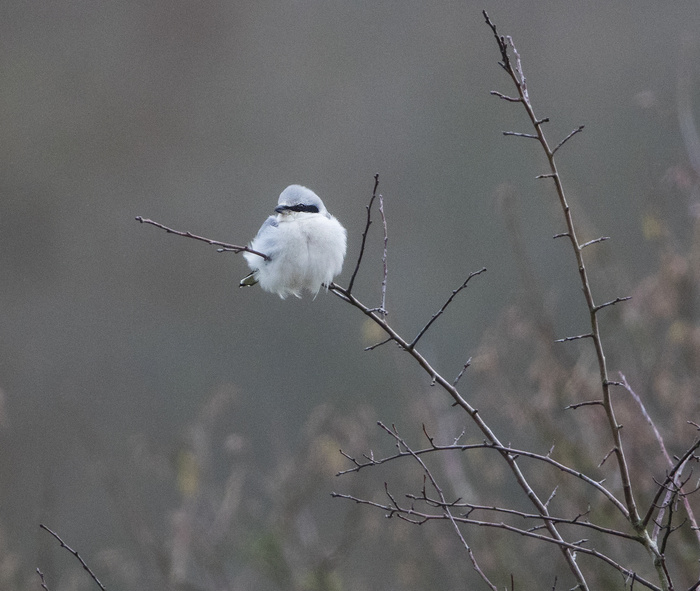
I called Susan to see it, nearly dropping a plate as I did so – I ran upstairs to get a lens and I opened a bedroom window and took a few low quality hand held shots before it flew out of sight. Susan and I saw it again briefly later, but then it disappeared.
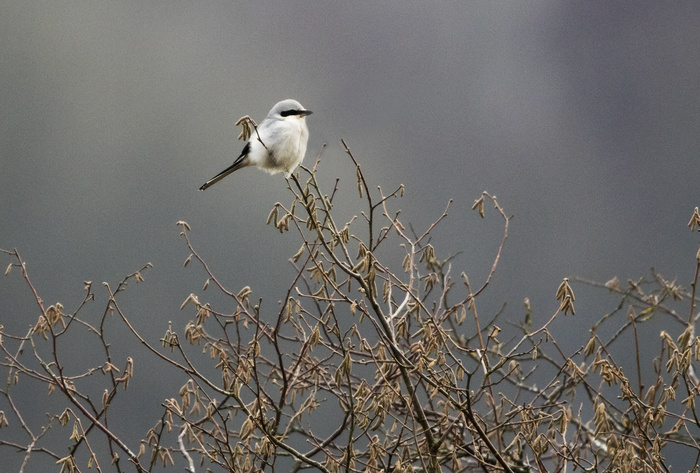
It was without doubt the rarest bird we have seen from our kitchen.
In the picture below you can see from the left, ‘Sugarloaf’ mountain, then Myarth in the centre and finally the sunrise above Mynydd Llangattwg on the right.
This morning I was up early again and up on top of Mynydd Llangynidr to try a different viewpoint for a sunrise. Disappointingly, nothing materialised despite the early morning looking promising. It was bitterly cold with a heavy frost and to be honest I was glad to come back home. When I arrived back home I cooked some breakfast to warm me up and afterwards when I was washing the dishes in my kitchen and I just casually looked across the field and I could see a light grey bird in the hedge row. I thought ‘What’s that?’ so I reached for my old Swift binoculars that I keep on the window sill, precisely for situations like this. I couldn’t believe what I was seeing, there was a Great Grey Shrike perched there looking across the field.
I called Susan to see it, nearly dropping a plate as I did so – I ran upstairs to get a lens and I opened a bedroom window and took a few low quality hand held shots before it flew out of sight. Susan and I saw it again briefly later, but then it disappeared.
It was without doubt the rarest bird we have seen from our kitchen.
Happy New Year.
01st January 2019
01st January 2019
I met up with a good friend of mine yesterday, basically just to get out and about but also to try and see a Great Grey Shrike that had been reported locally. When we arrived at the location the light was really bad with grey skies and a fine mist in the air. We realised very quickly that any shots would be mediocre at best and after locating the bird about 500 yds away we set off walking towards it, however, these birds are always mobile and this individual certrainly was. We managed to get a few distant record shots,
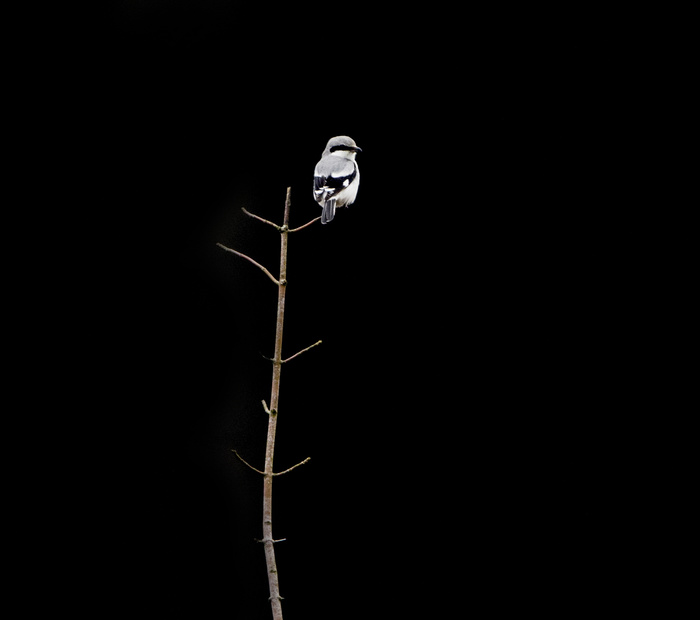
I lined the bird up against the very dark forestry to bring out it's light grey plumage.
Unfortunately the light was getting progressively worse so we abandoned the shoot and said our farewells. On the drive back from the area I stopped at a junction and suddenly a larch cone bounced off the road in front of me. This can only mean one thing, Crossbills!
I parked up and sure enough there were about five birds above me eating larch seeds. I took a few shots in what was now dreadful light.
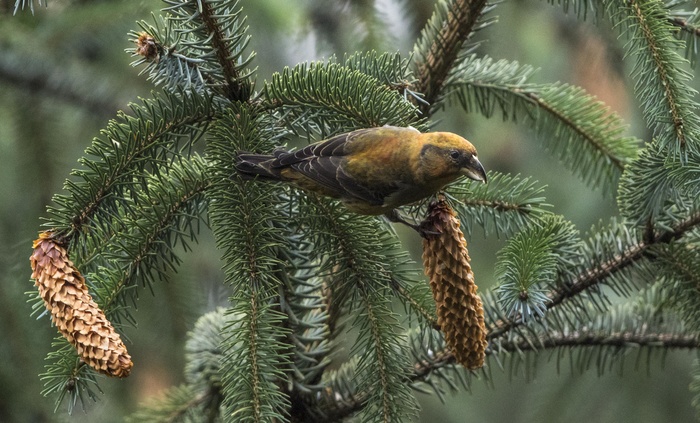
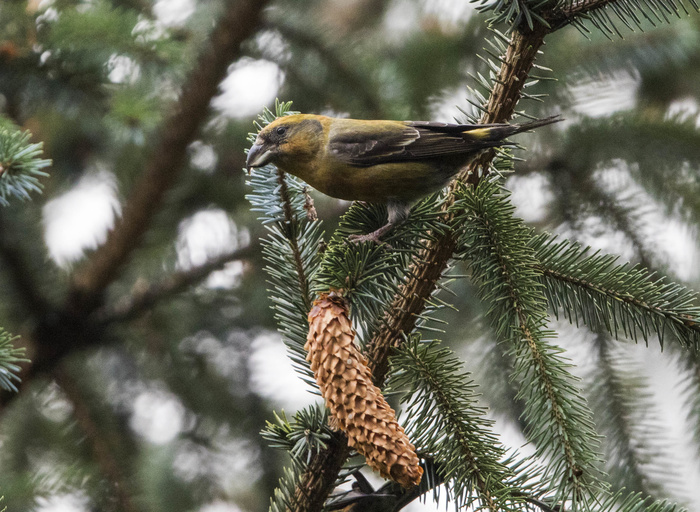
Very soon the birds disappeared in search of more food. However, it was nice to come across what are becomimg quite difficult birds to see in this area. It just goes to show that you have to get out because you never know - 'You've got to be in it to win it'!
I lined the bird up against the very dark forestry to bring out it's light grey plumage.
Unfortunately the light was getting progressively worse so we abandoned the shoot and said our farewells. On the drive back from the area I stopped at a junction and suddenly a larch cone bounced off the road in front of me. This can only mean one thing, Crossbills!
I parked up and sure enough there were about five birds above me eating larch seeds. I took a few shots in what was now dreadful light.
Very soon the birds disappeared in search of more food. However, it was nice to come across what are becomimg quite difficult birds to see in this area. It just goes to show that you have to get out because you never know - 'You've got to be in it to win it'!
Merry Xmas.
24th December 2018
24th December 2018
Well here we are again, and to quote Ebeneezer Scrooge - another year older and not a penny richer. However, unlike Ebeneezer I like Xmas and tonight is my favourite night of all. All our Xmas shopping is finished and we are going out for a light lunch with the family today and after that it's back home to chill out and enjoy the evening with some nice food and a few 'adult' beveridges. I will be digging out my copy of A Christmas Carol, with George C Scott in the title role, the best version ever - superb acting.
We have had another addition to the family - our little neice Eloise, born in July and she is absolutely scrumptious, so placid and always smiling, a real joy.
The weather here in the Brecon Beacons continues to be very mild and flowering bulbs are already showing through in the garden. Blackbirds are really enjoying the apples we are putting out and so are a Grey Squirrel and Carion Crow. There are ongoing squabbles between the Squirrel and some Jays over buried nuts, they watch each other finding nuts buried in the garden and then try and steal them which results in big arguments.
Llangors Lake is overflowing into the surrounding fields after the rains, which is not good for any prospective wintering Barn Owls, lets hope they survive. The garden birds continue to visit our feeders with a flock of Long Tailed Tits appearing lately and now visiting a couple of times a day.
This website continues to be popular and this morning was up to 440 on the Fat Birders, (top 1000 sites).
I hope to see some nice wildlife through the winter and let's hope it's a kind winter to us all.
All that's left on this festive occasion is to wish everyone who visits this site a Happy Xmas and a Peaceful and Bird Filled New Year.
Steve.
We have had another addition to the family - our little neice Eloise, born in July and she is absolutely scrumptious, so placid and always smiling, a real joy.
The weather here in the Brecon Beacons continues to be very mild and flowering bulbs are already showing through in the garden. Blackbirds are really enjoying the apples we are putting out and so are a Grey Squirrel and Carion Crow. There are ongoing squabbles between the Squirrel and some Jays over buried nuts, they watch each other finding nuts buried in the garden and then try and steal them which results in big arguments.
Llangors Lake is overflowing into the surrounding fields after the rains, which is not good for any prospective wintering Barn Owls, lets hope they survive. The garden birds continue to visit our feeders with a flock of Long Tailed Tits appearing lately and now visiting a couple of times a day.
This website continues to be popular and this morning was up to 440 on the Fat Birders, (top 1000 sites).
I hope to see some nice wildlife through the winter and let's hope it's a kind winter to us all.
All that's left on this festive occasion is to wish everyone who visits this site a Happy Xmas and a Peaceful and Bird Filled New Year.
Steve.
A Soggy Sparrowhawk.
29th November 2018
29th November 2018
What an abysmal spell of weather we have been enduring over the last few days. Fierce winds and thrashing rain all last night again have resulted in the little seasonal stream in my garden running at a good flow this morning. A number of years ago the bed of this little stream got blocked in similar weather conditions, fortunately it happened mid-morning and I witnessed a stream running down the garden towards our house. I just about managed to unblock the stream bed before we were flooded out, but took a fine soaking in the process!! In an effort to combat this frightening scenario happening again I constructed a covered concrete catchment chamber at the entrance to our garden to direct this little stream into land drainage pipes, that I also laid, to efficiently carry the water through the garden, thereby eliminating any chance of future flooding. If this episode had happened in the night things would have been far more serious. After piping, the stream re-emerges in my garden lower down and flows openly for about ten yards once it has passed the house. This catchment chamber initially has concrete walls set at an angle to catch all the stream water, then they straighten up and two six inch diameter pipes are set into the concrete, two sets of mesh filters catch any debris, these need light cleaning about every three years. There is also an ash tree in our garden and I have to religiously clear the leaves dropped from this tree which can cover the house’s drain covers, it’s critical to do this regularly when you live near trees because you can be so easily be flooded out in weather like this. I have invested in a petrol driven leave blower/sucker and it is absolutely brilliant and highly recommended because raking and sweeping leaves can be a depressing and monotonous task, but thankfully it appears that the leaves are now all stripped from the trees. All these potential hazards have to be considered when you live right out in the country.
We are now heavily into our winter feeding programme for the garden birds, with peanuts, sunflower and niger seeds disappearing at a rapid rate in this hostile weather. The birds have taken a real battering this week and yesterday a Juvenile Sparrowhawk, that we see most days, was perched on a small garden fence up against a hazel hedge, trying in vain to get some shelter. We have watched it doing this on a few occasions lately and yesterday I had my little Sigma lens waiting to see if I could steal a few quick shots. When it appeared on the little fence I gingerly opened the front door of the house and poked the lens through the gap, I had my Canon 7Dii on silent shooting mode, it’s not silent but it is much quieter than normal. I managed to take a few shots and it appeared the bird wasn’t that bothered, I put this down to the inclement weather, because normally they are really wary and will fly off at the slightest sound.
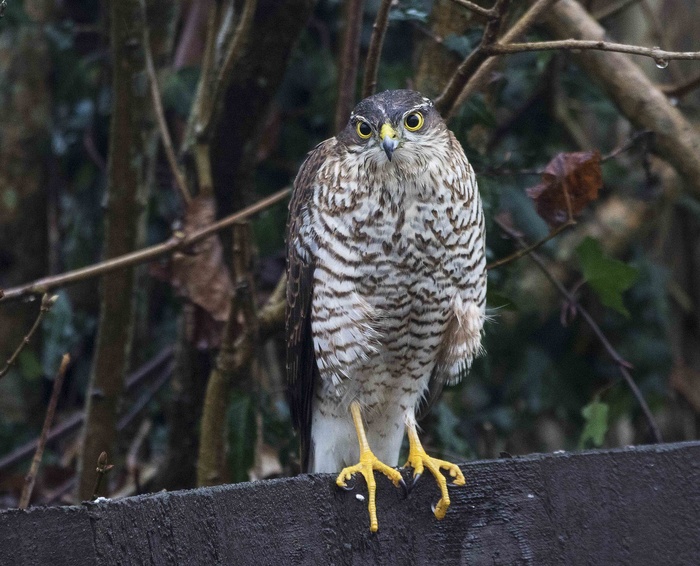
After a couple of minutes I thought I’d push the envelope and try and open a side door which was much nearer the bird. I opened the door about a foot and the bird looked straight at me and I thought that was the end of it, but no it looked away disinterestedly and stayed put, so I pointed the lens and took a few more shots as it just stayed perched there.
Notice how the barring on the breast and belly are very coarse, as opposed to the adult female Sparrowhawk's barring having quite tight horizontal lines.
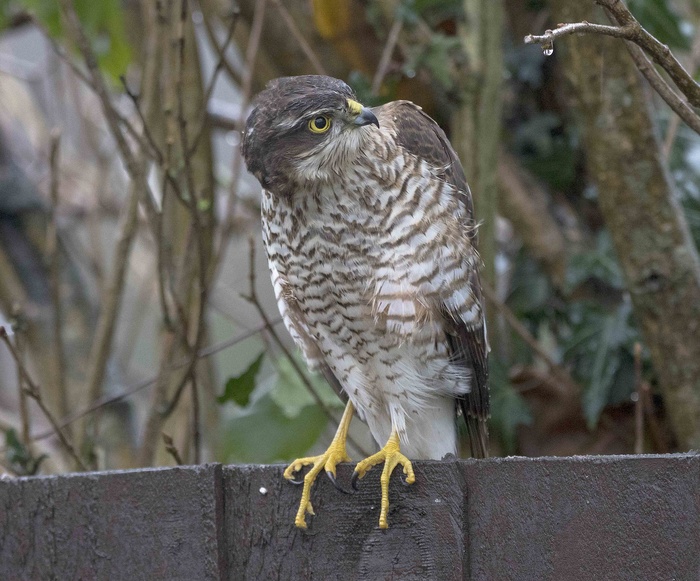
The barring on the breast is also broken up into chevrons on a Juvemile bird.
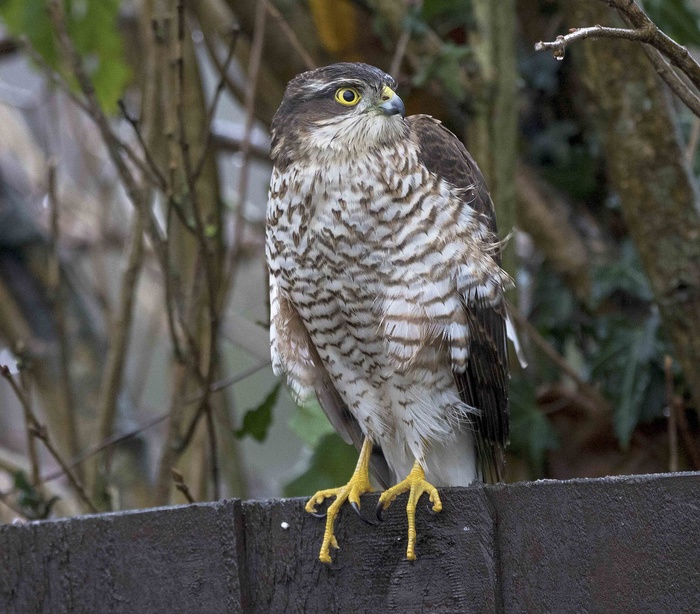
Look at the length of those middle toes and talons, specially evolved to snatch small prey from bushes and even bird feeder cages!
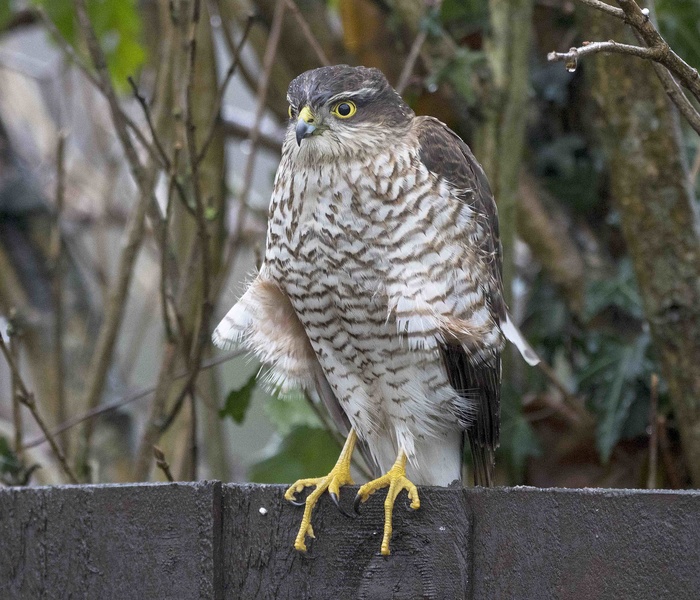
I think it was just too wet and cold to be bothered about me but after a minute or so it did finally fly off. However, I had managed to get really close to what is usually a very nervous bird.
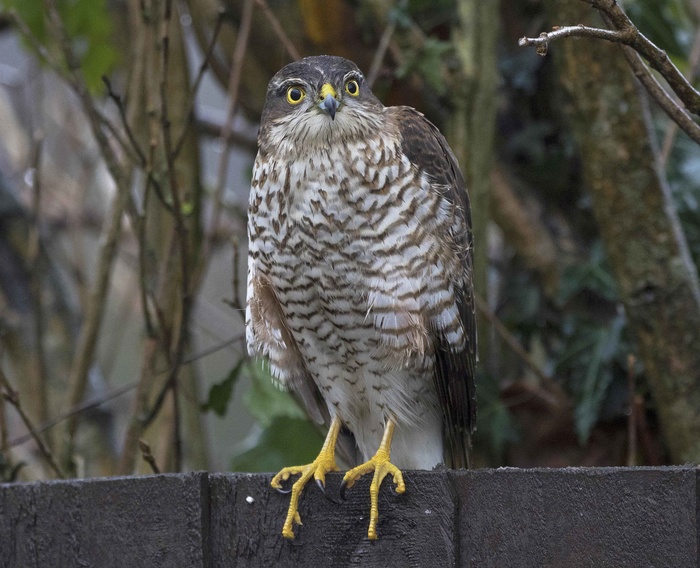
We are now heavily into our winter feeding programme for the garden birds, with peanuts, sunflower and niger seeds disappearing at a rapid rate in this hostile weather. The birds have taken a real battering this week and yesterday a Juvenile Sparrowhawk, that we see most days, was perched on a small garden fence up against a hazel hedge, trying in vain to get some shelter. We have watched it doing this on a few occasions lately and yesterday I had my little Sigma lens waiting to see if I could steal a few quick shots. When it appeared on the little fence I gingerly opened the front door of the house and poked the lens through the gap, I had my Canon 7Dii on silent shooting mode, it’s not silent but it is much quieter than normal. I managed to take a few shots and it appeared the bird wasn’t that bothered, I put this down to the inclement weather, because normally they are really wary and will fly off at the slightest sound.
After a couple of minutes I thought I’d push the envelope and try and open a side door which was much nearer the bird. I opened the door about a foot and the bird looked straight at me and I thought that was the end of it, but no it looked away disinterestedly and stayed put, so I pointed the lens and took a few more shots as it just stayed perched there.
Notice how the barring on the breast and belly are very coarse, as opposed to the adult female Sparrowhawk's barring having quite tight horizontal lines.
The barring on the breast is also broken up into chevrons on a Juvemile bird.
Look at the length of those middle toes and talons, specially evolved to snatch small prey from bushes and even bird feeder cages!
I think it was just too wet and cold to be bothered about me but after a minute or so it did finally fly off. However, I had managed to get really close to what is usually a very nervous bird.
Sigma 150 - 600 strikes again.
23rd November 2018
23rd November 2018
It was a much better day yesterday than on Tuesday when I saw the Bewick’s Swan, (previous blog) - that day was horribly cold, grey and generally very unpleasant. However, because the light was much better after an early morning fog had dissipated and the wind had dropped I decided to have another go at the Great White Egrets down at Llangors Lake, there are six birds there this autumn – quite a good count for the lake. These birds are expanding in numbers the same way as the Little Egrets did, it’s quite amazing to think that until relatively recently these birds would have initiated a ‘Twitch’. They are still reportable but are now quite widespread throughout the mid and south of the UK. Large numbers can be found on the Somerset levels and some areas of the UK are now, from an ornithological point of view, exhibiting quite a distinctive Mediterranean – like picture, with Little, Great and Cattle Egrets, Glossy Ibis and Little Bittern, etc. The northerly movement of these birds, hitherto found only in warmer climes, exemplifies how things are changing. I know this is only small and relatively insignificant in the bigger global warming picture but nevertheless these little examples are hard evidence of what is evolving around us. It was a shame that the Bewick’s Swan didn’t stay any longer but these Egrets should over – winter at the lake giving hopefully more photographic opportunities.
I was in the bird hide at the lake mid-morning and it was really quiet, just a couple of Water Rails scooting across a pathway between the reed beds and a brief visit by a fly – through Kingfisher. At some distance I could see a Great White Egret flying low over the lake coming in the direction of the hide. I was getting ready for the birds fly past, they generally don’t come too close to the hide because these are shy birds. This bird was, however, flying with an unusual purpose towards me and it kept getting closer until it came within shooting range of my lens, (Sigma 150-600 Contemporary), I took some shots at 600mm,
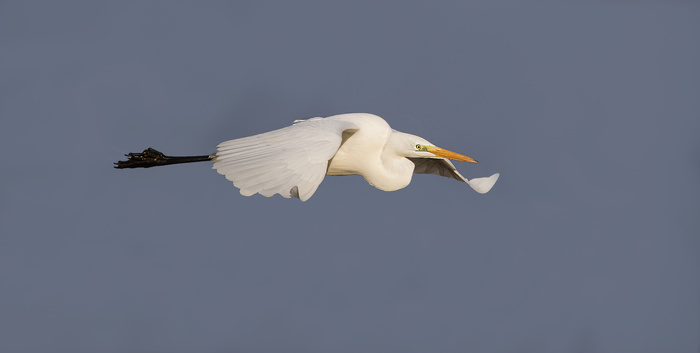
but the bird kept coming nearer, so I was forced to zoom – out. This is not usually the scenario that I experience with these birds but I still couldn’t frame the bird so I was forced to zoom out even more!
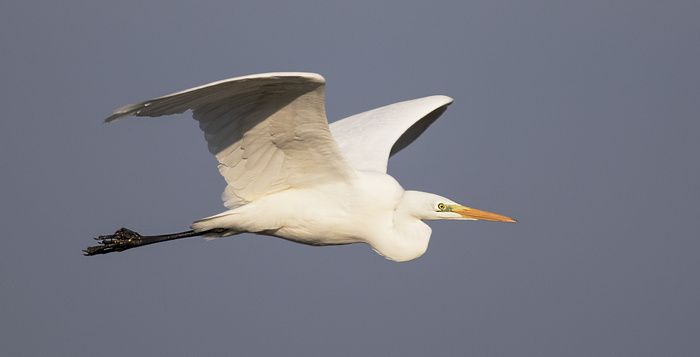
If I had brought my 600 f4 prime lens I would not have been unable to take a shot as most of the birds wings would have been clipped out of the frame.
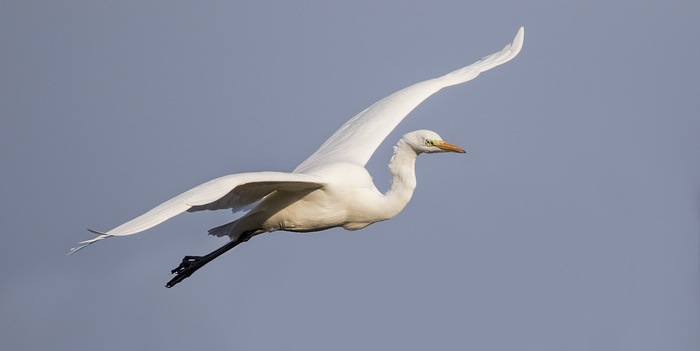
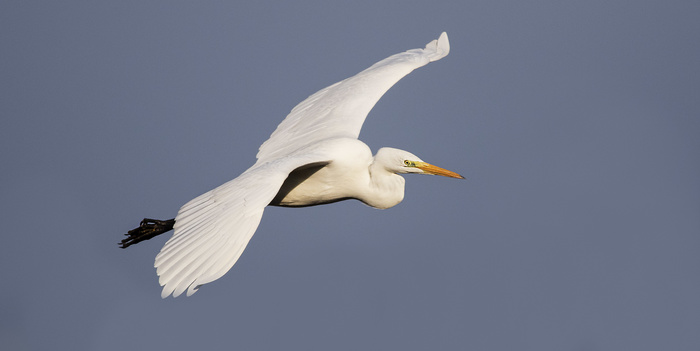
Finally it slowed right up and landed, wings opened right out,
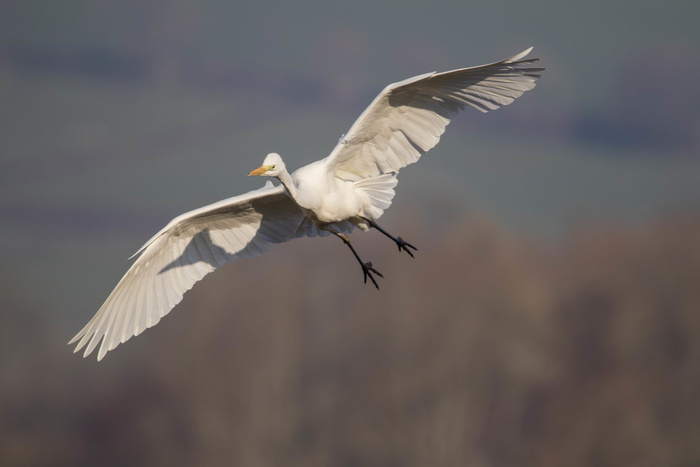
in a little disused channel that was used to launch small boats in years gone by. Annoyingly I could only take a shot through some Willows that were obscuring my view, (I am pleased to hear that these Willows will be cut down soon), because there’s no point in having a nice bird hide that is obstructed by foliage. The Egret didn’t stay long in the channel because it was now aware of my presence and it flew up and over the reed beds and disappeared – usual behaviour. I had, however, by virtue of a zoom lens got some real close – ups of a very shy bird.
At the risk of repeating myself, my little Sigma lens does it again!
I was in the bird hide at the lake mid-morning and it was really quiet, just a couple of Water Rails scooting across a pathway between the reed beds and a brief visit by a fly – through Kingfisher. At some distance I could see a Great White Egret flying low over the lake coming in the direction of the hide. I was getting ready for the birds fly past, they generally don’t come too close to the hide because these are shy birds. This bird was, however, flying with an unusual purpose towards me and it kept getting closer until it came within shooting range of my lens, (Sigma 150-600 Contemporary), I took some shots at 600mm,
but the bird kept coming nearer, so I was forced to zoom – out. This is not usually the scenario that I experience with these birds but I still couldn’t frame the bird so I was forced to zoom out even more!
If I had brought my 600 f4 prime lens I would not have been unable to take a shot as most of the birds wings would have been clipped out of the frame.
Finally it slowed right up and landed, wings opened right out,
in a little disused channel that was used to launch small boats in years gone by. Annoyingly I could only take a shot through some Willows that were obscuring my view, (I am pleased to hear that these Willows will be cut down soon), because there’s no point in having a nice bird hide that is obstructed by foliage. The Egret didn’t stay long in the channel because it was now aware of my presence and it flew up and over the reed beds and disappeared – usual behaviour. I had, however, by virtue of a zoom lens got some real close – ups of a very shy bird.
At the risk of repeating myself, my little Sigma lens does it again!
Wintering Swans.
22nd November 2018
22nd November 2018
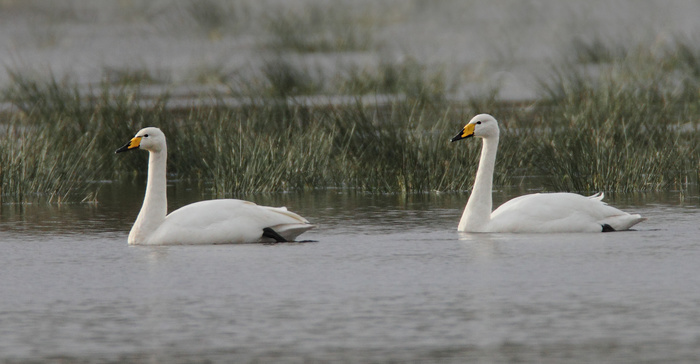
A spell of very cold weather always accelerates the already southerly movement of northern birds to the UK and there have been, typically, large flocks of Bramblings reported around the country. Every winter there are movements of wintering Swans to the UK, Whooper and Bewick’s. However, both these aren’t usually seen in any numbers in this area. They tend to settle in the east of England and also the Severn estuary. I have seen the odd Whooper at Llangors Lake over the years.
See the Wedge - like shape of the head and the yellow marking on the bill is more extensive, extending past the bird's nostrils.
Calls are usually made in twos and threes.
I have never seen a Bewick’s around here, there have been birds seen, but very infrequently. That changed for me as I went for a walk this week on a bitterly cold day at Llangors Lake. There was an extremely cold and unpleasant wind blowing and the day was overcast with a grey flat light but I was hoping to see one of the Great White Egrets that are currently at the lake. As I parked my car in the little car-park at Llangasty on the shores of the lake I immediately heard a distinctive ‘Bugling’ call that really cut through the air, I knew it was something different and as I looked up a large Swan flew over me and disappeared behind the churchyard. I thought ‘Whooper’ which was great, but I remembered that Whooper’s characteristically call repeatedly in threes and fours, it’s what they do! This bird was calling singly and only once did it call twice, so I thought I’d take a look. I quickly went through a gate at the side of the churchyard so I could get a better view and I managed a few quick shots of the bird on the flooded meadow where it had landed.
A much shorter head than the Whooper and less yellow and more black on the bill.
Calls are usually made singly.
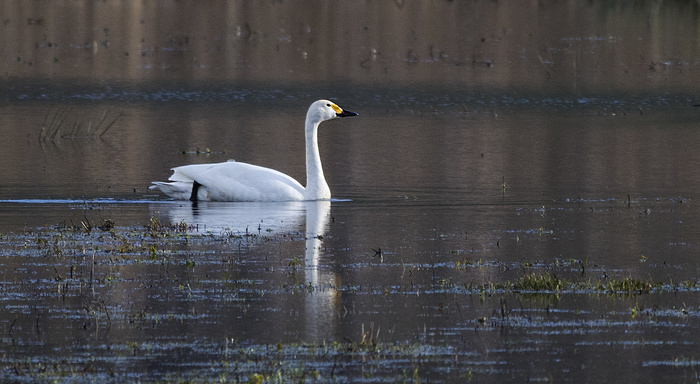
I looked through my binoculars and I could now see that it was indeed a Bewick’s Swan. It was quite restless, however, and it took off again and flew over to a group of Swans at the other side of the lake and I thought that was it. I walked over to the bird hide and I spent a fruitless hour there, but as I was about to leave I heard the call again and flying low over the water there it was coming towards me, as it passed the bird hide I took another shot,
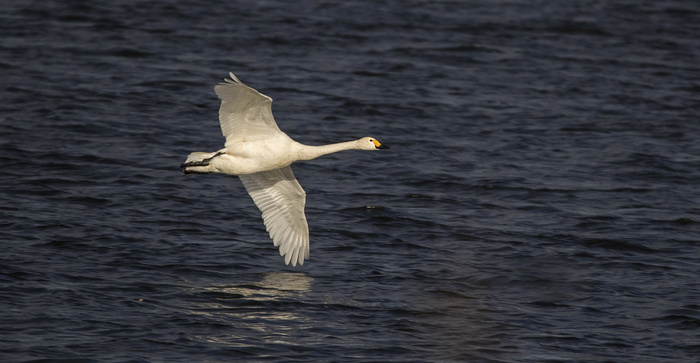
but then it wheeled up into the air and flew back over to the opposite side of the lake. A brief encounter and sadly it wasn’t seen again by anybody else, just the luck of the draw!
Luckily I had decided to bring my little Sigma 150-600 lens with me for my walk because I thought that for what bird life was potentially on offer, bringing and also carrying my Canon 600 f4 was not worth the effort - The Sigma continues to be very useful.
See the Wedge - like shape of the head and the yellow marking on the bill is more extensive, extending past the bird's nostrils.
Calls are usually made in twos and threes.
I have never seen a Bewick’s around here, there have been birds seen, but very infrequently. That changed for me as I went for a walk this week on a bitterly cold day at Llangors Lake. There was an extremely cold and unpleasant wind blowing and the day was overcast with a grey flat light but I was hoping to see one of the Great White Egrets that are currently at the lake. As I parked my car in the little car-park at Llangasty on the shores of the lake I immediately heard a distinctive ‘Bugling’ call that really cut through the air, I knew it was something different and as I looked up a large Swan flew over me and disappeared behind the churchyard. I thought ‘Whooper’ which was great, but I remembered that Whooper’s characteristically call repeatedly in threes and fours, it’s what they do! This bird was calling singly and only once did it call twice, so I thought I’d take a look. I quickly went through a gate at the side of the churchyard so I could get a better view and I managed a few quick shots of the bird on the flooded meadow where it had landed.
A much shorter head than the Whooper and less yellow and more black on the bill.
Calls are usually made singly.
I looked through my binoculars and I could now see that it was indeed a Bewick’s Swan. It was quite restless, however, and it took off again and flew over to a group of Swans at the other side of the lake and I thought that was it. I walked over to the bird hide and I spent a fruitless hour there, but as I was about to leave I heard the call again and flying low over the water there it was coming towards me, as it passed the bird hide I took another shot,
but then it wheeled up into the air and flew back over to the opposite side of the lake. A brief encounter and sadly it wasn’t seen again by anybody else, just the luck of the draw!
Luckily I had decided to bring my little Sigma 150-600 lens with me for my walk because I thought that for what bird life was potentially on offer, bringing and also carrying my Canon 600 f4 was not worth the effort - The Sigma continues to be very useful.
Bramblings in a Local Woodland.
12th November 2018
12th November 2018
When Susan and I were walking through a local deciduous woodland last week we saw about a hundred finches flying in a flock and in it were a good number of Bramblings. It’s always nice to see these wintering finches, they come mainly from Fennoscandia arriving in the UK in late October/November. They actively seek out beech mast to sustain them throughout our winter and can often be seen flying and feeding with Chaffinches, and because of their similar habits to these birds, they are easily overlooked.
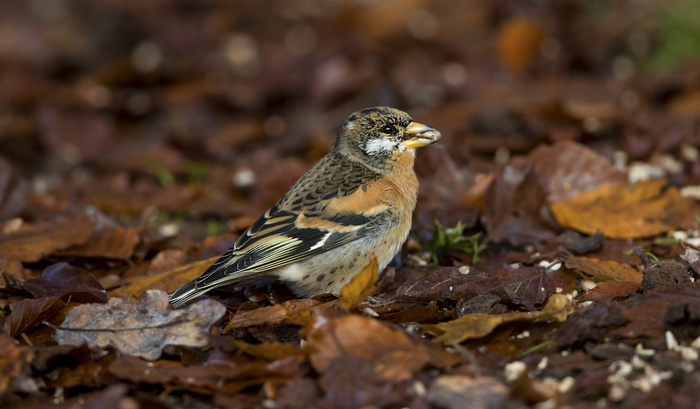
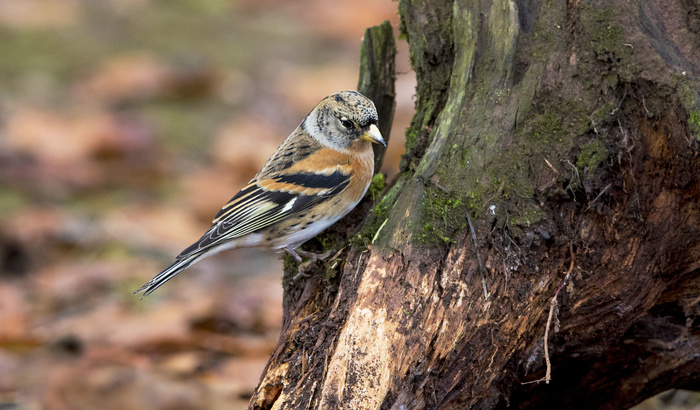
However, they are easily distinguished therefrom, they utter a persistent ‘Squeak’ which with a little practice is easily recognised. Their plumage when observed is totally different from the Chaffinch, Bramblings have a conspicuous white rump patch visible when they take off from the ground, males also have a burnt orange colouring on their breasts. Chaffinches don't have these markings.
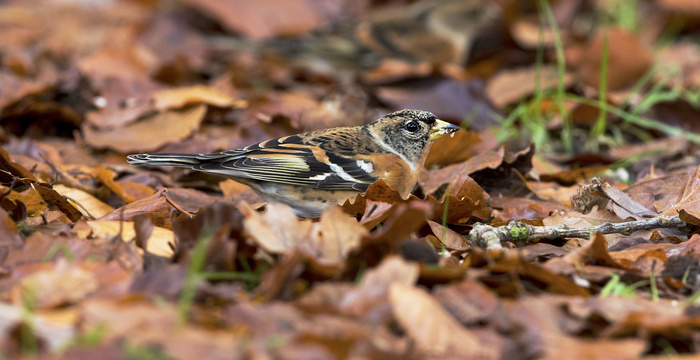
Male Bramblings will also have dark mottled heads and dark spots on the flanks and a striking yellow bill.
The females are less conspicuous but still have the distinct white rump patch.
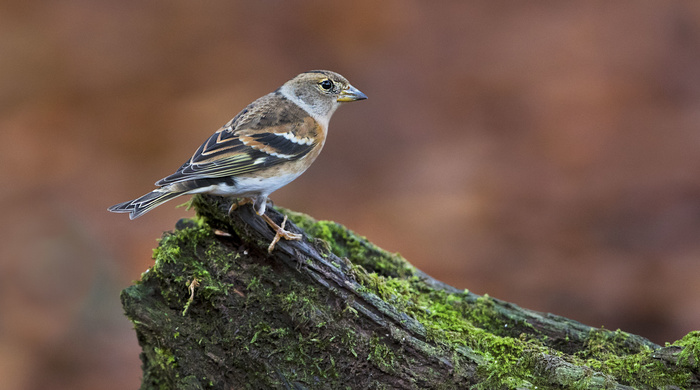
I had previously watched them for a few days to see where they were feeding and I was fortunate to be able to drive my car along the forest track right up to them. I placed an old tree stump on the ground and spread a bit of sunflower seed around to supplement the natural beech mast and then strung some camo netting over the window of my car and just waited.
It wasn’t too long before I heard that tell-tale squeak and first the Chaffinches and then the Bramblings came down to feed.
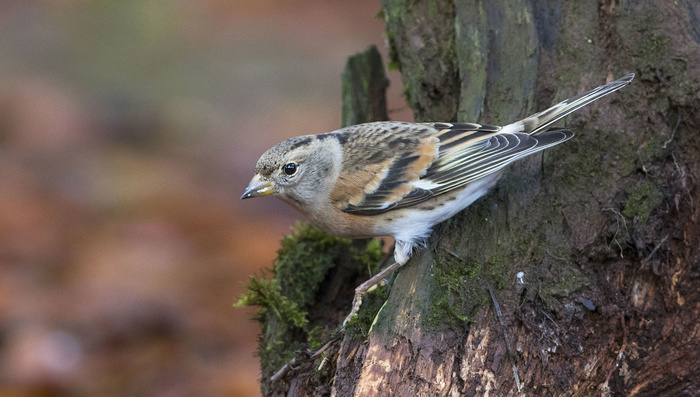
When I casually looked in the car’s mirror I could see a woman walking down the forest track – no big deal, but as she approached my car, with camo netting draped around the windows and a 600mm lens sticking out of the passenger window, instead of walking straight past she walked around the front of the car and stood right in front of the passenger window, two yards from my lens and completely blocking my view. I was hard to believe what she was doing, she couldn’t have done a better job of spooking the birds if she had tried! I politely asked her if she wouldn’t mind moving and she jumped and said ‘Oh you shocked me’ and then she said sorry and walked away down the track. It was hard for me to comprehend how unobservant she was and I was about to say that if she couldn’t see me there then she should take extra care the next time she crossed a road, but I thought better of it. These people go for a walk in the countryside, and that’s fair enough, but I seriously doubt if they see anything if that is their level of consciousness.
Anyway about ten minutes later the birds returned and I was able to take more shots of about twenty Bramblings that were intermittently feeding around the tree stump in front of me.
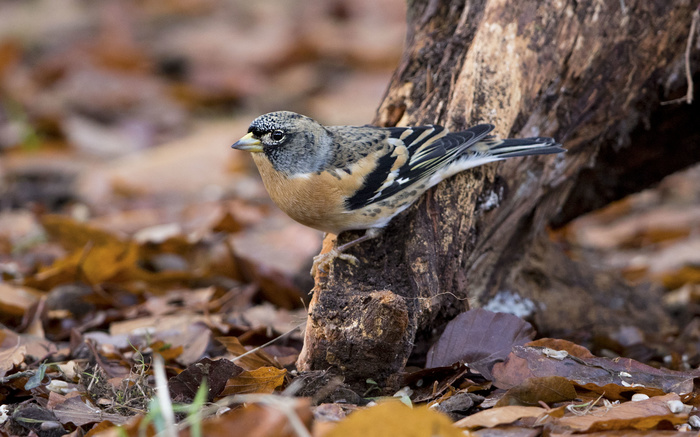
The wind then really started to blow and the leaves were whipping around the feeding area disturbing the birds so I packed up and put the little tree stump to one side in case a friend of mine wanted to use it. I left contented but still amused by the woman’s behaviour.
However, they are easily distinguished therefrom, they utter a persistent ‘Squeak’ which with a little practice is easily recognised. Their plumage when observed is totally different from the Chaffinch, Bramblings have a conspicuous white rump patch visible when they take off from the ground, males also have a burnt orange colouring on their breasts. Chaffinches don't have these markings.
Male Bramblings will also have dark mottled heads and dark spots on the flanks and a striking yellow bill.
The females are less conspicuous but still have the distinct white rump patch.
I had previously watched them for a few days to see where they were feeding and I was fortunate to be able to drive my car along the forest track right up to them. I placed an old tree stump on the ground and spread a bit of sunflower seed around to supplement the natural beech mast and then strung some camo netting over the window of my car and just waited.
It wasn’t too long before I heard that tell-tale squeak and first the Chaffinches and then the Bramblings came down to feed.
When I casually looked in the car’s mirror I could see a woman walking down the forest track – no big deal, but as she approached my car, with camo netting draped around the windows and a 600mm lens sticking out of the passenger window, instead of walking straight past she walked around the front of the car and stood right in front of the passenger window, two yards from my lens and completely blocking my view. I was hard to believe what she was doing, she couldn’t have done a better job of spooking the birds if she had tried! I politely asked her if she wouldn’t mind moving and she jumped and said ‘Oh you shocked me’ and then she said sorry and walked away down the track. It was hard for me to comprehend how unobservant she was and I was about to say that if she couldn’t see me there then she should take extra care the next time she crossed a road, but I thought better of it. These people go for a walk in the countryside, and that’s fair enough, but I seriously doubt if they see anything if that is their level of consciousness.
Anyway about ten minutes later the birds returned and I was able to take more shots of about twenty Bramblings that were intermittently feeding around the tree stump in front of me.
The wind then really started to blow and the leaves were whipping around the feeding area disturbing the birds so I packed up and put the little tree stump to one side in case a friend of mine wanted to use it. I left contented but still amused by the woman’s behaviour.
Willow Emerald Damselfly.
03rd November 2018
03rd November 2018
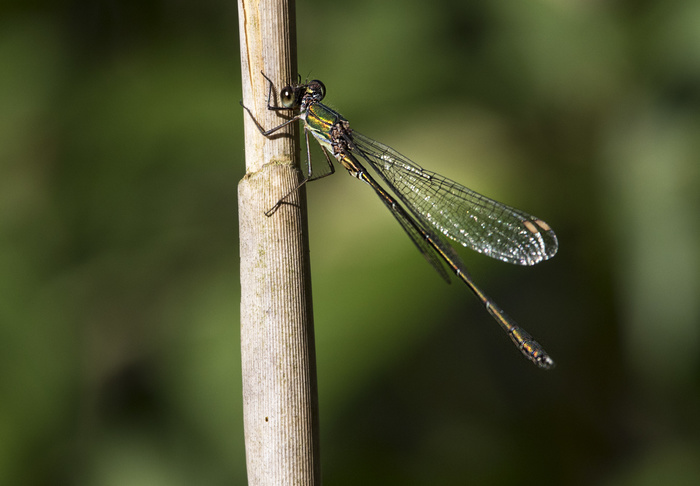
I love Damselflies: beautiful, delicate and like all Damselflies, so transient. They grace us with their presence for just a short period of time, allowing us a fleeting glimpse of their ethereal - like beauty. There is a species - Willow Emerald Damselfly – what a lovely name! It began to colonise south eastern England about ten years ago and has spread rapidly and can now be seen, if you are lucky, mainly in Norfolk and Suffolk but also in small numbers in nearby counties. We visited a reserve in North Norfolk called Sculthorpe Moor, a very nicely laid out reserve run by the Hawk and Owl Trust. There were hardly any people there and we were able to wander around at our leisure enjoying the scenery and wildlife. While we were standing beside a damp area near one of the hides we could see a Damselfly moving around. We didn’t know immediately what it was, but it was an Emerald of some sorts. I managed to take a few shots with my little Sigma 150 – 600 that I now carry around with me everywhere and later on after consulting a field guide we could see it was a Willow Emerald!. A new species for us and one which cannot be seen back home yet, and perhaps not at all in our lifetimes. It’s always exiting to see a new species of anything, so it was a nice addition to a pleasant morning out.
Autumn Colours.
28th October 2018
28th October 2018
Autumn is well and truly underway and now is the time to take a walk in a deciduous woodland. The full spectrum of colours are now on view and it is a truly beautiful scene.
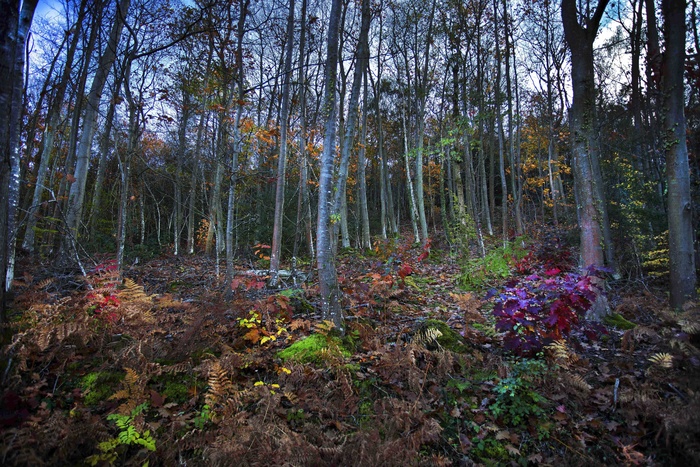
Susan and I have been walking through our local woodland enjoying the spectacle. In addition the recent northerly winds have brought Bramblings to these woodlands and they are feeding on fallen Beech mast. These birds are really attractive especially if they have retained some of their summer plumage.
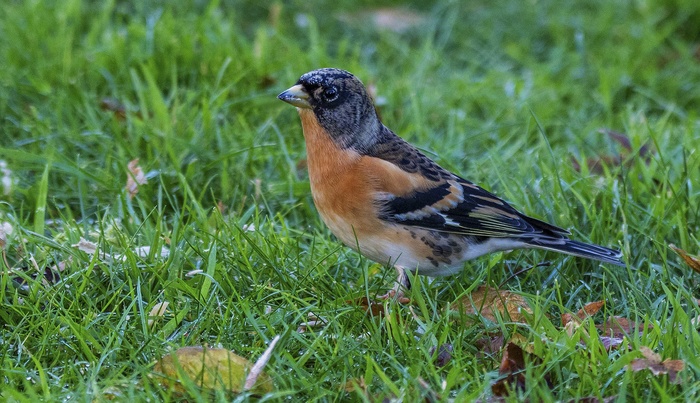
It’s a pleasure to see them. This past summer has provided a bountiful harvest which will hopefully sustain these birds along with the Chaffinches they associate with for the rest of the winter.
Susan and I have been walking through our local woodland enjoying the spectacle. In addition the recent northerly winds have brought Bramblings to these woodlands and they are feeding on fallen Beech mast. These birds are really attractive especially if they have retained some of their summer plumage.
It’s a pleasure to see them. This past summer has provided a bountiful harvest which will hopefully sustain these birds along with the Chaffinches they associate with for the rest of the winter.
Jack Snipe.
27th October 2018
27th October 2018
It reminds me of the old joke - 'Hello, RSPB, Jack Snipe speaking'.
Jack Snipe are quite uncommon in the UK but in the autumn but they can be seen in the right habitat, however, they are still difficult to get in front of your lens. They like a bit of cover and they tend to keep close to vegetation. They can be easily overlooked and will only fly if they are virtually trodden on and even then they don’t tend to fly far. There had been a bird reported at Titchwell Marsh, the big showpiece reserve in North Norfolk and I’ve said before I don’t like these big reserves, they are always packed out and they tend to be full of social birders with the hides full of noise with people talking and moving about. That’s fine if you like that, but I’m afraid I don’t so I suppose I’m what’s called an unsociable birder and that’s fine, I’m not criticising anyone – each to his own. Having said that I made my way to one of the big hides early one morning, it was one of the few days when it was raining quite heavily and therefore the hide was very quiet. I was there on my own and I was looking at the vegetation where the Jack Snipe had been seen previously and after about five minutes I could see it. They are quite distinctive and are, in good light, totally different to the Common Snipe.
Principally they have a dark median crown stripe as opposed to the Common Snipe’s cream coloured stripe.
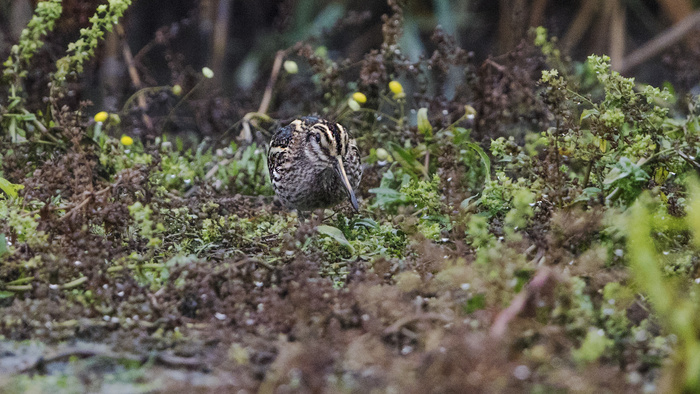
The stripes down their back are more contrasting than the Common Snipe, a rich straw colour.
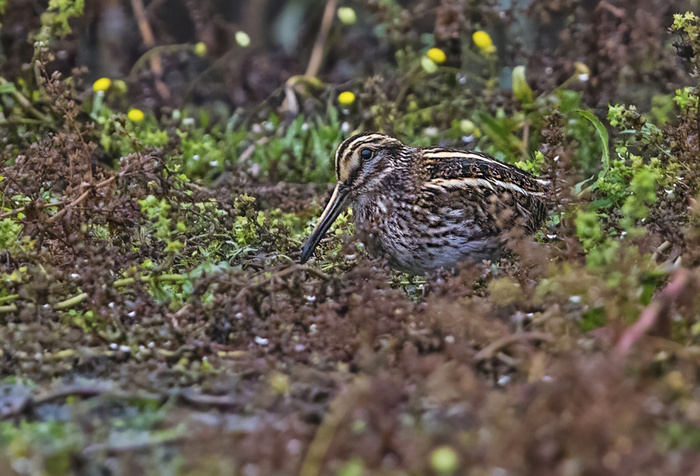
Their bill is much shorter and is also thicker at the base.
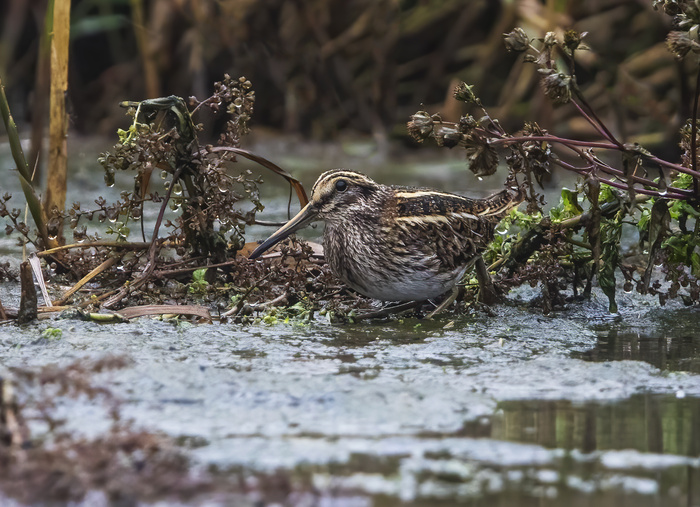
A very good field id is their comical bobbing up and down when feeding, almost as if they are on springs.
I waited paitiently for it to walk into the small gaps in the vegetation, and to be honest there weren’t many of those, so it was a far from ideal situation for a photograph, but I took a few before it disappeared again into deep cover. As people began to arrive and the rain has slackened I made a break for the car park, at least I had seen it.
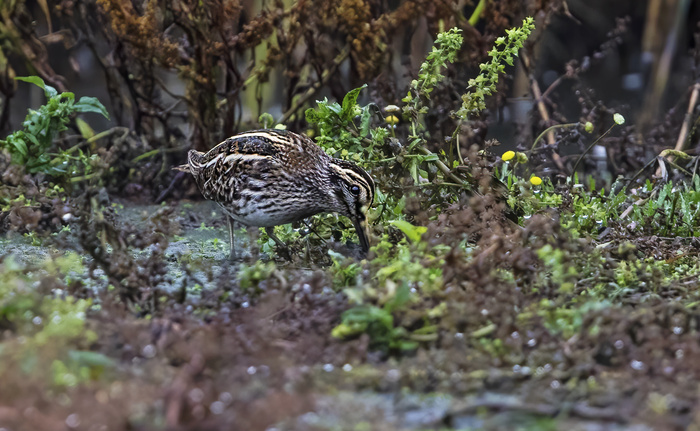
[
Jack Snipe are quite uncommon in the UK but in the autumn but they can be seen in the right habitat, however, they are still difficult to get in front of your lens. They like a bit of cover and they tend to keep close to vegetation. They can be easily overlooked and will only fly if they are virtually trodden on and even then they don’t tend to fly far. There had been a bird reported at Titchwell Marsh, the big showpiece reserve in North Norfolk and I’ve said before I don’t like these big reserves, they are always packed out and they tend to be full of social birders with the hides full of noise with people talking and moving about. That’s fine if you like that, but I’m afraid I don’t so I suppose I’m what’s called an unsociable birder and that’s fine, I’m not criticising anyone – each to his own. Having said that I made my way to one of the big hides early one morning, it was one of the few days when it was raining quite heavily and therefore the hide was very quiet. I was there on my own and I was looking at the vegetation where the Jack Snipe had been seen previously and after about five minutes I could see it. They are quite distinctive and are, in good light, totally different to the Common Snipe.
Principally they have a dark median crown stripe as opposed to the Common Snipe’s cream coloured stripe.
The stripes down their back are more contrasting than the Common Snipe, a rich straw colour.
Their bill is much shorter and is also thicker at the base.
A very good field id is their comical bobbing up and down when feeding, almost as if they are on springs.
I waited paitiently for it to walk into the small gaps in the vegetation, and to be honest there weren’t many of those, so it was a far from ideal situation for a photograph, but I took a few before it disappeared again into deep cover. As people began to arrive and the rain has slackened I made a break for the car park, at least I had seen it.
[
Norfolk Barn Owls.
25th October 2018
25th October 2018
No visit to Norfolk for me would be complete without a sighting of a Barn Owl and fortunately these beautiful birds are widespread there. Almost every village has one nearby and I wish it was the same back home but that will never be because of the local farming environment. In north Norfolk I have a location I have been watching for as long as I can remember, and it’s virtually guaranteed to turn up a Barn Owl every evening. After my dalliance with landscape photography we decided to try and see, and hopefully photograph a Barn Owl, and after our first visit to this location we could see what looked like a male bird hunting in a cut field, which is unusual because they usually like rough pasture where mice and voles can try to hide. We found a vantage point where we could see into this field via a gap in the hedge that surrounded it and the next evening we lay in wait for the Owl. As the afternoon progressed and what we call ‘Owl Light’ approached, suddenly there he was, hunting in the same place as previously. I took numerous flight shots as he quartered the field, coming closer, then moving away again. As I have mentioned in previous blog posts you can get plenty of flight shots,
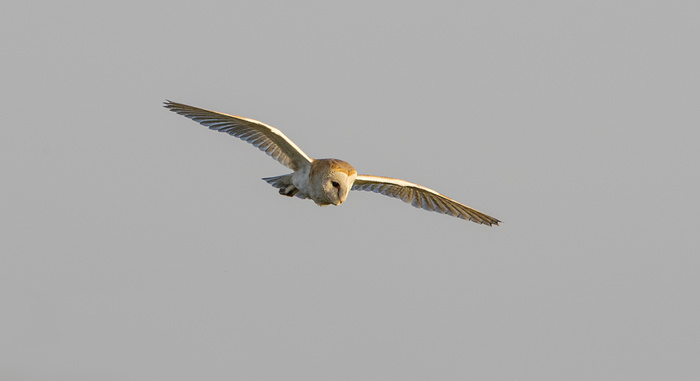
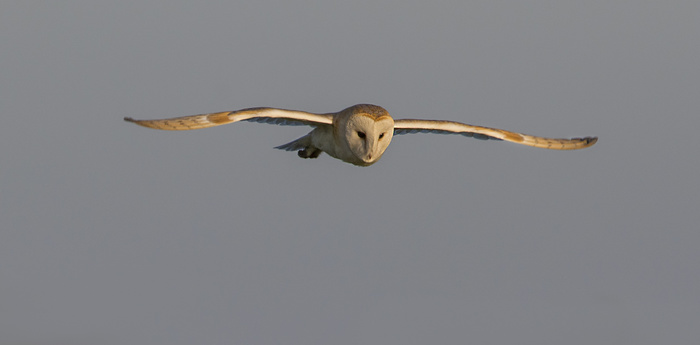
but a shot of an Owl on a post for example is more difficult. They frequently perch but it’s nearly always too far away for a decent shot, but this time it flew closer still and then perched on a nearby fence post.
You can see this is a male bird by the complete lack of any spotting on the breast and flanks and his overall white plumage.
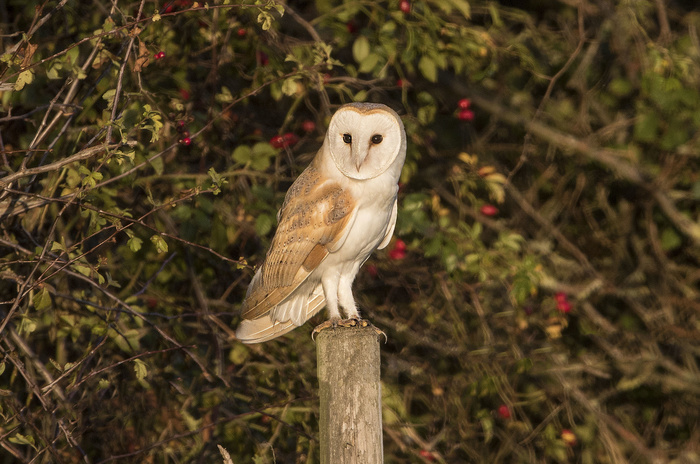
It doesn’t happen for us very often so I gratefully took the shot before it was up and flying again and disappearing out onto the marsh in search of further prey.
Always a nice way to end the day!
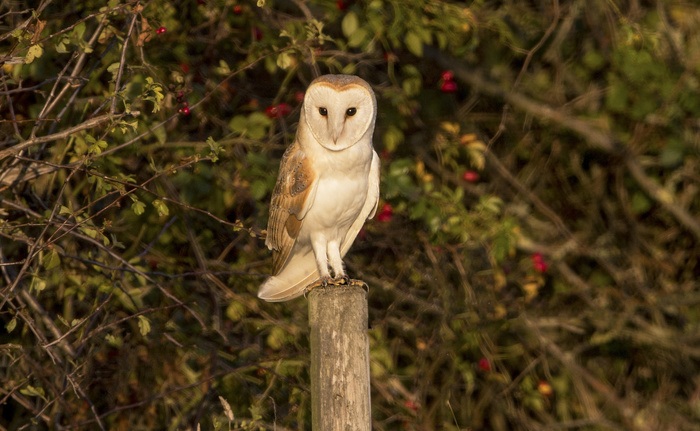
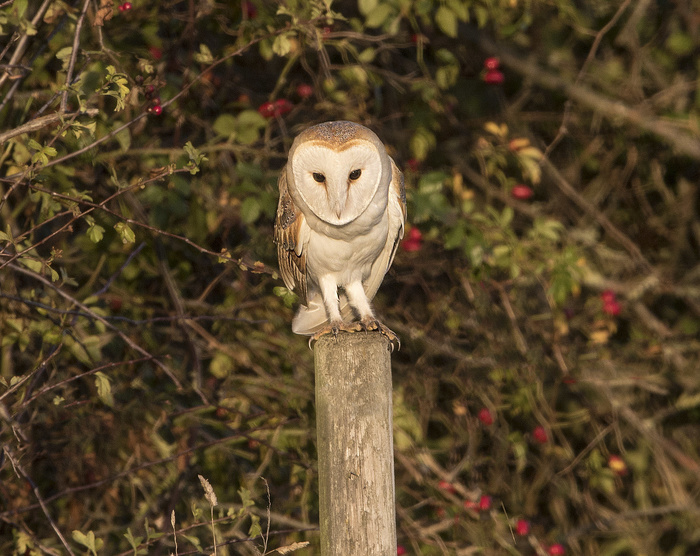
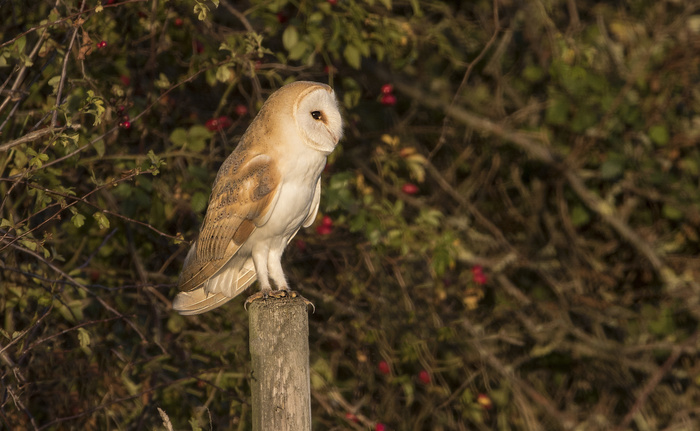
but a shot of an Owl on a post for example is more difficult. They frequently perch but it’s nearly always too far away for a decent shot, but this time it flew closer still and then perched on a nearby fence post.
You can see this is a male bird by the complete lack of any spotting on the breast and flanks and his overall white plumage.
It doesn’t happen for us very often so I gratefully took the shot before it was up and flying again and disappearing out onto the marsh in search of further prey.
Always a nice way to end the day!
North Norfolk in the autumn.
24th October 2018
24th October 2018
Susan and I have just returned home from a couple of weeks in North Norfolk where we enjoyed some glorious autumn weather. We have been birding in Norfolk for over thirty years but we have stayed in a little cottage in Thornham, (now a very up-market coastal village), for about twenty five years, it is owned by a dentist from Sheffield who is a very nice down to earth man and who has a group of loyal customers who have been staying in his house since the beginning. The days were warm and sunny and although rare birds were limited because of the weather patterns, (in the autumn you can’t have rare birds in Norfolk with southerly winds), we nevertheless saw some nice wildlife. We ate out several times, once in our favourite pub, The Gin Trap in the village of Ringstead, where the cuisine is a cut above the usual ‘Pub Grub’ but with fairly reasonable prices and none of the pretentious nonsense of some establishments, the service is quick and the staff friendly. Typically we enjoyed - to start, deep fried mozzarella and pistachio savoury rice balls with a spicy sauce sprinkled with parmesan cheese - for mains, fresh scallops on a bed of linguini pasta with vegetables in a delicious butter sauce - and for pudding, sloe gin crunch with a chocolate mousse, coffee ice cream and caramel sauce – delicious!!
We always drive on the ‘back - road’ from the Gin Trap pub in Ringstead to Thornham and you can stop and view Hares, Partridges and Pheasants in the fields at last light and on this occasion we saw three Barn Owls flying. Further on, as we neared Thornham, a small animal was caught in our headlights in the long grass, we thought it was either a Fox or a Hare but remarkably it was a Muntjac deer, (they are unbelievably small), and we enjoyed a very close encounter as it stared at us, frozen in the lights, then it disappeared safely into the fields. After another 100 yds’ there was something else sat in the middle of the road and as we approached it flew up into the lights - a Tawny Owl, it perched briefly in a small tree before disappearing into the night.
A very nice evening out indeed!
We always drive on the ‘back - road’ from the Gin Trap pub in Ringstead to Thornham and you can stop and view Hares, Partridges and Pheasants in the fields at last light and on this occasion we saw three Barn Owls flying. Further on, as we neared Thornham, a small animal was caught in our headlights in the long grass, we thought it was either a Fox or a Hare but remarkably it was a Muntjac deer, (they are unbelievably small), and we enjoyed a very close encounter as it stared at us, frozen in the lights, then it disappeared safely into the fields. After another 100 yds’ there was something else sat in the middle of the road and as we approached it flew up into the lights - a Tawny Owl, it perched briefly in a small tree before disappearing into the night.
A very nice evening out indeed!